
20-May-2025
Space Constraints? Efficient Small Workshop Crane Layout Solutions by Dongqi Crane
1. Introduction
In small workshops and manufacturing facilities, space is often a critical constraint. However, the need for efficient material handling remains high. Whether lifting heavy machinery, transporting raw materials, or moving finished products, a well-planned crane system can significantly enhance productivity while optimizing limited floor space.
This article explores how Dongqi Crane, a leading manufacturer of industrial lifting equipment, provides space-saving crane solutions for small workshops. We will analyze different types of cranes suitable for confined spaces, discuss key factors in layout planning, and provide actionable strategies to maximize efficiency.
By the end of this guide, you will understand:
- The best small workshop crane types for limited spaces.
- How to optimize crane layout for maximum productivity.
- Google search keywords related to compact crane solutions.
- Dongqi Crane’s recommended models for small workshops.

2. Types of Small Workshop Cranes for Limited Spaces
When selecting a crane for a small workshop, the key considerations are footprint, lifting capacity, and flexibility. Below are the most suitable crane types offered by Dongqi Crane:
2.1 Light-Duty Jib Cranes
- Best for: Small workstations with precise lifting needs.
- Advantages:
- Minimal floor space required (wall-mounted or freestanding).
- 180° or 360° rotation for flexible coverage.
- Ideal for repetitive lifting tasks (e.g., loading/unloading machines).
- Dongqi Model Recommendation: DQ-BZ Series (Freestanding Jib Crane)
2.2 Electric Chain Hoists (Single/Double Girder)
- Best for: Linear material handling in narrow spaces.
- Advantages:
- Compact design, suitable for low-ceiling workshops.
- Smooth operation with variable speed control.
- Can be mounted on existing support structures.
- Dongqi Model Recommendation: DQ-LD Single Girder Overhead Crane
2.3 Mobile Gantry Cranes
- Best for: Workshops requiring flexible, movable lifting.
- Advantages:
- No fixed installation—can be wheeled to different locations.
- Adjustable span and height for versatile use.
- Ideal for temporary or multi-workstation lifting.
- Dongqi Model Recommendation: DQ-MG Lightweight Gantry Crane
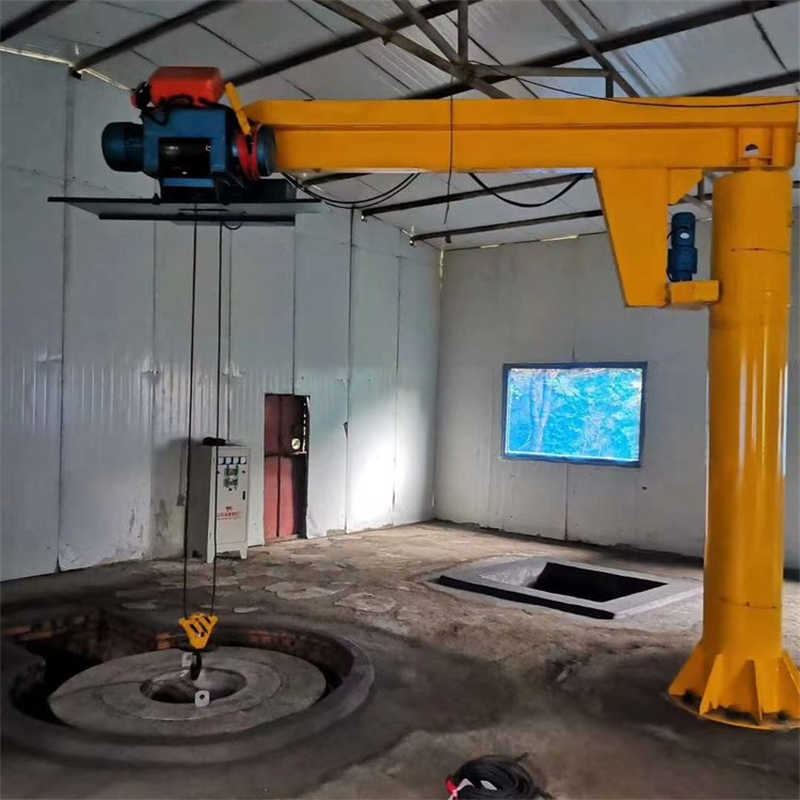
2.4 Column-Mounted Slewing Cranes
- Best for: Corner installations with high space efficiency.
- Advantages:
- 360° rotation maximizes coverage in tight spaces.
- Requires only a small foundation.
- Perfect for assembly lines and machine servicing.
- Dongqi Model Recommendation: DQ-PK Pillar Jib Crane
3. Key Factors in Small Workshop Crane Layout Planning
3.1 Space Assessment
- Measure workshop dimensions (length, width, ceiling height).
- Identify obstructions (machines, shelves, walkways).
- Ensure adequate clearance for safe crane operation.
3.2 Load & Usage Requirements
- Determine maximum lifting capacity (e.g., 0.5T, 1T, 2T).
- Assess lifting frequency (occasional vs. continuous use).
- Define coverage area (single workstation or multiple zones).
3.3 Installation Options
- Fixed Cranes (wall-mounted, ceiling-supported) – Best for permanent lifting needs.
- Mobile Cranes (gantry, trolley-based) – Ideal for flexible operations.
3.4 Safety & Compliance
- Follow OSHA/ISO standards for crane safety.
- Ensure proper load testing & operator training.
- Maintain emergency stop systems and overload protection.
4. Optimized Crane Layout Strategies for Small Workshops
4.1 Compact Jib Crane Placement
- Install wall-mounted jib cranes near workbenches to save floor space.
- Use freestanding jib cranes where wall support is unavailable.
4.2 Overhead Crane Systems for Vertical Space Utilization
- Single-girder cranes are ideal for low-ceiling workshops.
- Double-girder cranes provide higher lifting capacity in confined areas.
4.3 Mobile & Modular Solutions
- Portable gantry cranes can be moved as needed.
- Track-mounted hoists allow linear movement without floor obstruction.
4.4 Case Study: Dongqi Crane in a Small Machining Workshop
- Challenge: A 10m x 8m workshop needed a crane for machine loading.
- Solution: Installed a DQ-BZ 1T jib crane with 360° rotation.
- Result: 40% faster material handling without occupying floor space.
5. Recommended Dongqi Crane Models for Small Workshops
| Model | Type | Capacity | Key Feature |
|---|---|---|---|
| DQ-BZ Freestanding Jib | Jib Crane | 0.5T – 5T | 360° rotation, minimal footprint |
| DQ-LD Single Girder | Overhead Crane | 1T – 10T | Low headroom design |
| DQ-MG Mobile Gantry | Gantry Crane | 0.5T – 3T | Wheels for easy repositioning |
| DQ-PK Pillar Jib | Column Crane | 0.25T – 3T | Space-saving corner installation |
6. Implementation Steps & Best Practices
6.1 Step-by-Step Installation Guide
- Workshop Measurement – Map out available space.
- Crane Selection – Choose based on load, reach, and mobility.
- Professional Installation – Ensure structural stability.
- Testing & Training – Conduct load tests and operator safety training.
6.2 Maintenance Tips
- Regularly inspect wires, motors, and brakes.
- Lubricate moving parts to prevent wear.
- Follow Dongqi Crane’s maintenance guidelines.
7. Conclusion
For small workshops with limited space, Dongqi Crane offers optimized lifting solutions that maximize efficiency without compromising safety. By selecting the right crane type (jib, gantry, or overhead) and implementing a smart layout, businesses can enhance productivity while minimizing spatial constraints.
For customized crane solutions, contact Dongqi Crane’s engineering team for a tailored workshop assessment.
