
23-Jul-2025
Bridge Crane vs. Jib Crane: Choosing the Right Hoist for Automotive Assembly Plants
1. Introduction
In automotive assembly plants, material handling efficiency directly impacts production speed, worker safety, and overall operational costs. Selecting the right crane—whether a double-girder bridge crane or a jib crane—requires careful consideration of load capacity, workspace layout, and workflow dynamics.
Dongqi Crane, a leading manufacturer of overhead lifting solutions, specializes in customized cranes for the automotive sector. This guide compares bridge cranes and jib cranes, helping manufacturers make an informed decision based on their specific assembly line requirements.
2. Double-Girder Bridge Cranes in Automotive Assembly
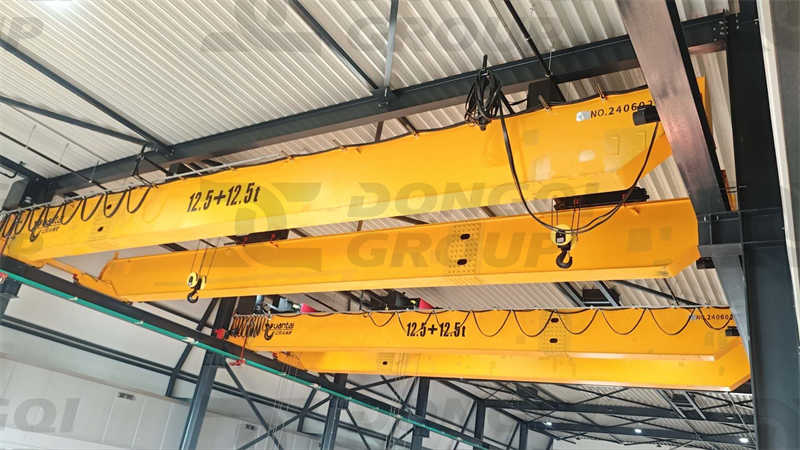
In high-volume automotive manufacturing, efficiency and precision are critical. Double-girder bridge cranes have become the preferred lifting solution for major automakers due to their robust construction, high load capacity, and seamless integration with automated production systems.
2.1 Why Automotive Plants Rely on Double-Girder Bridge Cranes
✅ Superior Load Handling (10-500+ Tons)
- Designed to lift entire vehicle bodies, heavy battery packs (for EVs), and large stamping components without deflection.
- Dongqi Crane’s reinforced steel girders ensure stability even under maximum capacity loads.
✅ Full Workshop Coverage
- Runs on runway beams spanning the entire production hall, enabling uninterrupted material flow from welding to final assembly.
- Customizable spans (up to 40+ meters) to fit different plant layouts.
✅ Precision Movement for Automated Lines
- Variable Frequency Drive (VFD) control allows smooth acceleration/deceleration, preventing load swing in high-speed assembly environments.
- Automation-ready – Can be integrated with RFID tracking, collision avoidance systems, and robotic arms for Industry 4.0 smart factories.
✅ Durability in Harsh Conditions
- Corrosion-resistant coatings for paint shops and humid environments.
- High-temperature insulation for foundry and heat treatment zones.
2.2 Key Applications in Automotive Manufacturing
🔧 Body Shop (BIW – Body-in-White Handling)
- Transports car frames between welding robots with sub-millimeter precision.
- Dongqi’s anti-sway technology ensures stable positioning, reducing rework due to misalignment.
🎨 Paint Shop Operations
- Overhead movement prevents floor contamination, critical for flawless paint finishes.
- Explosion-proof motors available for hazardous vapor zones.
⚡ Electric Vehicle (EV) Battery & Motor Assembly
- Handles heavy battery modules (500+ kg each) and complete battery packs (2-5 tons).
- Specialized lifting frames prevent damage to sensitive EV components.
🛠 Stamping & Press Lines
- Moves large metal sheets and stamped parts between hydraulic presses.
- High-duty cycle (up to C6 class) for continuous operation.
2.3 Dongqi Crane’s Advanced Features for Automotive Industry
🟢 Low Headroom Design
- Saves vertical space in facilities with height restrictions.
- Ideal for retrofitting older plants without major structural modifications.
🟢 Smart Crane Technology
- IoT-enabled monitoring for predictive maintenance (reducing downtime).
- Automated positioning via laser guidance for precise load placement.
🟢 Customizable Options
- Dual-hoist systems for balanced lifting of asymmetrical loads (e.g., SUV bodies).
- Magnetic/ Vacuum lifters for handling sheet metal and composite materials.
2.4 Real-World Example: Dongqi Crane in a Major Automotive Plant
Client: A leading German automaker (EV production)
Challenge: Needed a high-speed, high-precision crane for battery pack installation.
Solution: Dongqi supplied a 32m span double-girder crane with:
- 10-ton capacity + 2 auxiliary hoists for balanced lifting.
- Automated positioning (±2mm accuracy) synced with the assembly robots.
- Remote diagnostics for real-time performance tracking.
3. Jib Cranes in Automotive Assembly
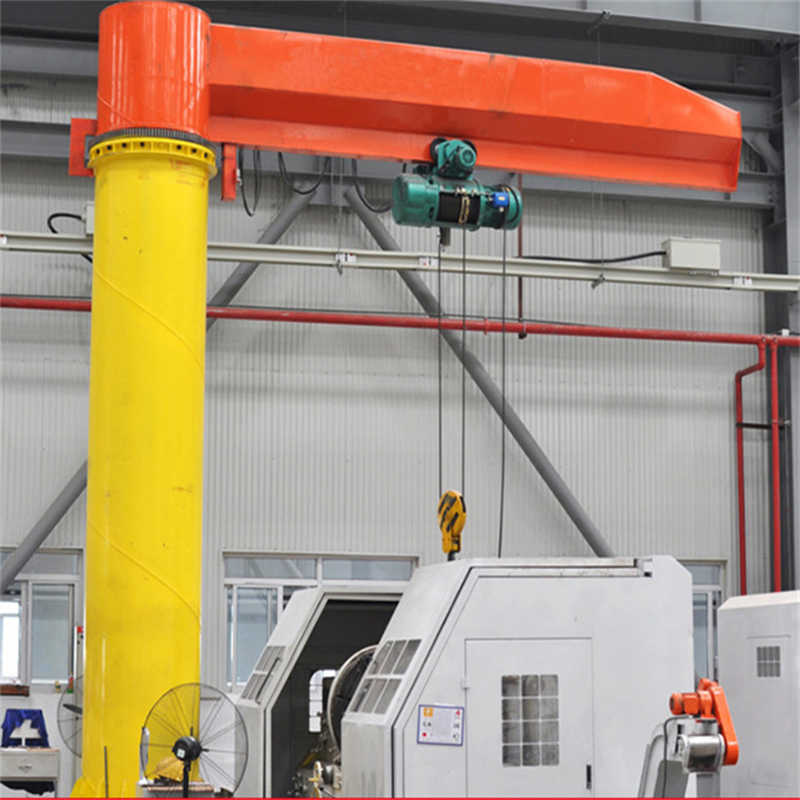
Jib cranes play a critical role in automotive assembly by enabling fast, flexible, and ergonomic material handling at individual workstations. Unlike bridge cranes that cover large areas, jib cranes excel in localized lifting tasks, making them ideal for component assembly, parts feeding, and maintenance operations.
3.1 Key Advantages of Jib Cranes in Automotive Manufacturing
✅ Space-Saving & Flexible Installation
- Wall-mounted, floor-mounted, or mobile designs adapt to tight spaces.
- No runway beams required—ideal for retrofitting existing production lines.
✅ Fast & Precise Load Positioning
- 180°–360° rotation allows operators to place parts with millimeter-level accuracy.
- Manual, electric, or pneumatic operation for different speed and control needs.
✅ Ergonomic & Worker-Friendly
- Reduces manual lifting injuries by handling loads up to 10 tons effortlessly.
- Balanced movement minimizes operator fatigue during repetitive tasks.
✅ Cost-Effective for Small to Medium Loads
- Lower upfront cost compared to bridge cranes.
- Quick ROI due to improved workstation efficiency.
3.2 Best Applications in Automotive Assembly Plants
🛠 Engine & Powertrain Assembly
- Lifting engines, transmissions, and differentials into vehicle chassis.
- Dongqi’s rotating jib cranes allow smooth positioning without strain.
🔌 Electrical & Interior Component Installation
- Handling dashboards, seats, and battery modules with precision.
- Anti-static options available for sensitive electronics.
⚙ Maintenance & Repair Stations
- Removing and reinstalling motors, gearboxes, and suspension parts.
- Mobile jib cranes provide flexibility across multiple service bays.
📦 Parts Feeding & Kitting Areas
- Supplying bolts, fasteners, and small assemblies to the line.
- Light-duty jib cranes (0.5–2 tons) optimize just-in-time delivery.
3.3 Dongqi Crane’s Jib Crane Solutions for Automotive Industry
🟢 Heavy-Duty Articulating Jib Cranes (3–10 Tons)
- Full 360° rotation for maximum coverage.
- Stiff boom design prevents deflection under load.
- Electric hoist options for automated lifting.
🟢 Lightweight Workstation Jib Cranes (0.5–2 Tons)
- Manual or motorized rotation for fast operation.
- Modular design—easy to relocate as production needs change.
🟢 Explosion-Proof & Corrosion-Resistant Models
- ATEX-certified for paint shops and hazardous zones.
- Stainless steel construction for humid or chemical-heavy environments.
🟢 Smart Jib Cranes with Automation Integration
- Encoder-controlled positioning for repeatable movements.
- IoT-enabled load monitoring to prevent overloading.
3.4 Case Study: Dongqi Jib Crane in a Japanese Auto Plant
Client: Major Japanese automaker (hybrid vehicle production)
Challenge: Needed faster engine installation without expanding floor space.
Solution: Dongqi supplied 6 electric jib cranes (5-ton capacity) with:
- 270° rotation for optimal workstation coverage.
- Anti-sway control for precise engine alignment.
- Push-button pendant for easy operator use.
4. Critical Comparison: Bridge Crane vs. Jib Crane for Automotive Assembly
4.1 Structural & Installation Differences
| Feature | Double-Girder Bridge Crane | Jib Crane |
|---|---|---|
| Support Structure | Requires runway beams & end trucks | Standalone (floor/wall-mounted) |
| Installation Complexity | High (needs structural reinforcement) | Low (modular, plug-and-play) |
| Space Requirements | Full bay coverage (15m+ spans) | Localized (2-8m radius) |
| Headroom Needed | 1.5-2m above lift height | 0.5-1m above lift height |
4.2 Performance & Operational Comparison
| Parameter | Bridge Crane | Jib Crane |
|---|---|---|
| Load Capacity | 10-500+ tons | 0.5-10 tons |
| Positioning Accuracy | ±5mm (standard), ±1mm (precision) | ±2mm (manual), ±0.5mm (motorized) |
| Speed (Trolley/Hoist) | 5-60 m/min (adjustable) | 2-20 m/min (fixed) |
| Duty Cycle | C4-C6 (heavy continuous) | A3-A5 (light-moderate) |
4.3 Automotive-Specific Application Matrix
| Production Need | Bridge Crane Advantage | Jib Crane Advantage |
|---|---|---|
| Body-in-White Handling | ✓ Full-line transfer | ✗ Limited capacity |
| Battery Pack Installation | ✓ Heavy load capacity | ✗ Not suitable |
| Engine Assembly | Overkill for most cases | ✓ Perfect precision |
| Paint Shop Operations | ✓ Overhead clearance | ✓ Explosion-proof options |
| Parts Feeding Stations | ✗ Not cost-effective | ✓ Ideal solution |
4.4 Cost & ROI Analysis
| Cost Factor | Bridge Crane | Jib Crane |
|---|---|---|
| Initial Investment | $50k-$500k+ | $5k-$50k |
| Installation Cost | 20-30% of equipment cost | 10-15% of equipment cost |
| Energy Consumption | 15-50 kW (typical) | 3-10 kW (typical) |
| Maintenance Cost/Year | $3k-$15k | $500-$3k |
| Typical Payback Period | 3-5 years | 6-18 months |
4.5 Workforce & Safety Considerations
| Aspect | Bridge Crane | Jib Crane |
|---|---|---|
| Operator Training | Certified crane operator needed | Basic training sufficient |
| Ergonomics | Requires floor space for movement | Reduces worker strain |
| Safety Features | Anti-collision, overload limiters | Mechanical stoppers, load cells |
| Accident Risk | Higher (large moving parts) | Lower (localized operation) |
4.6 Future-Proofing & Technology Integration
| Technology | Bridge Crane Implementation | Jib Crane Implementation |
|---|---|---|
| Automation Readiness | Full AMR/AGV integration | Limited integration |
| IoT Monitoring | Standard on premium models | Optional add-on |
| AI Load Optimization | Available (Dongqi SmartCrane) | Not applicable |
| Upgrade Potential | Can add auxiliary hoists | Fixed capacity |
Dongqi Expert Recommendation:
“For automotive plants, we recommend a hybrid approach – use bridge cranes for main assembly lines and jib cranes at workstations. Our Smart Factory Package combines both systems with synchronized controls for optimal efficiency.”
5. How to Choose the Right Crane for Your Automotive Plant
5.1 Hybrid Solution (Recommended)
Many modern automotive plants use a combination of both cranes:
- Bridge cranes for heavy lifting across main assembly lines.
- Jib cranes for precision workstations (e.g., engine fitting, electronics installation).
5.2 Dongqi Crane’s Customized Support
- 3D layout planning – Optimizes crane placement for maximum efficiency.
- Load & cycle analysis – Ensures the crane matches production speed demands.
- Future-proofing – Upgradeable with AI collision avoidance and remote monitoring.
5.3 Key Questions Before Deciding
- What is the maximum load weight in your workflow?
- Do you need full workshop coverage or localized lifting?
- Will the crane be used in hazardous zones (e.g., paint shops)?
- Is automation integration a future requirement?
6. Conclusion
Choosing between a bridge crane and a jib crane depends on your automotive plant’s layout, production volume, and material handling needs.
Dongqi Crane provides tailored lifting solutions for global automotive manufacturers, ensuring safety, efficiency, and cost-effectiveness.
📩 Contact Dongqi Crane today for a free consultation and customized crane solution for your assembly line!
