
28-Jul-2025
Low-Headroom Double-Girder Overhead Crane for Metro Depot Maintenance: Key Design Considerations & Dongqi Crane Solutions
Introduction: The Unique Demands of Metro Depot Maintenance
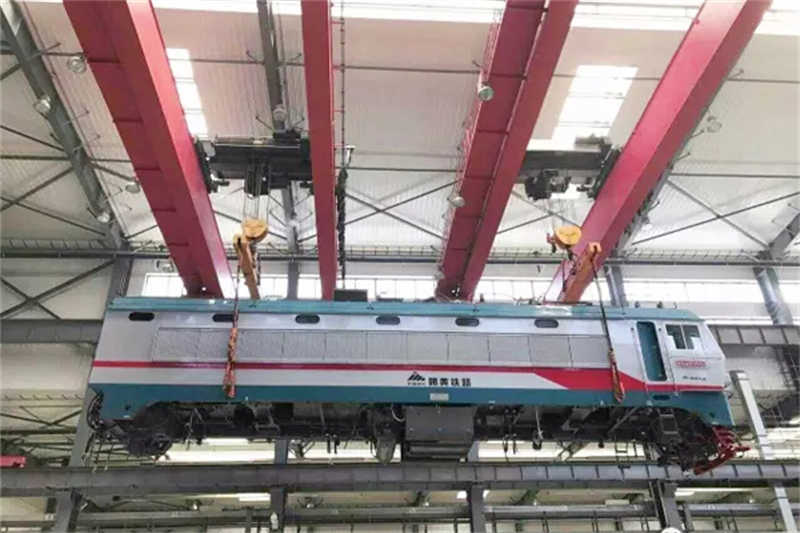
Metro depots require specialized lifting solutions to handle the maintenance, repair, and overhaul (MRO) of trains efficiently. Due to space constraints—particularly low ceiling heights—standard overhead cranes often fail to meet operational requirements. A low-headroom double-girder overhead crane is specifically engineered to maximize lifting height in confined spaces while maintaining high safety and reliability.
Dongqi Crane, a leader in customized lifting solutions, specializes in designing low-headroom cranes for metro depots, ensuring optimal performance within strict spatial limitations. This article explores the key design considerations for such cranes and highlights Dongqi Crane’s expertise in delivering high-performance, space-saving solutions.
1. Metro Depot Challenges & the Need for Low-Headroom Cranes
1.1 Operational Requirements in Metro Depots
- Frequent train movements – Cranes must operate smoothly alongside moving trains.
- Heavy component handling – Lifting bogies, carriages, pantographs, and other large parts.
- Limited workspace – Maintenance pits, narrow aisles, and overhead obstructions (pipes, ventilation, lighting).
- High safety standards – Strict regulations to prevent accidents involving personnel and rolling stock.
- Corrosion resistance – Depots may have humid or chemically aggressive environments.
1.2 Structural Constraints of Metro Depots
- Low ceiling height – The biggest challenge, requiring cranes to minimize dead space.
- Wide spans – Cranes must cover multiple tracks (often 20m+ spans).
- Column spacing – Building support columns may restrict crane runway layout.
1.3 Why Low-Headroom Double-Girder Cranes Are Ideal
- Maximize lifting height – Compact design allows higher hook approaches.
- Enhanced safety – Prevents collisions with overhead structures.
- Space efficiency – Optimizes depot layout for better workflow.
- High load capacity – Double-girder construction ensures stability for heavy lifts.
2. Key Design Features of Low-Headroom Double-Girder Cranes
2.1 Structural Optimization for Minimal Headroom
- Girder Design – High-strength steel (Q345B or equivalent) with optimized cross-sections (box girders, wide-flange beams) to reduce height without compromising strength.
- End Carriages – Compact wheel arrangements and low-profile designs to minimize vertical space usage.
- Trolley Frame – Ultra-slim construction with reinforced welding for rigidity.
- Dongqi Advantage: Patented “Ultra-Low Profile Trolley System” reduces headroom by up to 30% compared to conventional designs.
2.2 Hoisting Mechanism: Space-Saving Innovations
- Drum Configuration – Side-mounted drums or parallel drum arrangements to minimize height.
- Rope Reeving – Optimized pulley systems (2:1 or 4:1) to reduce rope layers on drums.
- Motor & Gearbox – Low-profile hollow-shaft gear motors or right-angle gear reducers for compact installation.
- Hook Block – Short-neck hooks and minimized hook travel distance.
- Dongqi Advantage: Customized “Low-Headroom Hoist Package” ensures maximum lift height under tight clearances.
2.3 Safety & Reliability: Critical for Metro Depots
- Redundant Braking – Dual braking (mechanical + electromagnetic) for fail-safe operation.
- Collision Avoidance – Laser/ultrasonic sensors to detect overhead obstructions.
- Overload Protection – Intelligent load monitoring with data logging.
- Anti-Sway Control (Optional) – Dongqi i-Sway™ system minimizes load swing for precision handling.
2.4 Smart Control & Automation Features
- Variable Frequency Drive (VFD) – Smooth acceleration/deceleration for precise load positioning.
- Remote Control & IoT Monitoring – Dongqi SmartCare™ enables real-time diagnostics and predictive maintenance.
- Ergonomic Cabin/Remote Options – Low-vibration, high-visibility operator environments.
2.5 Environmental Adaptability
- Corrosion Protection – C4/C5 coating or hot-dip galvanizing for humid/dirty environments.
- Low-Noise Design – Sound-dampened motors and gearboxes for reduced noise pollution.
- Easy Maintenance – Sealed bearings, centralized lubrication points, and modular components.
3. Case Studies: Low-Headroom Cranes in Metro Depots
Case 1: Singapore Metro Depot
- Challenge: Extremely low ceiling (6m), requiring a crane with max hook height.
- Solution: A Dongqi 20-ton double-girder crane with side-mounted drums, reducing headroom by 25%.
- Outcome: Uninterrupted lifting over train roofs while complying with strict height limits.
Case 2: London Underground Maintenance Facility
- Challenge: Handling 30-ton train bogies in a confined, high-traffic depot.
- Solution: A low-headroom crane with anti-sway control, enabling precise positioning in tight spaces.
- Outcome: Improved safety and efficiency in bogie replacement operations.
4. Why Choose Dongqi Crane for Metro Depot Solutions?
✔ Proven Expertise – Successfully deployed in Beijing, Shanghai, and Dubai Metro projects.
✔ Full Customization – Adapts to exact depot layouts and lifting requirements.
✔ Premium Components – Uses Siemens, ABB, and Demag-compatible systems.
✔ Smart Crane Technology – IoT-enabled monitoring and automation-ready designs.
✔ Lifetime Support – Installation, training, and maintenance services.
Conclusion: Optimizing Metro Depot Efficiency with Dongqi Cranes
A well-designed low-headroom double-girder overhead crane is essential for maximizing lifting capacity in restricted metro depots. Dongqi Crane’s innovative engineering, safety-focused design, and smart control systems ensure reliable, high-performance solutions tailored to metro maintenance needs.
Contact Dongqi Crane today for a customized lifting solution that saves space, enhances safety, and boosts productivity in your metro depot!
