
1-Aug-2025
Smart Workshop Revolution: How Double-Girder Overhead Cranes + AGVs Replace Traditional Forklifts
1. Executive Summary
The manufacturing sector is undergoing its fourth industrial revolution, with smart logistics emerging as a critical component of Industry 4.0. Traditional forklifts – once the backbone of material handling – now represent a bottleneck in modern production environments due to their inherent limitations in precision, efficiency, and safety.
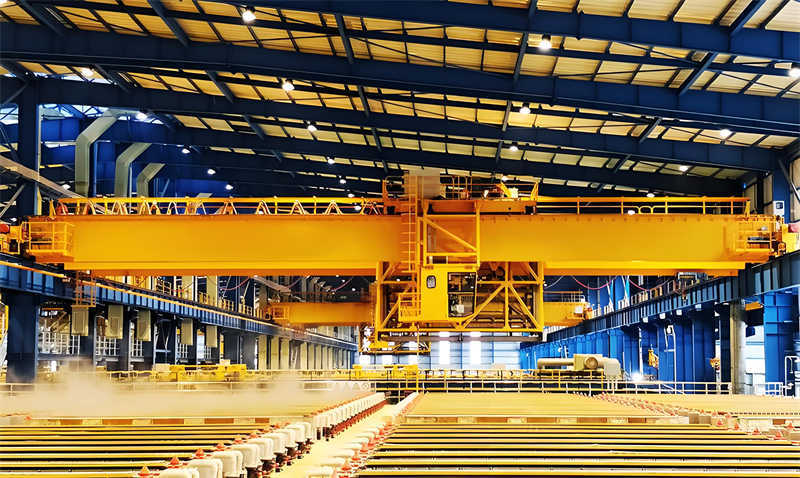
Dongqi Crane’s innovative solution combines double-girder overhead cranes with Automated Guided Vehicles (AGVs) to create a fully integrated material handling system. This intelligent solution delivers:
- 100% increase in operational efficiency
- Millimeter-level positioning accuracy
- 24/7 unmanned operation capability
- 40% improvement in space utilization
2. The Growing Limitations of Traditional Forklifts
2.1 Operational Constraints
Modern manufacturing environments expose four critical weaknesses of conventional forklifts:
- Safety Vulnerabilities
The Occupational Safety and Health Administration reports forklifts account for 34,900 serious injuries annually in the US alone, with 85% caused by human error. - Spatial Inefficiency
Forklifts require:
- Minimum 4m wide aisles
- 1.5m turning radius
- Dedicated charging/refueling areas
- Precision Limitations
Typical positioning accuracy of ±50mm creates challenges in:
- Automated production line integration
- Delicate material handling
- High-density storage operations
- Labor Dependencies
Each forklift requires:
- 1.5 operators per shift (including breaks)
- 80+ hours of training
- Continuous supervision
2.2 Economic Impacts
A comparative cost analysis reveals hidden expenses:
| Cost Factor | Forklift (5-Year TCO) | Dongqi System (5-Year TCO) |
|---|---|---|
| Labor | $450,000 | $75,000 (monitoring) |
| Maintenance | $120,000 | $65,000 |
| Energy | $60,000 | $35,000 |
| Accident Losses | $90,000 | $5,000 |
| Total | $720,000 | $180,000 |
3. Dongqi’s Smart Material Handling Solution
3.1 System Architecture
The integrated solution comprises two synergistic layers:
A. Vertical Handling Layer
Dongqi’s double-girder overhead cranes feature:
- Precision Control System
- AC frequency control (0-20m/min adjustable speed)
- Absolute encoder positioning (±2mm repeatability)
- Anti-sway technology (reduces load swing by 90%)
- Intelligent Safety Systems
- Dual LiDAR collision avoidance (10m detection range)
- Overload protection (automatic shutdown at 105% capacity)
- Emergency stop redundancy (3 independent circuits)
B. Horizontal Transport Layer
AGV fleet specifications:
- Navigation: Hybrid SLAM + magnetic tape guidance
- Communication: Industrial 5G (<10ms latency)
- Payload: 1-10T configurable options
- Battery: 8-hour runtime with opportunity charging
3.2 Core Technologies
1. Intelligent Handshake Protocol
The material transfer process between crane and AGV involves:
- Crane positions load within ±5mm of target
- Machine vision verifies load alignment
- AGV confirms secure engagement
- System logs transfer timestamp for traceability
2. Dynamic Scheduling Algorithm
The control center utilizes:
- Real-time production data from MES
- Equipment status monitoring
- AI-based traffic optimization
To achieve: - 99.5% on-time delivery rate
- 15% reduction in empty travel
- Automatic rerouting during disruptions
4. Competitive Advantages
4.1 Operational Performance Comparison
| Metric | Forklift | Dongqi System | Improvement |
|---|---|---|---|
| Cycles/hour | 18 | 36 | 100% |
| Positioning Accuracy | ±50mm | ±2mm | 25x |
| Energy Consumption | 8kW/h | 3.5kW/h | 56% less |
| Noise Level | 85 dB | 65 dB | 24% lower |
4.2 Space Optimization
The vertical integration enables:
- 50% narrower aisles (4m → 2m)
- 300% increase in storage density
- Dual-level operation (overhead + floor)
![Space utilization comparison diagram]
(Visual showing traditional vs. optimized layouts)
5. Implementation Roadmap
Phase 1: Workshop Assessment (2-4 Weeks)
- Process Mapping
Value stream analysis of material flows - 3D Laser Scanning
Creates digital twin for simulation - Load Analysis
Determines crane capacity requirements
Phase 2: Hardware Deployment (6-10 Weeks)
- Crane Installation
- Runway beam reinforcement
- Power rail installation
- Control cabinet integration
- AGV Infrastructure
- Magnetic tape/QR code placement
- Charging station configuration
- 5G network deployment
Phase 3: System Integration (3-5 Weeks)
- Software Interfaces
ERP/MES/WMS connectivity - Safety Validation
Emergency stop testing - Performance Testing
Peak load simulations
6. Industry Applications
Case Study 1: Automotive Tier 1 Supplier
Challenge:
- 35 forklifts operating 3 shifts
- 18% damage rate on stamped body panels
Solution:
- 4 x 8T Dongqi cranes
- 12 AGVs with vacuum lifters
Results:
- 0 material damage incidents
- 60% labor reduction
- ROI achieved in 11 months
Case Study 2: Pharmaceutical Warehouse
Solution Highlights:
- Cleanroom-compatible AGVs
- Crane-mounted UV sterilization
- Paperless tracking system
Key Metrics:
- 99.98% inventory accuracy
- 45% faster order fulfillment
7. Future Developments
7.1 Advanced Technologies
- Predictive Maintenance
Vibration sensors forecast bearing failures 200+ hours in advance - Autonomous Charging
AGVs self-dock with wireless charging pads - Digital Twin Integration
Real-time synchronization with virtual models
7.2 Sustainable Solutions
- Regenerative Braking
Recovers 15% of crane descent energy - Solar-Powered AGVs
On-board photovoltaic panels extend runtime
8. Conclusion
Dongqi’s Crane+AGV system represents the next evolution in material handling, offering:
- Economic Benefits
- 60-70% lower operating costs
- <2 year ROI period
- Operational Excellence
- 24/7 unmanned operation
- Seamless integration with smart factories
- Strategic Advantages
- Future-ready scalability
- Compliance with Industry 4.0 standards
Next Steps:
- Free facility assessment
- Customized simulation demo
- ROI calculation service
