
1-Dec-2025
European Standard Single Girder Overhead Cranes: A Cost and Specification Guide for 5T, 10T, and 16T Models
For professionals in manufacturing, warehousing, and assembly, selecting the right overhead crane is a critical investment that balances capability, reliability, and cost. European Model (or FEM/DIN standard) Single Girder Overhead Cranes are renowned for their efficient design, precise control, and compliance with stringent international safety and performance norms. If you are evaluating options for capacities of 5, 10, or 16 tons, understanding the price landscape and its determining factors is essential. As a leading manufacturer, Dongqi Crane provides globally compliant solutions, and this guide offers a professional overview to inform your decision-making process.
Reference Price Ranges and Core Specifications
The price of a standard European single girder overhead crane is primarily driven by its lifting capacity. It is crucial to understand that any listed price is an estimate; the final cost is customized based on your facility’s specific parameters.
The table below provides reference price ranges for standard configurations, synthesized from industry data. These figures assume typical spans, standard lifting heights, basic duty cycles (A3-A4), and conventional power supplies.
| Lifting Capacity | Typical Price Range (USD) | Key Application Notes & Standard Specs |
|---|---|---|
| 5 Ton | $3,000 – $41,500 | Ideal for workshops, warehouses, and assembly lines with moderate lifting needs. Features a compact structure for easy operation. |
| 10 Ton | $4,000 – $45,000 | A versatile capacity for heavier machinery handling, steel service, and logistics. A popular model with high global demand. |
| 16 Ton | $5,000 – $48,000 | Suited for heavier industrial applications like metal fabrication or handling large raw materials. Requires more robust structural design. |
Note on Pricing Variability: The wide price ranges in the table reflect how other variables drastically affect cost. For example, a 10-ton crane with a minimal span and basic features may start near the range’s lower end, while one customized for a wide bay with advanced controls will approach the upper limit.
Key Factors That Determine Your Final Investment
Beyond the basic lifting capacity, seven primary engineering and operational factors will define your crane’s specifications and final price.
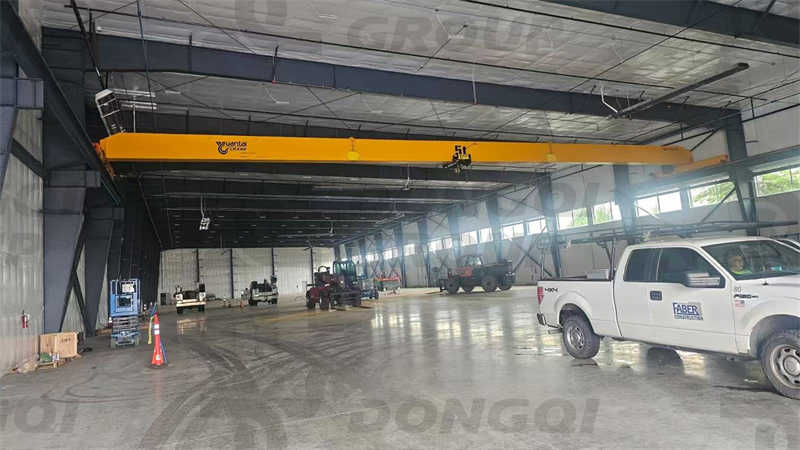
1. Span and Lift Height: The Dimensions of Your Space
The span (distance between runway rails) and lift height are perhaps the most significant cost drivers after capacity.
- Span: Longer spans require a stronger, and often larger, main girder to resist deflection under load. This increases material and manufacturing costs.
- Lifting Height: A greater hook travel distance requires more hoist wire rope, a more powerful motor, and potentially a taller crane structure, each adding to the cost.
2. Crane Duty Class and Usage Intensity
The duty class (e.g., A3, A4, A5) defines how intensively the crane will operate. A crane for continuous, heavy-duty use in a metallurgical plant (Class A5-A6) will need more durable components—such as heavy-duty motors, reinforced brakes, and robust electrical systems—than one for light, occasional use in a warehouse (Class A3). Specifying your daily operational hours is crucial for a correct and cost-effective design.
3. Hoist and Control System Specifications
- Hoist Type and Quality: The choice between a standard electric wire rope hoist and a premium European-style hoist impacts price and performance. European hoists are known for compact design, superior motor quality (using brands like Schneider), better speed control, and higher durability, which commands a higher initial investment.
- Control Mode: Options range from standard pendant control to wireless remote control or operator cabin control. Remote systems offer safety and visibility benefits but increase complexity and cost.
4. Power Supply and Electrical Components
While many regions use a 3-phase 380V/50Hz supply, requirements vary globally. Customizing voltage and frequency (e.g., 480V/60Hz) and opting for premium electrical components will influence the final price.
5. Operational Environment and Special Features
The working environment necessitates specific engineering:
- Harsh Conditions: Environments with dust, moisture, or extreme temperatures (-20°C to 40°C is standard) may require special protection for electrical components.
- Explosion-Proof Requirements: Operations in hazardous areas require certified explosion-proof motors, controls, and fittings, significantly increasing costs.
- Additional Features: Options like variable frequency drives (VFDs) for smooth acceleration, overload limiters, or specialized hooks also contribute to the final price.
6. Installation, Logistics, and After-Sales Support
Consider the total project cost:
- Installation & Training: Professional installation, commissioning, and operator training ensure safety and longevity but are separate cost items.
- Warranty and Support: A comprehensive warranty (typically one year for main parts) and reliable after-sales service are invaluable for long-term operational reliability.
- Shipping and Local Costs: Logistics to your port and local taxes or installation labor costs in your country must be factored into the overall budget.
How to Obtain an Accurate Quotation
Given the high degree of customization, the most reliable way to determine cost is to request a formal quotation based on your specific needs. To expedite this process, prepare the following information for your supplier:
- Basic Specifications: Required lifting capacity (e.g., 5T, 10T, 16T), span, and lifting height.
- Power Details: Your facility’s power supply voltage and phase.
- Usage Profile: Detailed working conditions, number of operating hours per day, and the crane’s duty class.
- Site Information: Whether the runway rails need to be supplied and installed, and the total crane travel length.
- Special Requirements: Any needs for explosion-proofing, special controls, or other features.
Providing these details allows manufacturers like Dongqi Crane to design a solution that optimizes safety, productivity, and cost-efficiency for your operation.
Making an Informed Decision
Investing in a 5T, 10T, or 16T European Single Girder Overhead Crane requires looking beyond the base price per tonnage. The final system’s value lies in its precise fit for your operational intensity, spatial constraints, and long-term reliability needs.
By methodically defining your requirements across the factors outlined above, you can engage with suppliers on a clear, technical basis. This ensures the final quotation and delivered equipment will be a capital asset that enhances your facility’s material handling efficiency and safety for years to come.
For a detailed discussion and a tailored price offer for your project, you are encouraged to contact the Dongqi Crane engineering team with your specific parameters.
