
17-Dec-2025
Crane Selection and Safety Guide for Metallurgical Plants: A Comprehensive Framework for Decision-Making
Foreword: Safety and Efficiency – The Dual Cornerstones of Metallurgical Production
In the high-risk, high-stakes environment of metallurgy, overhead cranes are far more than auxiliary tools. They are the critical arteries of the production lifeline. The scientific basis of their selection and the absolute priority of their safety directly impact personnel safety, asset protection, and production continuity. This guide provides a systematic framework for the core knowledge and decision-making processes involved in crane selection and long-term safe operation. It serves as a clear, practical reference for plant managers, equipment engineers, and safety officers. As a partner deeply rooted in the metallurgical industry, Dongqi Crane is committed to sharing expertise to help clients build inherently safer and more efficient production systems.
Part 1: The Foundation – Understanding Severe Service Conditions and Special Requirements
Chapter 1: The Inescapable Extreme Operating Environment
Metallurgical cranes operate in uniquely punishing conditions that dictate their fundamental design:
- Extreme Heat: Continuous radiant heat from molten metal (creating ambient temperatures exceeding 80°C) critically impacts the lifespan and performance of steel structures, electrical components, and wire ropes.
- High Loads and High Frequency: Continuous production demands cranes operate at heavy (A6) or very heavy (A7/A8) duty classes, with frequent starts and stops, requiring exceptional mechanical fatigue strength .
- Abrasive Contaminants: High levels of dust and metallic particulates accelerate wear on moving parts and degrade electrical insulation.
- Process-Critical Operations: Duties like handling ladles of molten metal demand absolute smoothness and reliability, with zero tolerance for failure.
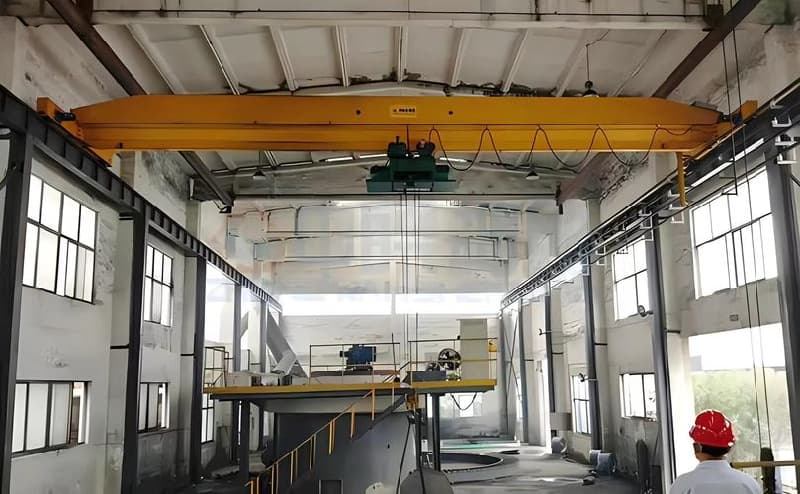
Chapter 2: The Lifeline of Regulations and Standards
Compliance is non-negotiable. Key standards include:
- Chinese Mandatory Regulations: The Special Equipment Safety Law and the Special Equipment Safety Supervision Regulations classify metallurgical cranes for special oversight, requiring regular inspection and certified operators .
- Core Product Standards:
- National Standards: Including GB/T 3811 (Crane Design Code), GB/T 6067.5 (Safety Rules for Bridge and Gantry Cranes), and the specialized JB/T 7688.5 (Technical Conditions for Metallurgical Cranes – Casting Cranes) .
- International Standards: Understanding global frameworks like ISO 4301 is crucial for export projects or benchmarking . The European FEM standard is particularly noted for its focus on fatigue life and mechanical endurance under high-cycle conditions .
- Certification Marks: CE Marking (for the European market) and China’s Special Equipment Manufacturing License are essential proofs of compliance, and their verification is a critical step in procurement.
Part 2: Scientific Selection – Building a Process-Matched Lifting System
Chapter 3: The Key Parameter Decision Tree
Selecting the right crane is a systematic process that starts with your specific process.
- Step 1: Define Process Needs: Map your workflow: Load Object (Hot ladle, ingot, scrap, mold) → Process Flow (Charging, pouring, stripping, finishing) → Define “what to lift” and “how to lift.”
- Step 2: Calculate & Select Core Parameters:
- Capacity: Must include the weight of lifting attachments (e.g., a ladle can be 30-50% of the payload) and potential overload factors—never base it solely on product weight.
- Duty Class (A1-A8): Determined by annual operating hours and load spectrum analysis. Cranes in main production flows are typically A6 or higher . The table below shows how different global standards classify these demanding cycles.
- Span & Lifting Height: Plan based on workshop column spacing, equipment layout, and stacking heights.
- Speed & Positioning Precision: Balance productivity with smooth, precise operation. Pouring applications demand exceptional micro-speed control.
Comparative Duty Class Reference Table
| Service Intensity | Typical Metallurgical Application | ISO 4301 Framework | FEM 1.001 | Approx. CMAA |
|---|---|---|---|---|
| Moderate / Regular | Scrap handling, maintenance | U4 (Utilization) / Q3 (Load Spectrum) | A4 / M5 | Class D |
| Heavy / Continuous | Ladle handling, coil transport | U5-U6 / Q3-Q4 | A6-A7 / M6-M7 | Class E |
| Severe / Intensive | Primary casting, continuous billet handling | U7-U8 / Q4 | A7-A8 / M7-M8 | Class F |
Chapter 4: Core Component & Configuration Selection
The right classification ensures you select suitable components.
- Drive & Braking Systems: Dual braking (service + safety/holding) is essential. Discuss the advantages of integrated “triple-drive” units for metallurgy.
- Structural Design: Explain the choice between box girders, the use of heat shield plates under the girder and cab, and designs to resist thermal distortion.
- Electrical & Controls:
- Motor Insulation: Minimum Class F, with Class H recommended for severe heat exposure.
- Control Modes: Evaluate cab, pendant, and industrial wireless remote control for safety and ergonomics.
- Safety Subsystems: Mandatory Safety Monitoring System (SMS), variable frequency drives for control, and comprehensive limit switches and sensors.
Part 3: Safety in Practice – Lifecycle Management from Installation to Decommissioning
Chapter 5: The Golden Rules of Installation, Testing & Acceptance
- Foundation & Runway: Installation precision (e.g., rail levelness, alignment) is critical for smooth operation and wheel longevity.
- Load Testing: Detail the standard procedures for 125% Static and 110% Dynamic load tests as per acceptance protocols.
- Documentation Handover: Maintain a checklist for mandatory documentation, including general arrangement drawings, electrical diagrams, major component certificates, type test reports, and safety device commissioning records.
Chapter 6: Daily Operation & Maintenance: The Safety Red Lines
Proactive maintenance is key to safety. Best practices include establishing daily and monthly inspection checklists for brakes, wire ropes, and structural connections, and clearing dust and oil buildup to maintain efficiency .
- Enhanced “Do Not Lift” Rules: Adapt standard rules for metallurgy (e.g., “Do not lift un-solidified molten metal,” “Do not lift if safety device alarms are active”).
- Inspection & Maintenance Regime: Implement daily checks (brakes, wire rope), monthly/quarterly maintenance (bolt torque, electrical contacts), and annual overhaul aligned with regulatory inspections.
- Critical Component Life Management: Provide recommended inspection and replacement intervals for wear parts like wire ropes, brake linings, and wheels.
Chapter 7: Risk Mitigation & Modernization
- Failure Mode Warning Signs: List symptoms (structural cracks, brake drift, unusual vibration) and their potential causes.
- The Value of SMS Data: Explain how data on overload events, motor starts, and run times enables predictive maintenance, shifting from reactive repair to proactive prevention. Modern smart systems can analyze this data to predict component life and pre-empt over 99% of potential failures .
- Modernization of Aging Cranes: Provide a framework for evaluating older cranes (e.g., girder deflection, obsolete controls) and outline retrofit options (SMS addition, drive modernization).
Part 4: The Future – Intelligence and Sustainable Safety
The industry is moving towards integration and data-driven management.
- The Intelligent Trend: The future lies in smart systems that provide remote diagnostics, real-time monitoring, and data analytics for predictive maintenance . The advent of AI and digital twin technology allows for “remote diagnostics” and “cloud-based troubleshooting” of equipment .
- Green & Human-Centered Design: Features like energy-regenerating drives, low-noise operation, and ergonomic cabs contribute to long-term sustainability and operator well-being.
Conclusion: Safety is a Never-Ending Project
In summary, scientific selection is the starting point for safety, rigorous management is its guarantee, and continuous investment is its future. Choosing a partner who provides not just a product, but full lifecycle technical support, safety training, and continuous improvement services is paramount for achieving operational excellence in the demanding world of metallurgy.
Ready to build a safer, more efficient lifting system? Contact Dongqi Crane’s engineering team for a customized consultation or to download our comprehensive plant assessment checklist.
