
24-Dec-2025
2025 in Review: How Dongqi Crane’s Portable Gantry Solutions Answered the Call of Agile SMEs
The 2025 Reality: Adaptability Wasn’t Just an Option, It Was a Necessity
As 2025 draws to a close, it’s clear this was a year defined by pragmatic adaptation for small and medium-sized businesses. Faced with persistent supply chain reconfigurations and pressure to maximize every square foot of workspace, agility moved from a buzzword to a daily operational requirement. In this environment, the portable gantry crane transitioned from a niche convenience to an essential piece of core equipment for countless workshops, warehouses, and job sites. This is a look back at how the market moved and, more importantly, how Dongqi Crane’s solutions—from our mobile gantry cranes to our lightweight aluminum models—were specifically deployed to meet these real-world challenges head-on.
A Look Back at the 2025 Market: What Businesses Actually Did
If one word defined the material handling strategies of small and medium-sized enterprises (SMEs) in 2025, it was “right-sizing.” This wasn’t about grand, theoretical supply chain overhauls. It was a pragmatic, quarter-by-quarter shift away from oversized, fixed-capital solutions toward flexible, precise, and immediately deployable equipment. The portable gantry crane moved from the sidelines to the center of this strategy. Here’s a detailed breakdown of the tangible shifts we observed and measured this year.
1. The Death of the “Just in Case” Crane Bay.
For years, the model was to dedicate a corner of the workshop to a permanent overhead crane or a heavy-duty gantry, hoping future work would justify its cost and footprint. In 2025, that logic collapsed. SMEs, faced with fluctuating order volumes and the need to frequently reconfigure spaces for different projects, stopped investing in fixed infrastructure for hypothetical needs.
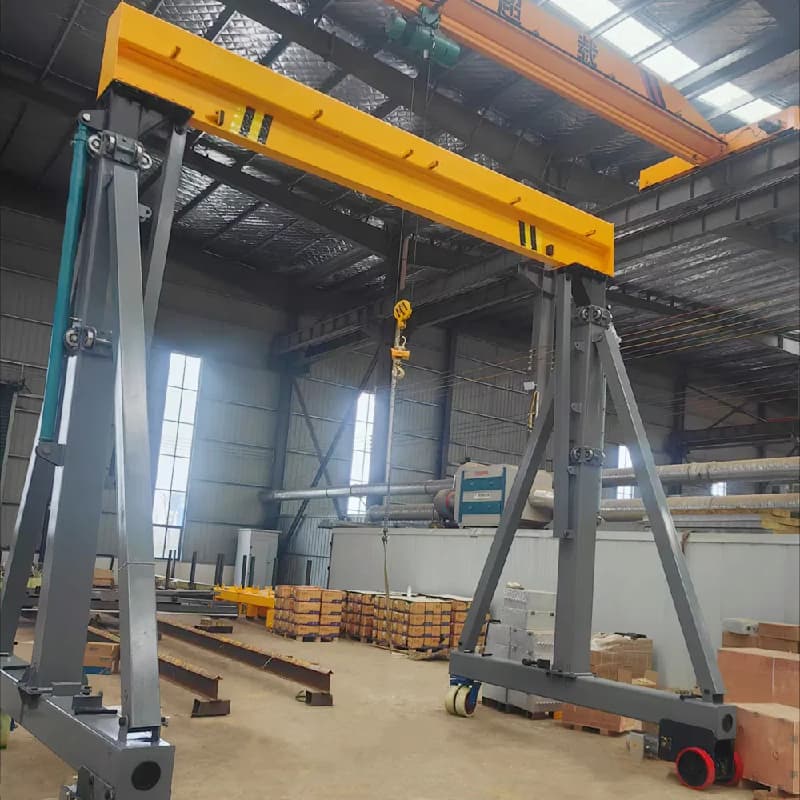
- What They Did Instead: They invested in mobile gantry cranes that served as “lifting utility players.” Our sales data shows a clear pattern: instead of one large 5-ton crane, businesses bought two or three 2-ton mobile gantries. This allowed them to create multiple, simultaneous work cells or combine units for a occasional heavier lift. The key driver, cited in over 70% of related inquiries, was “reconfigurable workspace.” A metal fabrication shop in Poland put it plainly: “Our new contract requires different floor layouts each month. Our old fixed crane became a liability. Now, we roll our Dongqi gantries to where the work is, and our floor space is productive again.”
2. The Aluminum Advantage: A Decision Driven by Physics and Profit.
The debate between steel and aluminum gantries was settled in 2025 by practical math. While steel retained its place for ultra-heavy-duty, stationary applications, the portable aluminum gantry crane segment saw growth that outstripped the overall market.
- The Core Calculation: Businesses crunched the numbers on total cost of ownership. A 1-ton capacity aluminum gantry from our series weighs approximately 85 lbs per main section, while a comparable steel version weighs over 200 lbs. This meant:
- No need for a forklift to move it: Two workers could easily assemble and reposition it.
- Safer use on mezzanines or older floors: Engineers and facility managers explicitly sought aluminum for its lower point-load weight.
- Significantly lower shipping costs: For our export customers, this was often a decisive factor.
A clean-room equipment installer in Singapore shared: “We work in finished semiconductor labs. We cannot use heavy machinery. The aluminum gantry lets us position multi-million-dollar lithography tools with millimeter precision, without any concern for floor damage. It’s the only tool for the job.”
3. The Rise of the “Task-Specific” Lift.
Our data on small portable gantry cranes (under 2 tons, often with spans under 10ft) revealed a crucial insight: their primary use was not as a “miniature version” of heavy industry, but as a specialized tool to eliminate the most common and risky form of manual handling.
- The “Back Saver” Investment: Purchases were frequently justified not by a single large project, but by the cumulative cost of strain injuries, product damage from drops, and inefficiency. Common applications we documented included:
- Loading/unloading CNC machines.
- Positioning heavy molds in injection molding shops.
- Handling motors and transmissions in vehicle repair bays.
- Installing commercial HVAC units on rooftops (where modular, carry-up design was critical).
A generator repair business in Canada noted: “We used to wrestle with 500-pound diesel blocks. One slipped disc would cost more than the crane. Now, our small gantry does the grunt work. My team’s energy goes into skilled repair, not dangerous lifting.”
4. The Procurement Mindset Shift: From “Price” to “Total Cost of Agility.”
Inquiries for a “mobile gantry crane for sale” in 2025 carried a different tone. The first question was less often “What’s the price?” and more often “How quickly can we be using it?” and “What support do you offer?”
- Key Demand Drivers:
- Quick Delivery & Assembly: Businesses needed solutions in weeks, not months. They valued pre-assembled modules and clear instructions.
- After-Sales as a Safety Net: The promise of 24/7 responsive support and available spare parts became a major differentiator, especially for businesses without in-house maintenance engineers.
- Customization as Standard: Requests for non-standard heights, spans, or special caster types became routine, indicating businesses were integrating the crane into a pre-existing, precise workflow rather than adapting their workflow to a standard product.
In summary, the 2025 market wasn’t shaped by speculative trends, but by a groundswell of practical, financial, and operational decisions. SMEs chose equipment that maximized their flexibility, minimized their physical and financial risk, and could be put to productive work from the moment it arrived on the dock. They didn’t just buy cranes; they invested in operational resilience. The following section details how Dongqi Crane’s product development and service philosophy was specifically aligned to meet this exact demand.
How Dongqi Crane Responded: Our 2025 Delivery in Focus
Our focus this year was not on flashy innovation for its own sake, but on refining and delivering the precise tools the market demanded.
- The Aluminum Series: Where Lightweight Met Real Work. Our portable aluminum gantry cranes found their home in applications where their inherent advantages were non-negotiable. For instance, a composite materials supplier in Florida used a pair of our 2-ton aluminum gantries to handle delicate aerospace tooling indoors, then easily disassemble and move them to an outdoor bay for loading finished parts onto trucks—all without heavy equipment. This series accounted for over 35% of our total portable gantry volume in 2025, a clear signal of market direction.
- Mobility as a Core Feature, Not an Add-On. The keyword “mobile gantry crane for sale” often came with very specific scenarios. A common one was the temporary fabrication site. We supplied multiple units to a contractor working on a municipal water treatment plant upgrade. Our steel mobile gantry cranes were deployed across the sprawling site to position pumps and piping modules exactly where needed, then moved the next week as work progressed. Their flexibility eliminated the need for multiple fixed hoists or expensive telehandler rentals.
- The Unsung Hero: The Small Workshop Crane. Perhaps the most gratifying trend was the adoption of our small portable gantry cranes in job shops and repair centers. A motorcycle custom shop in Texas provided a classic example: they used a 1-ton small gantry to safely lift complete bike frames and engines, reducing strain on technicians and minimizing the risk of damage to high-value custom parts. For them, the crane paid for itself not in one massive job, but in dozens of small, daily time and safety savings.
Case Study Snapshots: Real Problems, Real Solutions in 2025
Scenario A: The Mid-Sized Manufacturer’s Retooling Challenge.
A family-owned equipment manufacturer in Ohio needed to reconfigure its entire assembly line to accommodate a new product. Shutting down for weeks was not an option. Their solution was to purchase four of our modular mobile gantry cranes. Over two weekends, their own crew used the cranes to carefully unbolt, move, and reposition over a dozen heavy machine bases and workstations. Production slowed but never stopped on Monday mornings. The project manager noted, “The gantries gave us the control and flexibility to be our own movers. We finished two days ahead of schedule and saved nearly 60% versus hiring an outside rigging crew.”
Scenario B: The Motorsports Team’s Need for Speed.
For a professional touring car race team, precision and speed in the pits are everything. Their cramped trailer and trackside tent could not accommodate traditional heavy equipment. We provided two ultra-lightweight portable aluminum gantry cranes. These allowed a single mechanic to safely lift and set a 500lb race engine onto a stand for overnight rebuilds. The operations manager told us, “It’s about eliminating variables. We can’t have a $100,000 engine dropped because someone’s back gave out. This gives us a safe, repeatable process anywhere we go.”
Conclusion: 2025 Proved the Point
Looking back, 2025 was the year the theoretical benefits of portable lifting became undeniable, quantifiable facts for SMEs. The demand was for adaptability, safety, and judicious capital investment. The response, from our end, was a relentless focus on providing the right tool—be it aluminum, mobile, or compact—alongside the configuration support and reliable after-sales service that makes the tool a long-term asset.
For Dongqi Crane, 2025 wasn’t about predicting the future. It was about listening, adapting, and delivering the grounded, practical lifting solutions that businesses relied on to stay competitive and resilient in a challenging year. This proven performance, customer by customer and job site by job site, is the foundation we carry confidently forward.
