
29-Dec-2025
The Definitive Guide to Specifying and Procuring a 35-Ton Double Girder Overhead Crane for Indoor Warehouse Applications
Introduction: The Strategic Backbone of Modern Warehousing
In the architecture of modern industrial and logistics facilities, the overhead crane is not merely a piece of equipment; it is the strategic backbone of material flow. For warehouse construction or retrofitting projects involving heavy unit loads—be they machinery, steel coils, packaged goods on heavy pallets, or full shipping containers—the decision to invest in a 35-ton double girder overhead travelling crane is a significant one. This choice impacts everything from initial building design and long-term operational efficiency to safety and total cost of ownership.
As a leading manufacturer with deep engineering expertise, Dongqi Crane understands that this procurement process is multifaceted. This comprehensive guide is designed to navigate you, the decision-maker, through the critical considerations for selecting the optimal Indoor Overhead Crane system. We will move beyond basic specifications to explore the engineering rationale behind a Double Girder Design for a 35 Ton Capacity, ensuring your investment delivers maximum Material Handling Efficiency and reliability for years to come.
Phase 1: Foundational Planning – Defining the Need
Before delving into technical specs, it’s crucial to solidify the operational requirements.
1.1 Assessing the True Load Requirement: Is 35-Ton the Right Benchmark?
The “35-ton” rating is a critical starting point. A thorough analysis must consider:
- Maximum Unit Load: What is the single heaviest item you need to lift? Include the weight of lifting attachments (spreaders, hooks, magnets).
- Future-Proofing: Are there plans to handle heavier products in the foreseeable future? Underspecifying capacity is a costly error.
- Load Frequency: Will the crane consistently operate near its 35-ton capacity (suggesting a heavier-duty class), or is this for occasional heavy lifts with mostly lighter work? This influences the crane’s work duty classification (e.g., FEM/ISO A5, A6), which dictates the design robustness of motors, gears, and structures.
1.2 Spatial Integration: The Crane Within the Building
The success of an Indoor Overhead Crane hinges on its seamless integration into the Warehouse Construction.
- Span: The horizontal distance between the crane rails is the single most influential factor on crane cost and design. Accurate measurement of the bay width is essential. For double girder cranes, the girders themselves sit on top of the runway beams, a factor your building designer must account for in column loading.
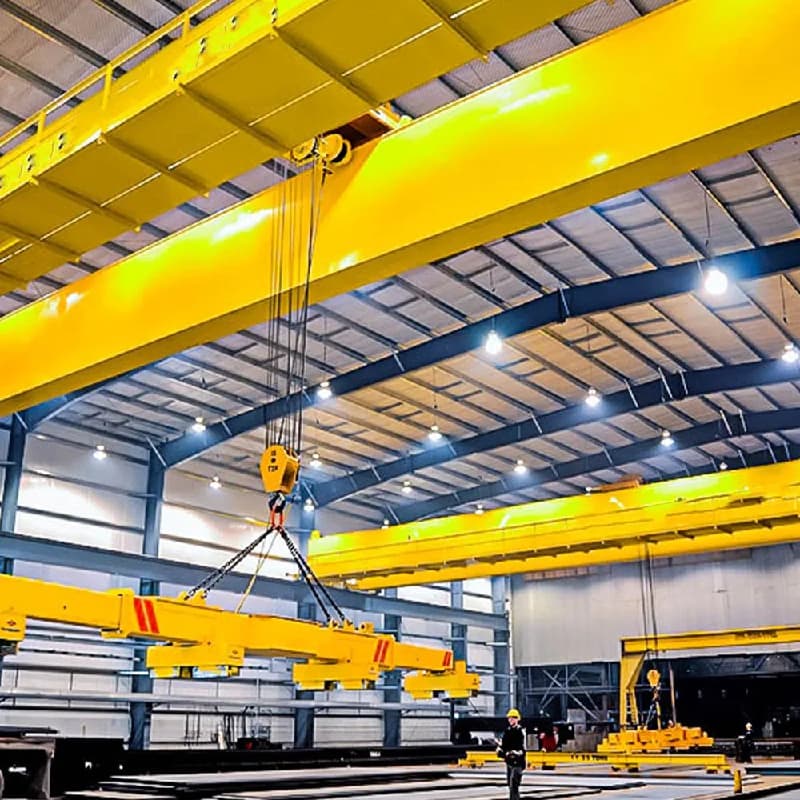
- Lifting Height and Headroom: This is where Double Girder Design offers a distinct advantage for indoor use. The hoist is positioned between the two main girders, creating a low headroom configuration. This maximizes the available hook travel in buildings with limited ceiling height—precious space that can be used for higher storage racks instead of being consumed by the crane itself.
- Clearance and Coverage: Map out the required coverage area. Does the crane need to service the entire bay, or specific workstations? Consider clearances from walls, columns, and other equipment.
Phase 2: Technical Specification – The Core of the Double Girder Advantage
With operational needs defined, we translate them into precise technical parameters.
2.1 Why Double Girder for a 35-Ton Indoor Crane?
For capacities at and above 35 tons, a double girder design is almost always the engineered solution of choice for indoor applications, and for good reason:
- Superior Structural Integrity: The twin-bridge girder system provides immense stiffness and strength, minimizing deflection under full load. This ensures smooth, controlled travel and precise load spotting—a cornerstone of safe and efficient operation.
- Enhanced Hoist Performance: Double girder cranes can accommodate more powerful hoists with larger drums and ropes. This allows for higher lifting speeds and better rope fleet angles, contributing directly to cycle time reduction and Material Handling Efficiency.
- Optimal Utilization of Space: As mentioned, the low headroom design preserves vertical space. Additionally, the top-mounted trolley offers a clean profile, allowing for better use of the space below the crane.
- Durability and Longevity: Designed for heavier duty cycles, double girder cranes are built to endure the rigors of constant indoor industrial use, leading to a longer service life and lower lifetime maintenance costs.
2.2 Key Components and Customization Options
- Hoist Unit: For 35-ton lifting, a heavy-duty wire rope hoist is standard. Key decisions include lifting speed (single or variable), motor insulation class (for duty cycle), and safety features like dual braking systems and overload limit switches.
- Trolley Design: The trolley travels along the top of the double girders. Design focuses on minimizing wheel wear and ensuring smooth transition across rail gaps.
- End Trucks & Drive: The end trucks house the wheels that move the entire crane bridge. Considerations include the number of driven wheels (typically 50% or 100% drive) and the type of drive motors. Variable Frequency Drives (VFDs) are highly recommended for indoor cranes as they provide soft starts/stops, precise speed control, and significantly reduce mechanical stress and load swing.
- Control System: Options range from pendant push-button stations (wired or radio remote) to fully enclosed operator cabins. For optimal Material Handling Efficiency and operator ergonomics in a large warehouse, a cabin or remote control is often preferred.
- Power Supply: Indoor Overhead Cranes typically use conductor bar (safe bar) systems or festooned cable systems. Conductor bars are favored for cleaner operation, lower maintenance, and reliability over long travel distances.
Phase 3: Integration, Safety, and Intelligence
A modern crane is part of a larger ecosystem.
3.1 Safety as a Non-Negotiable Standard
Dongqi cranes are designed and built to international standards (ISO, FEM, CMAA, AS). Core safety features for a 35-ton crane must include:
- Redundant Braking: Primary and secondary brakes on the hoist.
- Limit Switches: Upper and lower travel limits for both the hoist and trolley/bridge motions.
- Anti-Collision Systems: For warehouses with multiple cranes operating in the same bay.
- Load Moment Indicator: For critical lifts, providing real-time load data to the operator.
3.2 Smart Features for Enhanced Efficiency
Integrating intelligence transforms a crane from a simple lifter into a data-driven productivity tool.
- Automation & Positioning: Automated travel to pre-set positions can drastically reduce cycle times and operator error.
- Remote Monitoring: IoT-enabled sensors can monitor crane health, usage patterns, and predict maintenance needs, preventing unexpected downtime.
- Weighing Systems: Integrated load cells provide in-motion weighing, adding a valuable dimension to inventory and logistics management.
Phase 4: Partnership with Dongqi Crane – From Specification to Operation
Choosing the right partner is as important as choosing the right specifications.
4.1 Our Collaborative Process
- Consultation & Data Collection: We work with your team to gather all necessary data: CAD layouts, load details, duty cycles, and operational goals.
- Engineering & Proposal: Our engineers perform structural calculations and propose a custom-designed solution, including all interfaces with your building.
- Manufacturing & Quality Control: Components are manufactured in our facilities under strict quality protocols. Pre-delivery inspection ensures compliance.
- Installation & Commissioning: We provide professional installation services or supervise local teams, followed by comprehensive testing and operator training.
- After-Sales Support: Our global network provides spare parts, technical support, and preventive maintenance programs to safeguard your investment.
4.2 The Dongqi Advantage
- Deep Engineering Expertise: Decades of experience in designing cranes for global industries.
- Customization Capability: We don’t just sell catalog items; we engineer solutions tailored to your specific Warehouse Construction and workflow.
- Quality Assurance: From steel sourcing to final testing, quality is embedded in every step.
- Lifecycle Perspective: We focus on providing a reliable asset that delivers low total cost of ownership through durability and efficiency.
Conclusion: Making an Informed Investment
Selecting a 35-ton double girder overhead travelling crane for your indoor warehouse is a strategic decision that demands a systematic, technically-informed approach. It begins with a clear understanding of your operational needs and flows through meticulous attention to spatial constraints, duty requirements, and a desire for operational excellence.
The Double Girder Design stands as the robust, efficient, and space-optimized foundation for a 35 Ton Capacity indoor system. When paired with thoughtful specification, modern safety systems, and intelligent features, it becomes a powerful engine for Material Handling Efficiency, directly contributing to the productivity and safety of your Warehouse Construction project.
At Dongqi Crane, we are committed to being more than a supplier; we aim to be your engineering partner in this process. We invite you to engage with our technical team to transform your warehouse lifting challenges into a seamless, efficient, and reliable material handling solution.
Ready to Define Your Specification? Contact Dongqi Crane today for a detailed consultation and a preliminary engineering assessment tailored to your project’s blueprint and operational goals.
