
15-Jan-2026
2025 Jib Crane Market Review: Our Perspective at Dongqi Crane
At Dongqi Crane, we view our sales data as a direct conversation with the industries we serve. The figures from 2025 are not merely totals; they are a detailed map of the practical challenges our customers face daily. As a specialist in providing focused lifting solutions, we see jib cranes as essential tools for enhancing workstation productivity, safety, and ergonomics. Here is our analysis of what the past year’s trends tell us about the real-world applications driving your choices.
Understanding the Markets We Serve
Our cranes are specified for environments where precise, repetitive lifting within a defined area is critical. The demand consistently comes from sectors where optimizing a specific process point yields significant returns:
- Manufacturing & Machining Cells: This is our core application area. Here, our jib cranes are integral for machine tending, component assembly, and workpiece positioning. The need is for unwavering reliability to keep production lines moving and for precision to handle valuable parts.
- Warehousing & Logistics Hubs: In these settings, our equipment provides localized loading/unloading solutions at docks or within storage aisles. Customers choose them for their cost-effectiveness over larger systems and their flexibility in handling pallets or packaged goods.
- Maintenance & Repair Facilities: From automotive shops to industrial plant maintenance bays, our cranes perform engine hoisting, equipment servicing, and parts handling. Key demands here are ease of use, durability, and a compact footprint.
- Steel Fabrication & Metalworking: Our robust models are used for handling sheet metal, steel beams, and fabricated structures during cutting, welding, and finishing. These applications require equipment that can manage heavier, often unwieldy loads with steadfast dependability.
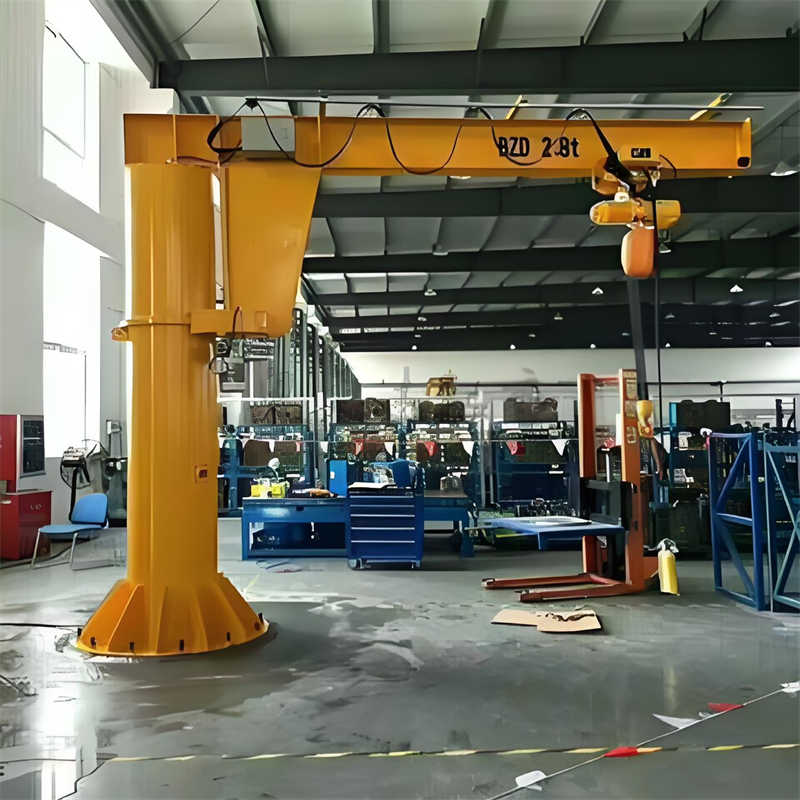
What Your Choices Told Us: A Configuration Analysis
The distribution of your selections in 2025 gave us clear insights into prevailing operational priorities. The following table breaks down what we believe these preferences indicate:
| Configuration | Percentage | Our Interpretation of Industry Need |
|---|---|---|
| BZ Column-Mount + Electric Chain Hoist | ~59.1% | This dominant choice confirms the widespread need for a general-purpose productivity enhancer. It represents the standard for eliminating manual lifting in high-frequency tasks across assembly and production, where electric power is essential for efficiency. |
| BZ + Electric Chain Hoist + Vacuum Lifter | ~9.1% | This significant niche highlights a growing segment focused on damage-free material handling. We see this in industries like glass processing, advanced sheet metal fabrication, and panelized construction, where protecting surface integrity is as crucial as the lift itself. |
| BZ + Manual Chain Hoist | ~9.1% | A steadfast choice for cost-conscious and utility-focused operations. It meets essential lifting needs in maintenance areas, low-volume workshops, or as a backup solution, proving that simplicity and value remain highly important. |
| BZ + European Style Hoist | ~9.1% | This reflects demand from customers with higher performance thresholds. These are often operations with intense duty cycles or those in regulated industries where superior control, smoother operation, and adherence to stringent standards are critical investment drivers. |
| BZ + Wire Rope Hoist (CD/MD) | ~9.1% | Selected for applications requiring specific technical profiles, such as greater lifting height or the particular performance characteristics of a wire rope hoist in demanding fabrication or handling scenarios. |
| BX Wall-Mount + Electric Chain Hoist | ~4.5% | This option is the definitive solution for space optimization. Its consistent selection underscores its irreplaceable role in workshops where maximizing clear floor space along walls or in corners is a primary layout constraint. |
Our Guidance for Your Selection
Based on these ongoing conversations with our market, we advise focusing on a practical assessment of your worksite’s needs:
- Map the Task and Space: Begin by defining the load’s maximum weight and dimensions, the exact coverage area required, and the physical constraints of the installation site. An open floor favors a column-mounted model, while a perimeter-based workflow often benefits from a wall-mounted design.
- Match the Hoist to the Work Rhythm: For high-cycle, repetitive lifting that impacts production throughput and operator wellness, an electric hoist is the necessary standard. For sporadic or maintenance-focused tasks, a manual hoist provides essential capability. If your primary challenge involves large, smooth, or delicate surfaces, integrating a vacuum lifter should be a primary consideration.
- Plan for Long-Term Demands: For a station that will see continuous or heavy use, specifying a hoist with a higher duty class and robust construction (like our European-style offerings) is an investment in reduced lifecycle cost and operational reliability.
In summary, at Dongqi Crane, we interpret the 2025 data as evidence of a market that makes thoughtful, application-driven decisions. Our role is to provide the product clarity and configuration expertise to ensure your investment perfectly aligns with the specific demands of your workstation.
Should you wish to evaluate a specific scenario, we are here to provide detailed configuration support based on your load, reach, and duty cycle requirements.
