
26-Mar-2026
Bridge Crane vs. Gantry Crane: 5 Dimensions to Guide Your Investment Based on Factory Structure
In the initial stages of industrial factory construction or renovation, the selection of an overhead crane (often referred to as an EOT – Electric Overhead Traveling crane) is a decision that fundamentally dictates the logistical efficiency of the entire production line. A common pitfall for many business owners is to focus exclusively on lifting capacity (“tonnage”) or the initial purchase price. This narrow focus often leads to critical issues during installation, such as insufficient hook height, excessive load on the building’s foundation, or operational bottlenecks that could have been avoided with proper forethought.
The selection of a crane is not a simple matter of determining “which type is better.” Instead, it is a strategic exercise in determining which type is more compatible with your specific physical environment. Choosing the wrong crane can result in underutilized floor space, costly structural reinforcements, or compromised operational safety.
This article will dissect the decision-making logic from five professional dimensions: Space Utilization, Structural Load Capacity, Installation Flexibility, Operational Efficiency, and Return on Investment (ROI) . By analyzing these factors, we aim to provide a clear roadmap for choosing between a bridge crane (specifically the Low Headroom, LH type double-girder design) and a gantry crane.
Dimension 1: Space Utilization – “Maximizing Height” vs. “Maximizing Span”
In a manufacturing facility, every square meter of floor space represents a sunk cost. The structural design of your crane directly impacts how much of that space is usable for production, storage, and logistics.
Bridge Crane (Focus: LH Type Double Girder)
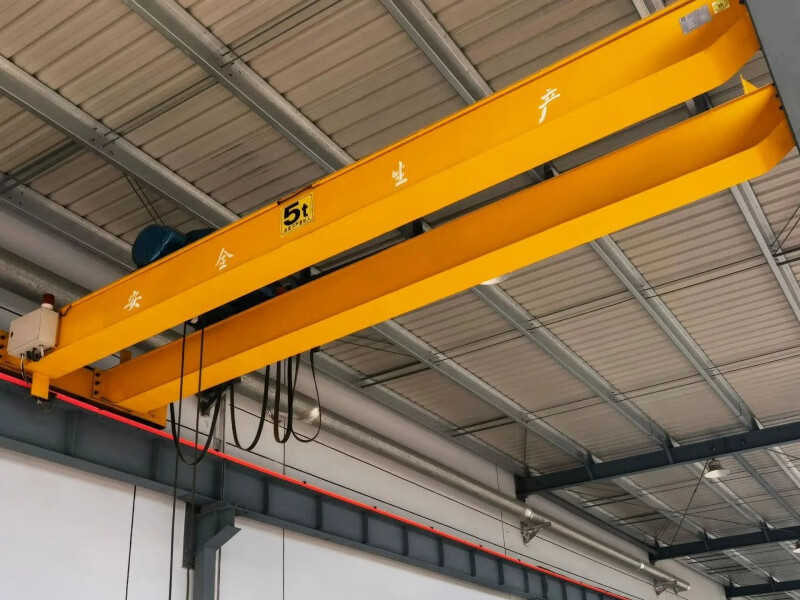
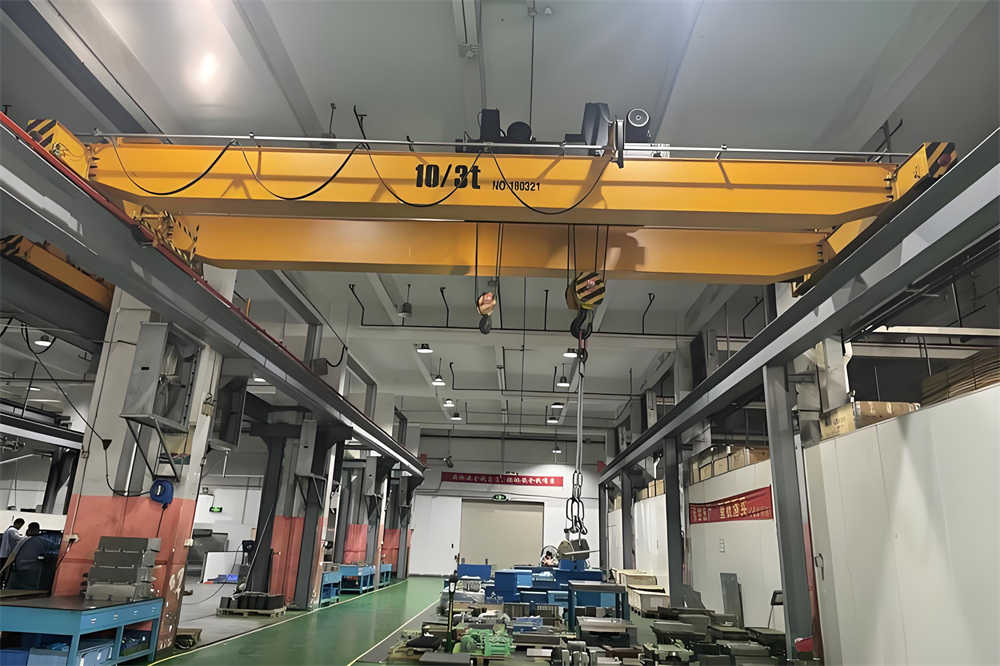
The defining characteristic of a bridge crane is its installation method. It operates on runways installed on overhead columns (corbels) . The crane’s bridge spans the width of the workshop, traveling along the longitudinal axis of the building, while the hoist trolley traverses across the bridge. Because it is mounted overhead, it occupies zero ground space.
The LH type double-girder crane represents the pinnacle of space optimization in this category. It utilizes an electric hoist that runs on a specially designed double-girder structure. The key advantage here is the “compact design.” By minimizing the distance between the top of the crane beam and the roof structure (the “deadband”), the LH type significantly maximizes the usable lifting height.
- Core Advantage: It “squeezes” every centimeter of vertical space. If your factory has a low roof clearance but requires handling of tall machinery or molds, the LH type bridge crane can provide a significantly higher lifting height than a standard single-girder or gantry crane.
- Impact on Logistics: The floor remains completely unobstructed. Forklifts, AGVs (Automated Guided Vehicles), and workers can move freely across the entire width of the bay without being blocked by structural legs or rails.
Gantry Crane
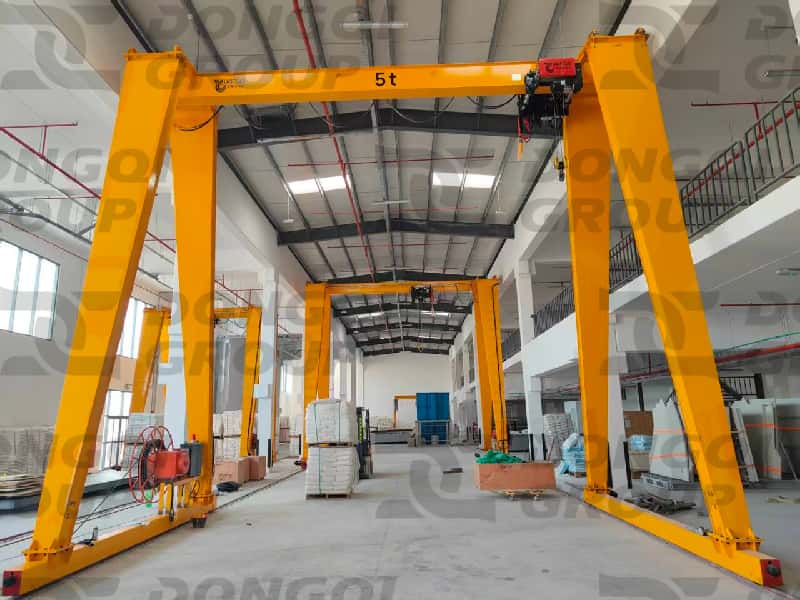
In contrast, a gantry crane is a self-supporting structure. It features legs that run on rails installed at ground level. While this independence from the building structure offers certain advantages, it comes at a high cost in terms of space utilization.
- Core Disadvantage: The legs and the ground rails create physical barriers. The pathways along which the legs travel must be kept clear of materials, machinery, and personnel traffic. This creates “logistical dead zones” that fragment the factory floor, reducing usable storage and workspace.
Decision Insight:
If your internal logistics are intensive, if you rely on cross-bay transportation, or if every square foot of ground space is allocated for production, Bridge Cranes (LH type) are the only logical choice. Gantry cranes should only be considered if the building structure cannot support an overhead crane (e.g., in a simple shed) or if the workspace is an outdoor yard where ground space is abundant.
Dimension 2: Structural Load Capacity – Can Your Building Support It?
A crane is a dynamic, heavy-load power device. The pressure it exerts on the building structure—whether static or dynamic—is the most critical parameter for structural engineers. Choosing a crane that is incompatible with your building’s design can lead to safety hazards and costly retrofitting.
Bridge Crane: The Need for “Corbels”
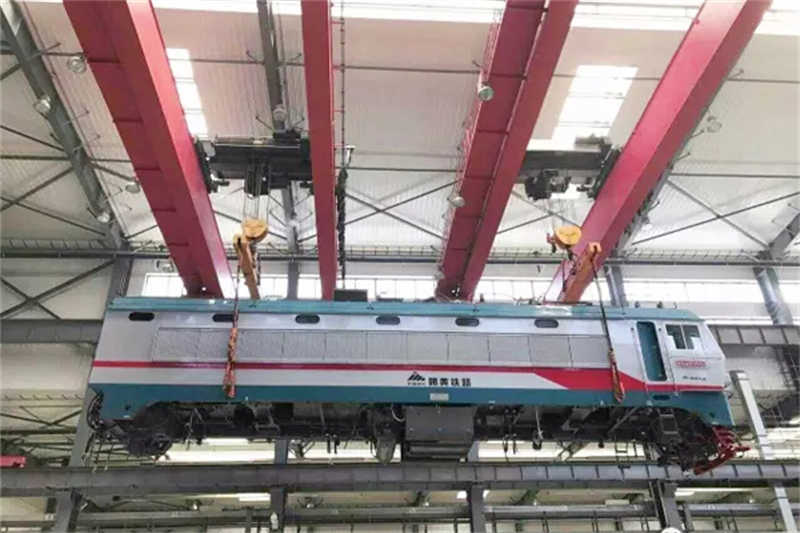
A bridge crane transfers its weight—including the dead weight of the crane itself and the live load of the lifted material—through the end trucks onto the crane runways. These runways are mounted on the factory’s columns (specifically on corbels or brackets). This creates a horizontal thrust and a vertical load that the building’s steel structure must be designed to withstand.
The “Weight Reduction” Technology of LH Type:
Modern crane designs, such as the LH series, utilize advanced engineering methodologies like Finite Element Analysis (FEA) to optimize the structure. This allows for the removal of excess steel while maintaining or even enhancing structural integrity.
- Key Benefit: Low Wheel Load. The optimized self-weight of the LH crane results in a significantly low wheel load. For a given lifting capacity (e.g., 10 tons), an LH crane exerts far less lateral force on the column corbels compared to older, more traditional designs.
- Impact on Investment: If you are building a new factory, opting for LH type cranes allows your structural engineering team to potentially reduce the steel section size of the columns and corbels, resulting in substantial savings on construction materials.
Gantry Crane: Independence from the Roof
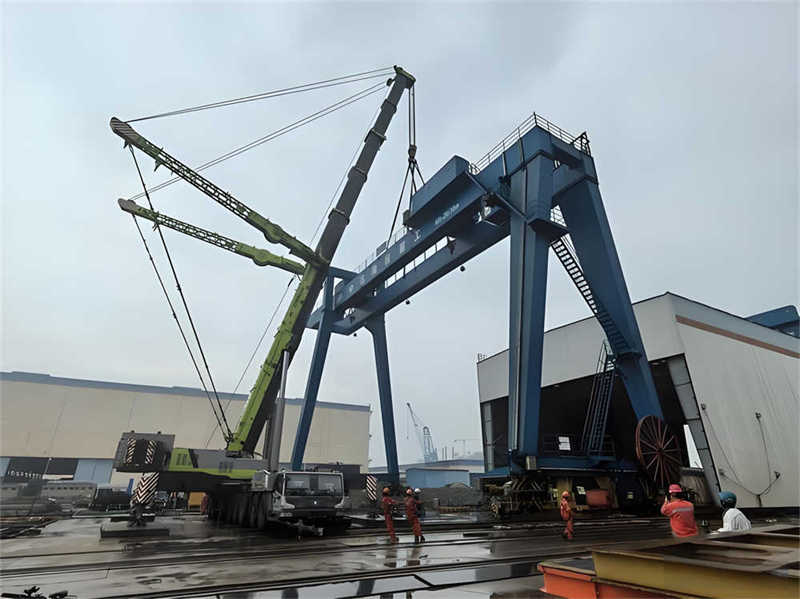
A gantry crane transfers its entire load (crane weight + load weight) directly to the ground through its legs.
- Advantage: It does not rely on the building’s roof structure. This is ideal for temporary structures, outdoor yards, or factories with steel structures that are too weak to support an overhead crane.
- Disadvantage: While it doesn’t load the columns, it imposes high demands on the ground. Gantry cranes typically require excavated foundations, reinforced concrete, and embedded rails. The cost of this civil engineering work is often underestimated and can be substantial, sometimes exceeding the cost of the crane itself in areas with poor soil bearing capacity.
Decision Insight:
If your factory already has a robust steel structure with pre-installed corbels and runway beams, the Bridge Crane is the most cost-effective and structurally sound option. If your factory is a lightweight agricultural-style shed or an open yard, a Gantry Crane avoids the need to reinforce the roof structure.
Dimension 3: Installation & Modification Flexibility – Balancing Present Needs with Future Adaptability
B2B capital investments, particularly in heavy machinery, are long-term commitments. However, business landscapes change. Your chosen crane should not lock you into an inflexible arrangement.
Bridge Crane: The “Permanent Asset”
Once installed, a bridge crane is generally considered a fixed asset with a lifespan that matches the factory building. Its mobility is limited to the bay for which it was designed.
- Adaptability: However, modern bridge cranes like the LH series are designed with modularity. In the future, if your production requirements change, you are not necessarily stuck with the entire crane. The modular design allows for the replacement of the electric hoist trolley to upgrade capacity or control systems (e.g., switching from pendant control to remote radio control) without the need to dismantle the main girders or runway system. This allows for technological upgrades with minimal disruption and cost.
Gantry Crane: The “Mobile Asset”
The primary advantage of a gantry crane, especially a single or double girder gantry, is its flexibility.
- Portability: Gantry cranes are often the go-to choice for temporary work sites, construction projects, or facilities that are rented. If a business is leasing a facility and the lease is not renewed, or if production needs to be relocated, a gantry crane can be dismantled, transported, and re-erected at a new site.
- Modification: In a rented facility, tenants often face restrictions on welding or modifying the steel structure. A gantry crane bypasses this issue entirely, as it is self-supporting and does not require permanent attachment to the building.
Decision Insight:
Choose a Bridge Crane if you are looking for a permanent, stable, and highly integrated asset for a facility you own, with a focus on long-term stability and asset appreciation. Choose a Gantry Crane if your business model involves high mobility, temporary contracts, or if you operate in a leased building where permanent structural modifications are not permitted.
Dimension 4: Operational Coverage, Precision, and Efficiency
The primary function of a crane is to move materials efficiently. The differences in structural rigidity and coverage area between bridge and gantry cranes significantly impact operational performance.
Hook Coverage and “Dead Zones”
- Bridge Crane: The trolley on a bridge crane can travel from one end of the bridge to the other, bringing the hook extremely close to the longitudinal walls of the building. This provides near-total area coverage of the bay. The operator can service workstations located at the very edges of the factory floor without repositioning the material.
- Gantry Crane: The “dead zones” for a gantry crane are not just the floor space occupied by the legs, but also the area outside the rail tracks. The hook can only service the area spanned by the bridge. Any material stored outside the legs or beyond the track ends requires secondary handling equipment like forklifts.
Precision and Stability
- Double Girder Advantage (LH Type): For applications requiring high precision, such as die handling, mold changing, or precision machinery assembly, the double girder bridge crane is superior. In a double girder configuration (like the LH type), the trolley runs on top of the two main beams. The load is suspended directly between these beams, creating an extremely stable center of gravity. This results in minimal load swing and high positioning accuracy.
- Gantry Crane Limitation: While modern gantry cranes are stable, they are inherently subject to the conditions of the ground rails. If the tracks settle unevenly or are not perfectly level, the entire gantry can tilt, leading to crab-walking (skewing) of the wheels and increased load swing. This makes precision tasks slower and more difficult.

Decision Insight:
For high-frequency, high-precision production environments—such as automotive assembly lines, tool-and-die shops, or heavy machinery manufacturing—the Double Girder Bridge Crane (LH type) is the recommended choice. For general yard work, container handling, or low-precision material transport, a gantry crane is sufficient.
Dimension 5: Total Life Cycle Return on Investment (ROI)
Looking beyond the initial purchase price to the total cost of ownership is crucial for making a sound financial decision. The cost equation involves civil engineering, maintenance, and downtime.
1. Initial Capital Expenditure
- Gantry Crane: The standalone “sticker price” of a gantry crane is often lower than that of a comparable bridge crane.
- Hidden Costs: However, the Total Installed Cost is where the tables turn. A gantry crane requires significant civil works: trenching, rebar reinforcement, concrete pouring, and installation of heavy-duty crane rails. These costs can add 20% to 50% to the total project cost.
- Bridge Crane: The bridge crane requires structural steel runway beams on the factory columns. If the building is already designed with these, the installation cost is simply the mechanical installation of the crane itself. If the building is new, the cost of the crane structure is offset by savings in ground-level civil engineering.
2. Maintenance and Operational Costs
- Bridge Crane (LH Type): Operating inside a controlled environment (indoors) protects the crane from the elements. Rain, UV radiation, and temperature fluctuations do not affect the mechanical components, steel structure, or electrical systems. This results in slower wear and tear, lower lubrication requirements, and a longer lifespan.
- Gantry Crane: Exposed to the outdoors (in most cases), gantry cranes suffer from accelerated corrosion, weathering of electrical components, and issues related to debris on the rails. The wheel flanges and rails require more frequent maintenance. If the crane operates in a dusty yard, the maintenance frequency increases further.
3. Downtime Risk and Standardization
- LH Type Advantage: Because the LH type double-girder crane utilizes a modular electric hoist and standardized components (end carriages, wheels, electrical panels), parts are readily available from stock. If a failure occurs, repairs are faster. In contrast, many gantry cranes, especially custom-designed ones for specific yards, rely on bespoke components that may have long lead times for replacement, leading to costly production stoppages.
Expert Summary Comparison Table
| Dimension | Bridge Crane (Recommended: LH Type) | Gantry Crane |
|---|---|---|
| Space Occupancy | Occupies overhead space only; 100% floor space availability for production and logistics. | Legs occupy floor space; creates permanent logistical dead zones and traffic obstacles. |
| Lifting Height | LH type features an ultra-low headroom design, maximizing hook height in low-clearance buildings. | Lifting height is limited by the leg height and the overall structure of the gantry. |
| Civil/Structural Cost | Relies on factory columns; requires steel runways. Low wheel load reduces building steel requirements. | Requires significant excavation, concrete foundations, and embedded ground rails. Civil costs are high. |
| Operational Precision | High. Double girder design ensures a stable center of gravity, ideal for precision assembly and die handling. | Medium. Stability is dependent on ground rail flatness; susceptible to load swing and skewing. |
| Application Environment | Ideal for indoor, clean, heavy manufacturing, assembly lines, and workshops. | Ideal for outdoor stockyards, container handling, construction sites, and simple open sheds. |
Conclusion
Choosing between a bridge crane and a gantry crane is fundamentally a search for the “golden balance” between building costs, equipment costs, and operational efficiency.” There is no one-size-fits-all answer; the correct choice is determined by the unique physical and operational constraints of your facility.
If your factory is characterized by low clearance, intense internal logistics, and a need for high-precision material handling, the LH Type Double Girder Bridge Crane represents the highest-return investment. Its compact design maximizes vertical space, its low wheel load reduces structural stress, and its indoor operation ensures longevity and low maintenance costs.
Conversely, if you are operating in a wide-open outdoor yard, lack the structural capacity in your building, or require the ability to relocate your lifting equipment, a gantry crane is the appropriate solution.
Need Expert Guidance?
Selecting the wrong crane is a costly mistake that can affect your productivity for decades. If you are still uncertain which configuration is right for your specific site, we are here to help.
Our technical team provides a no-obligation, professional consultation. To eliminate the guesswork and ensure a perfect fit, we invite you to upload your factory CAD drawings.
Within 24 hours, we will provide you with:
- A 1:1 scale crane simulation layout overlaid on your factory plan to visualize coverage and clearances.
- A detailed wheel load calculation report to verify compatibility with your structural columns or ground foundation.
Contact us today to make a data-driven, scientifically sound investment in your lifting infrastructure.
