
17-Apr-2026
Single Girder vs. Double Girder Overhead Cranes: It’s Not Just About Price—It’s About the Right Application
A Technical Selection Guide from DONGQI CRANE for Factory Owners and Project Engineers
When procurement teams begin researching overhead crane options, the conversation almost always starts the same way: “What’s the price difference between single girder and double girder?”
It is a natural question. Budgets matter. But focusing exclusively on the initial equipment cost misses the fundamental truth of crane selection: single girder and double girder cranes are not simply “cheap” and “expensive” versions of the same machine. They are different tools designed for different jobs. Selecting the wrong configuration—whether overpaying for capacity you do not need or under-specifying for a demanding application—creates consequences that far outweigh any initial savings.
At DONGQI CRANE, a Sino-New Zealand joint venture with over 40 years of manufacturing experience and products operating in 96 countries, we have guided thousands of clients through this exact decision. This article provides a comprehensive, technically grounded comparison to help you make the right choice for your specific facility, application, and long-term operational goals.
The Fundamental Distinction: It’s About Load Distribution, Not Just Load Weight
The core difference between single girder and double girder overhead cranes lies in how they manage the forces generated during lifting operations.
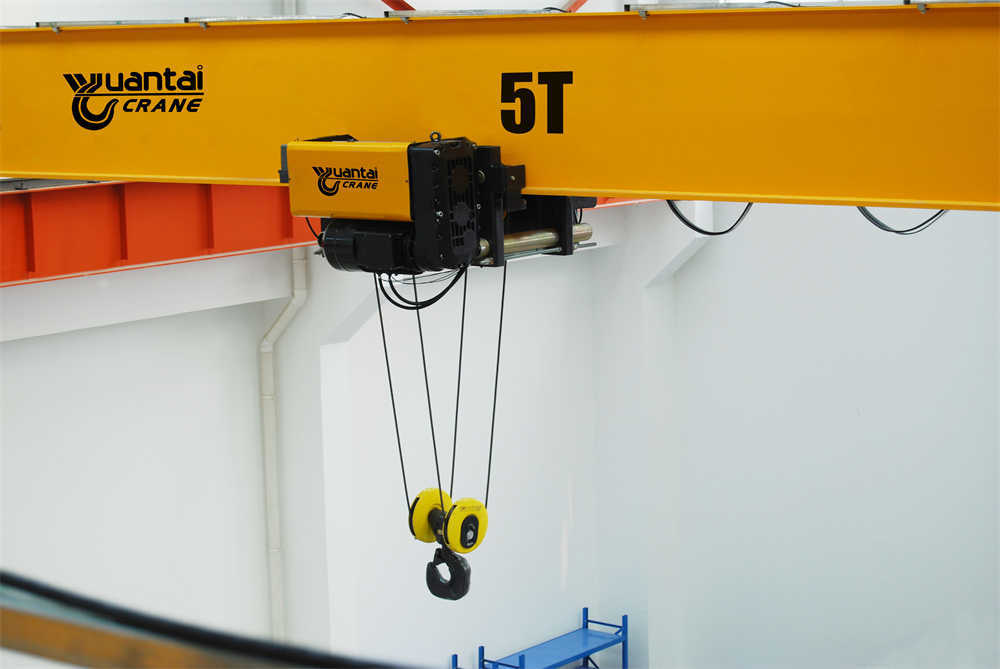
A single girder crane uses one main bridge beam spanning the width of the runway. The hoist trolley travels on the bottom flange of this single beam. This configuration is inherently lighter, uses less structural steel, and costs less to manufacture. However, it concentrates both the lifted load and the trolley’s own weight onto a single structural member.
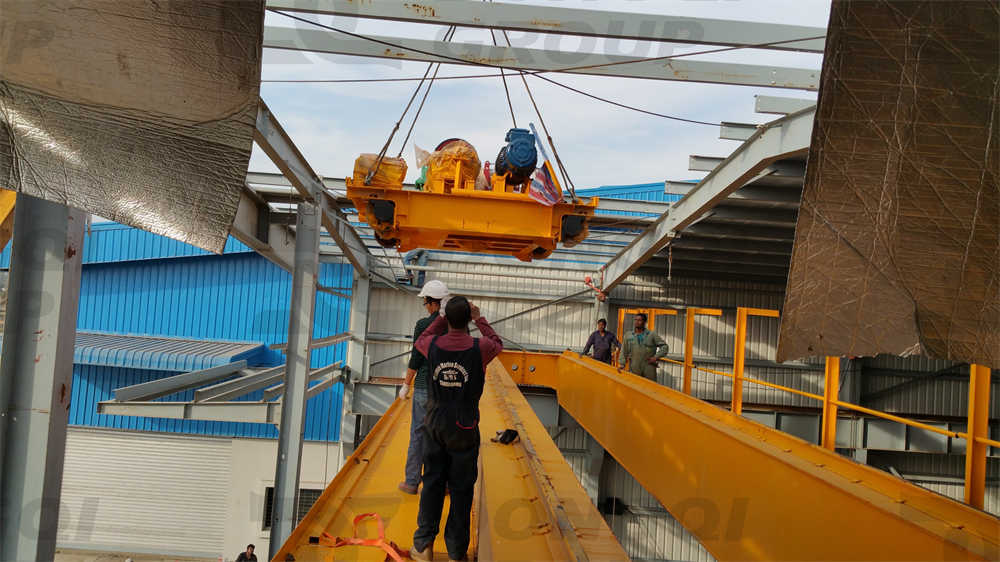
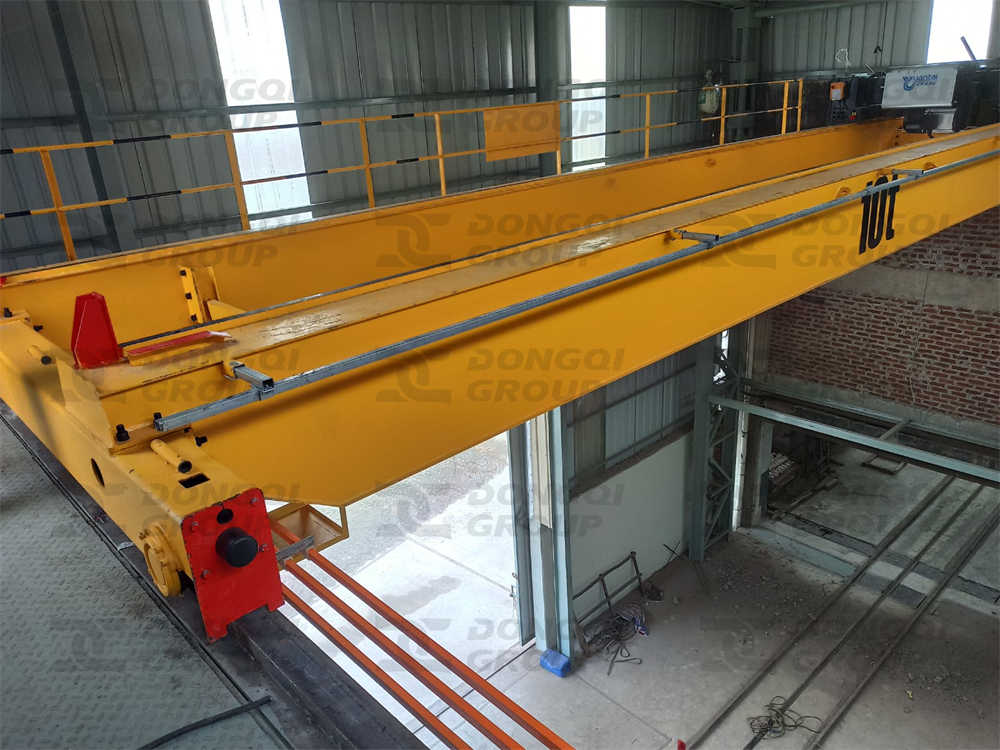
A double girder crane uses two parallel bridge beams. The hoist trolley travels on rails mounted on top of these two beams. This configuration distributes loads across two structural members, provides greater vertical clearance for the hook, and enables significantly higher lifting capacities and longer spans.
Think of it this way: A single girder crane is like a pickup truck—versatile, economical, and perfect for most daily tasks. A double girder crane is like a heavy-duty flatbed—built for the jobs that would break the pickup truck’s suspension.
Head-to-Head Comparison: Single Girder vs. Double Girder
| Selection Criteria | Single Girder Overhead Crane | Double Girder Overhead Crane |
|---|---|---|
| Typical Capacity Range | 1 ton – 20 tons (DONGQI HD Series up to 20T) | 5 tons – 500+ tons (DONGQI QDX Series) |
| Maximum Practical Span | Up to 31.5 meters | 35+ meters (customizable beyond 35m) |
| Hook Height Advantage | Hoist sits under the girder—consumes vertical clearance | Hoist sits on top of girders—recovers 300mm–600mm of lift height |
| Structural Weight | Lighter—reduces wheel loads on runway | Heavier—requires stronger runway support |
| Equipment Cost | Lower initial investment | 40%–80% higher than equivalent single girder |
| Installation Complexity | Simpler, faster installation | More complex; heavier components require larger lifting equipment |
| Maintenance Access | Hoist access from below; some components may require platforms | Full-length maintenance walkway available between girders |
| Duty Cycle Capability | Best suited for light to medium duty (M3–M5) | Designed for medium to heavy/continuous duty (M5–M8) |
| Customization Flexibility | Limited by single-girder geometry | Highly customizable—auxiliary hoists, multiple trolleys, specialized below-the-hook equipment |
When a Single Girder Crane Is the Right Choice
For the vast majority of general manufacturing, assembly, and warehousing applications, a single girder crane provides the optimal balance of performance and economy. If your operation fits the following profile, a single girder crane is almost certainly your best solution.
Ideal Applications for Single Girder Cranes
1. Light to Medium Manufacturing
- Small parts assembly lines
- Tool and die maintenance shops
- Light fabrication and welding stations
- Packaging and palletizing operations
2. Warehousing and Logistics
- Loading and unloading trucks
- Staging materials for production
- Inventory management in storage facilities
3. Workshops and Maintenance Bays
- Occasional equipment changeouts
- Pump and motor repairs
- General facility maintenance
4. Cleanroom and Precision Environments
- Electronics manufacturing
- Pharmaceutical production
- Laboratory material handling
The DONGQI CRANE Single Girder Advantage
Our HD Series Single Girder Overhead Crane is engineered for reliable, efficient operation in exactly these scenarios. Key features include:
- Capacity range: 1 ton to 20 tons
- Span capability: Up to 31.5 meters
- Hoist options: Standard CD/MD wire rope hoists or premium European-style hoists with SEW/NORD components
- Control flexibility: Pendant, radio remote, or automated PLC integration
- FEA-optimized beam design: Minimizes structural weight without compromising strength or rigidity
- Variable frequency drive (VFD) compatibility: Smooth acceleration and deceleration reduce load swing and mechanical wear
For buyers seeking European performance at competitive price points, our European-Style Single Girder Crane series offers 1–20 ton capacity with frequency conversion speed regulation, FEA-optimized lightweight beam design, and compatibility with global power standards from 220V to 690V. These cranes deliver 30–40% annual electricity savings compared to traditional fixed-speed designs.
When a Double Girder Crane Is the Right Choice
Double girder cranes excel in applications where single girder configurations reach their practical limits—whether due to capacity requirements, span length, duty cycle intensity, or specialized operational needs.
Ideal Applications for Double Girder Cranes
1. Heavy Manufacturing and Fabrication
- Steel coil handling and processing
- Heavy equipment assembly (construction machinery, agricultural equipment)
- Pressure vessel and heat exchanger fabrication
- Large component machining support
2. Steel Mills and Metal Processing
- Charging and tapping operations
- Slab and billet handling
- Roll changing and maintenance support
- Scrap charging for electric arc furnaces
3. Foundries and Casting Operations
- Mold handling and positioning
- Ladle transfer and pouring
- Shakeout and finishing operations
- Sand and raw material handling
4. Power Generation Facilities
- Turbine and generator maintenance
- Hydroelectric dam gate handling
- Transformer installation and replacement
- Nuclear fuel handling (specialized configurations)
5. Shipyards and Port Facilities
- Engine and propulsion system installation
- Hull section positioning
- Container handling (specialized gantry configurations)
- Bulk material transfer
6. Aerospace and Defense Manufacturing
- Fuselage section handling
- Wing assembly positioning
- Satellite and payload integration
- Rocket stage assembly
The Critical Advantages of Double Girder Configuration
Superior Hook Height. Because the hoist trolley rides on top of the bridge girders rather than suspended beneath them, a double girder crane recovers 300mm to 600mm (12 to 24 inches) of vertical lifting height compared to an equivalent-capacity single girder crane. In facilities with limited ceiling clearance, this difference can determine whether a crane installation is feasible at all.
Higher Duty Cycles. Double girder cranes are structurally engineered for continuous, high-frequency operation. The dual-girder design distributes cyclic loading across two beams, dramatically extending fatigue life. DONGQI CRANE’s QDX series double girder cranes are rated for FEM Class 4m/M6 and above—suitable for 24/7 operation in demanding industrial environments.
Auxiliary Hoist Capability. Double girder cranes readily accommodate a secondary auxiliary hoist on the same trolley. This configuration is invaluable for applications requiring both a high-capacity main hoist for primary loads and a lower-capacity, higher-speed auxiliary hoist for handling rigging, fixtures, or smaller components. A typical configuration pairs a 50-ton main hoist with a 10-ton auxiliary hoist.
Full-Length Maintenance Access. A walkway installed between the two bridge girders provides safe, convenient access for inspection, lubrication, and maintenance of the hoist trolley, electrical panels, and wire rope systems. This reduces maintenance downtime and improves technician safety.
The DONGQI CRANE Double Girder Portfolio
QDX Series Heavy-Duty Double Girder Overhead Crane
- Capacity: 5 tons to over 500 tons
- Span: Customizable beyond 35 meters
- Lift Height: Up to 30+ meters
- Work Duty: M5/M6/M7/M8 (ISO/FEM)
- Features: Premium SEW/NORD drives, Siemens/Schneider controls, full VFD on all motions, anti-sway technology, remote monitoring capability
QD Series Standard Double Girder Overhead Crane
- Capacity: 5 tons to 320 tons
- Span: 10.5m – 35.5m
- Lift Height: 6m – 30m
- Work Duty: M3–M6
- Features: Reliable performance for general heavy industrial applications, multiple control options, comprehensive safety systems
Specialized Double Girder Configurations
- Explosion-Proof Cranes: For petrochemical, paint, and hazardous atmosphere applications
- Metallurgical Cranes: Reinforced structures and heat shielding for molten metal handling
- Automated Cranes: PLC-controlled positioning with warehouse management system integration
- Multi-Trolley Cranes: Coordinated lifting for long or awkward loads
The Decision Framework: How to Choose Correctly
Rather than starting with a preference for “single” or “double,” start with a clear understanding of your operational requirements. The following decision framework will guide you to the appropriate configuration.
Step 1: Define Your Load Profile
| Question | If Your Answer Is… | Consider… |
|---|---|---|
| What is your maximum lift weight? | ≤ 20 tons | Single girder likely sufficient |
| 20–30 tons | Single girder possible; double girder offers advantages | |
| ≥ 30 tons | Double girder required | |
| How many lifts per day? | < 50 lifts | Single girder (light duty) |
| 50–200 lifts | Single or double (medium duty) | |
| > 200 lifts | Double girder (heavy duty) | |
| What percentage of capacity is typical load? | < 50% of rated capacity | Single girder may suffice |
| > 70% of rated capacity | Double girder recommended for longevity |
Step 2: Assess Your Building Constraints
| Measurement | Why It Matters |
|---|---|
| Available Hook Height | Subtract hoist depth from ceiling height. Double girder recovers 300–600mm of lost height. |
| Runway Capacity | Double girder cranes impose higher wheel loads. Existing runways may require reinforcement. |
| Span Length | Single girder spans up to 31.5m; double girder spans 35m+. Longer spans favor double girder. |
| Column Interference | Double girder cranes require more lateral clearance for trolley and walkway access. |
Step 3: Consider Long-Term Operational Factors
| Factor | Single Girder | Double Girder |
|---|---|---|
| Future Production Increases | Limited upgrade path | Can accommodate higher duty cycles |
| Resale Value | Lower | Higher; broader application appeal |
| Energy Efficiency | Lower absolute consumption | Higher absolute consumption but more efficient per ton lifted |
| Maintenance Access | May require temporary platforms | Permanent walkway included |
Common Misconceptions About Single vs. Double Girder Selection
Misconception #1: “Double girder cranes are always safer.”
Reality: Both single and double girder cranes from reputable manufacturers meet identical safety standards. A properly specified single girder crane with appropriate capacity margin is entirely safe for its rated application. The key is matching the crane’s design parameters to the actual duty cycle—not assuming more steel equals more safety.
Misconception #2: “If I can afford it, I should always buy double girder.”
Reality: Over-specifying a crane wastes capital that could be deployed elsewhere. A double girder crane requires a heavier runway, more powerful electrical service, and more complex installation. In a light-duty application, these are unnecessary expenses with no operational benefit.
Misconception #3: “Single girder cranes cannot handle spans over 20 meters.”
Reality: DONGQI CRANE’s HD Series single girder cranes routinely operate at spans up to 31.5 meters. The limiting factor is not the single girder configuration itself, but proper engineering of the beam section, material grade, and deflection control.
Misconception #4: “Double girder cranes are too heavy for my existing building.”
Reality: While double girder cranes are heavier, the wheel loads can often be managed by proper runway design. In some cases, a double girder crane with optimized wheel configuration may impose lower point loads than a poorly designed single girder installation. Engineering analysis—not assumption—should guide this decision.
The DONGQI CRANE Support Model: Expertise Where You Need It
Selecting between single girder and double girder configurations is an engineering decision, not just a purchasing decision. At DONGQI CRANE, we provide the technical expertise to ensure you make the right choice.
Comprehensive Pre-Sale Engineering Review
Before we quote any crane, our engineering team conducts a thorough review of your application requirements:
- Load spectrum analysis to determine correct FEM/ISO work duty classification
- Building constraint evaluation to verify hook height and clearance feasibility
- Runway assessment to confirm wheel load compatibility
- Electrical system review to ensure power supply adequacy
- Future expansion consideration to avoid near-term obsolescence
Direct Engineer Dispatch for Installation and Commissioning
DONGQI CRANE does not rely on third-party agents or local representatives with limited product knowledge. When your crane arrives at your facility, we dispatch our own factory engineers directly from our China headquarters to your site anywhere in the world. Our engineers supervise alignment, oversee commissioning, conduct load testing, and provide operator training. You receive support from the engineers who designed and built your crane—not subcontractors reading a manual for the first time.
Rapid Spare Parts Fulfillment
We maintain comprehensive parts inventory at our 240,000-square-meter manufacturing facility. Standard replacement components ship within 24–48 hours via international express courier, reaching most global destinations within 3–7 business days. For clients who prefer immediate on-site availability, we provide a recommended critical spares list at the time of purchase.
Remote Technical Support
Our engineering team provides video-assisted troubleshooting via WeChat, WhatsApp, or Zoom. Many operational questions and minor issues can be resolved remotely, minimizing downtime and avoiding unnecessary travel costs.
Case Example: The Cost of Choosing Incorrectly
A food processing facility in Southeast Asia required a crane for moving mixing vessels weighing approximately 8 tons. The procurement team, focused on capital cost, selected a single girder crane rated for 10 tons—adequate on paper.
What the specification missed: The operation required 120 lifts per day, with the crane moving continuously during two 10-hour shifts. The single girder crane was rated for M3 (light duty) intermittent use. Within 14 months, the gearbox failed, the wire rope showed accelerated wear, and the facility faced three unplanned production stoppages.
Total cost of the “cheaper” choice:
- Original single girder crane: $18,000
- Replacement gearbox and repairs: $7,500
- Production downtime (estimated): $42,000
- Replacement with double girder M6-rated crane: $34,000
Lesson: The application demanded a medium/heavy-duty crane. The 10-ton capacity was correct; the duty classification was not. A double girder crane, while more expensive initially, would have been the appropriate tool for the job.
Conclusion: Choose the Tool That Matches the Task
The decision between single girder and double girder overhead cranes should not be driven by price alone. It should be driven by a clear-eyed assessment of your operational requirements—capacity, duty cycle, span, lift height, and future production plans.
A single girder crane is the right choice when:
- Your loads are 20 tons or less
- Your duty cycle is light to moderate (under 200 lifts per day)
- Your span is under 31.5 meters
- Your budget prioritizes initial capital efficiency
A double girder crane is the right choice when:
- Your loads exceed 20–30 tons
- Your operation runs continuously or near-continuously
- You require maximum hook height in a constrained building
- You need auxiliary hoist capability or specialized configurations
- Your long-term TCO analysis justifies the higher initial investment
At DONGQI CRANE, we manufacture both configurations to the same exacting standards—ISO 9001, ISO 14001, ISO 45001, and CE certified. Our commitment is not to sell you the more expensive crane, but to help you select the right crane for your application. Because a crane that perfectly matches your operational needs will deliver reliable, safe, and efficient service for decades—and that is the truest measure of value.
Ready to determine the optimal configuration for your facility?
[Contact DONGQI CRANE’s engineering team today for a complimentary application review and custom proposal.]
DONGQI CRANE: Your Direct-from-Factory Partner for Overhead Cranes, Gantry Cranes, and Custom Lifting Solutions Since 1985.
Single Girder • Double Girder • Gantry • Jib • Workstation • Custom Solutions
ISO 9001 • ISO 14001 • ISO 45001 • CE Certified
240,000m² Manufacturing Facility • 10,000+ Annual Capacity • Exports to 96+ Countries
Direct Engineer Dispatch Worldwide • Express Spare Parts Delivery • Remote Technical Support
