
29-Apr-2026
The Lifecycle Cost Calculator: Why the “Cheapest” Crane Often Costs You the Most
Introduction: The Invoice That Keeps Billing
In 2023, a manufacturing plant manager in Southeast Asia celebrated a procurement victory. He had negotiated the purchase of three 10-ton overhead cranes for his new production hall at a price 22% below the nearest competitor’s quotation. The savings were substantial enough to draw a commendation from the corporate finance team. Three years later, the same manager sat in an emergency meeting reviewing a maintenance budget that had overshot projections by 180%, production losses from unplanned downtime that had mounted into the millions, and energy bills that stubbornly refused to align with the equipment’s rated efficiencies. The “cheapest” cranes on the market had become the most expensive machines in his facility.
This scenario is not an anomaly. Across the industrial landscape—from automotive assembly lines to steel service centers, from food processing plants to heavy machinery workshops—procurement decisions based predominantly on upfront capital expenditure repeatedly prove to be the most financially damaging strategy a company can adopt. The reason is straightforward: the initial purchase price of an overhead crane represents only a fraction of the total cost the machine will incur over its service life. Failing to account for the rest is not thrift; it is an accounting error with compounding consequences.
At Dongqi Crane, we have spent more than four decades engineering lifting solutions for clients in over 96 countries. Our engineering team has been called upon countless times to replace underperforming equipment that was selected purely on the basis of its low bid price. These experiences have led us to develop a rigorous, data-driven framework for evaluating crane investments—the Dongqi Crane Lifecycle Cost Calculator—which this article will explain, substantiate, and demonstrate through real-world case analysis.
By the end of this article, you will understand why the cheapest crane frequently becomes the costliest liability, how to quantify the true total cost of ownership, and how to build a procurement business case that satisfies both your engineers and your finance department.
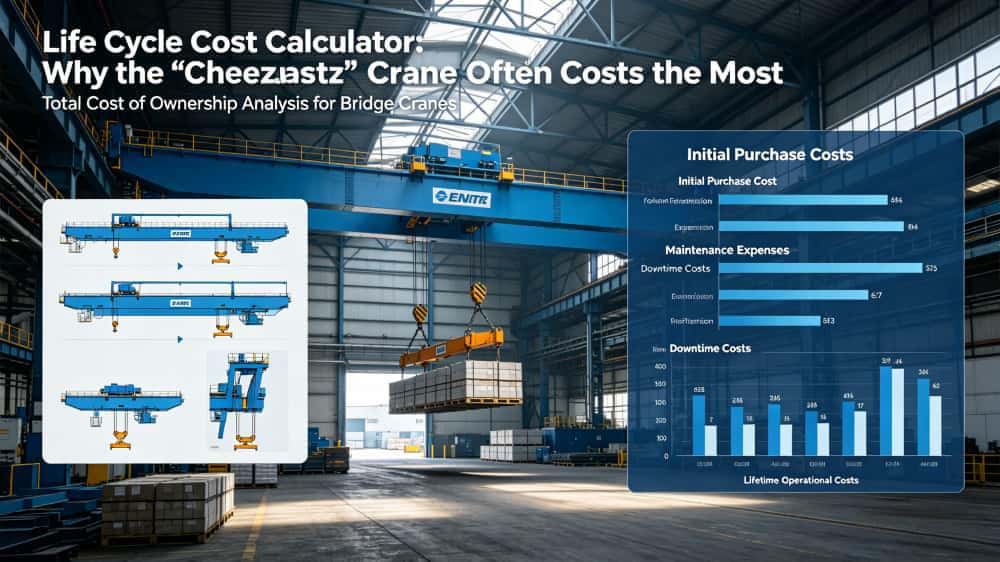
1. The CapEx Trap: When the Purchase Price Blinds You
The psychology behind low-bid selection is understandable. Capital budgets are finite. Procurement key performance indicators often emphasize purchase price variance. A quotation that comes in 15% or 20% lower than competing offers feels like an immediate, tangible win. The decision appears data-driven: after all, numbers on a spreadsheet do not lie.
The problem is that the spreadsheet only contains one number—the acquisition cost.
According to a widely cited body of industrial lifecycle research (including longitudinal studies across the material handling, pump, motor, and rotating equipment industries), the initial purchase price of a capital equipment asset typically accounts for only 10% to 25% of its total cost of ownership over a 15- to 25-year operating life. The remaining 75% to 90% is consumed by energy, maintenance, repair parts, unplanned downtime, operator labor inefficiencies, regulatory compliance, and eventual decommissioning.
For an overhead crane—a machine that integrates a steel structure, precision-machined mechanical drive trains, high-cycle electrical systems, wire ropes, sheaves, brakes, and increasingly, intelligent control electronics—this ratio skews even further toward operational expenditure. A low acquisition cost is frequently achieved by economizing on exactly those elements that determine long-term cost performance: structural weight, component quality, motor efficiency, surface protection, and design margin.
At Dongqi Crane, we encounter the consequences routinely during our after-market service engagements. We replace gearboxes in five-year-old competitor cranes that should have lasted twenty. We re-coat steel structures in coastal facilities where the original supplier specified an indoor-grade paint system for an outdoor salt-laden environment. We retrofit electrical panels where inadequate IP protection led to dust ingress and contactor failure. Each repair invoice a client pays is a deferred installment on the “savings” that were celebrated at the time of purchase.
The central lesson: procurement decisions for capital equipment must be evaluated using a lifecycle cost model, not a purchase price comparison. The Dongqi Crane Lifecycle Cost Calculator was built to make this model accessible and actionable for every purchasing decision.
2. Deconstructing Crane Lifecycle Costs: Where Your Money Really Goes
To understand total cost of ownership (TCO), we must first map every cost category that a crane imposes from the moment the purchase order is signed to the day it is dismantled and scrapped. The Dongqi Lifecycle Cost Calculator organizes these into seven distinct cost buckets.
2.1 Acquisition Cost (CapEx)
This is the obvious starting point: the price paid to the manufacturer for the crane itself, inclusive of the bridge structure, trolley, hoist, electrical control system, power supply, and any specified options. It may also include freight, import duties, and installation labor if those are bundled into the supply contract.
While this is the most visible cost, it is also the least representative of total expenditure over time. A 15% differential in acquisition cost—say, $24,000 versus $28,000 for a 5-ton single-girder overhead crane—can translate into a less than 2% differential in total 20-year TCO once operational costs are tallied. The Dongqi Lifecycle Cost Calculator automatically weights acquisition cost appropriately so that it informs, but does not dominate, the comparison.
2.2 Installation and Commissioning
Installation includes the labor, heavy lifting equipment, alignment, testing, and certification work required to bring the crane to operational readiness. Low-cost cranes can paradoxically increase installation costs if they arrive with incomplete documentation, require field modifications to fit existing runways, or lack the modular assembly features that speed up erection.
Dongqi Crane’s European-design philosophy emphasizes factory pre-assembly and modular shipping. Our single-girder European-style cranes, for example, are engineered such that the hoist and trolley can be integrated at the factory and shipped as a pre-tested unit, minimizing on-site rigging time. For export projects, this translates directly into reduced installation costs and faster project handover.
2.3 Energy Consumption: The Silent Daily Drain
An overhead crane consumes electricity every time it lifts a load, traverses the bridge, or moves the trolley. What is less obvious is that it also consumes electricity even when moving empty. A crane with an excessively heavy main girder, a heavy-duty hoist oversized for the application, or a motor running without a variable frequency drive will incur an energy penalty on every single empty-hook return trip.
Consider two 10-ton double-girder cranes operating in the same facility for 8 hours per day, 300 days per year. Crane A, a traditional design built with generous structural margins and standard-efficiency IE2 motors, has a dead weight of 18 tons and a total connected electrical load of 45 kW. Crane B, a Dongqi European-standard optimized design, weighs 13.5 tons and has a connected load of 34 kW, utilizing IE3 premium-efficiency motors and regenerative VFDs that recover braking energy. Assuming an average duty cycle factor of 40% and an industrial electricity tariff of $0.10 per kWh, the annual energy cost differential alone exceeds $2,600. Over 20 years, undiscounted, that is $52,000—more than the entire acquisition cost of many standard overhead cranes.
The Dongqi Lifecycle Cost Calculator prompts users to input their local electricity rate and estimated daily operating hours, then calculates energy cost projections for each crane configuration under comparison.
2.4 Preventive Maintenance: The Scheduled Expenditure
All cranes require periodic maintenance: lubrication, inspection, adjustment, and replacement of wear components such as brakes, wire ropes, contactors, and bearings. The frequency and cost of these interventions are directly influenced by design quality and component selection.
A crane that uses a high-grade, hardened-and-ground gearbox from a recognized manufacturer (such as SEW-Eurodrive or equivalent, which Dongqi employs in its premium product lines) will typically require gear oil changes at intervals of 5,000 to 8,000 operating hours and will not need a gearbox overhaul for 15 to 20 years under normal usage. Lower-cost gearboxes may require oil changes twice as frequently and could demand a major rebuild or replacement within 7 to 10 years.
Similarly, wire rope life is a function of the drum and sheave diameters selected, the rope design (standard versus rotation-resistant), and the quality of the steel wire itself. Dongqi engineers specify minimum D/d ratios (drum/rope diameter ratio) and sheave materials that preserve rope integrity, directly extending replacement intervals.
A realistic preventive maintenance budget for a well-designed 5-ton overhead crane operating a single shift might run $800 to $1,500 annually. For a poorly designed alternative with undersized components and difficult access for lubrication, that figure can easily double or triple. The calculator includes an annual maintenance cost estimate based on historical data from Dongqi’s global service operations.
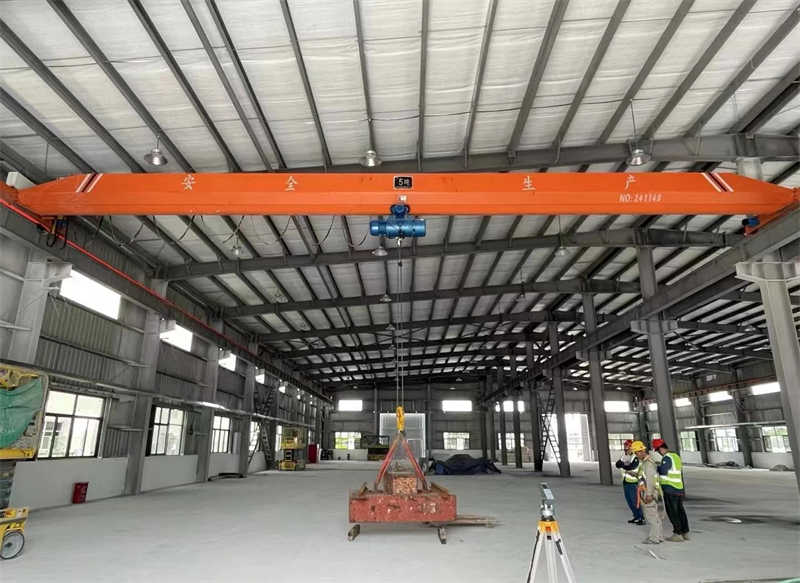
2.5 Unplanned Downtime: The Invisible Destroyer of Profitability
If energy and preventive maintenance represent the controllable, scheduled dimensions of operational cost, unplanned downtime is their chaotic, high-impact counterpart. A crane that stops production unexpectedly due to a component failure imposes costs that are frequently orders of magnitude larger than the price of the failed part itself.
Consider an automotive stamping line or a steel coil processing center. If the overhead crane serving the line fails, the entire downstream process may halt within minutes. The cost of lost production—measured in unproduced units, idle labor, expedited shipping penalties, and missed delivery commitments—can range from hundreds to tens of thousands of dollars per hour depending on the industry.
The difference between a low-cost crane and an engineered crane manifests most starkly in downtime frequency. High-quality bearings, properly sized brakes, adequately rated electrical contactors, and robust structural connections do not eliminate the possibility of failure—nothing in mechanical engineering is failure-proof—but they push the probability curve dramatically to the right, increasing mean time between failures (MTBF) by multiples.
Dongqi Crane’s intelligent crane systems now incorporate IoT-based condition monitoring modules that track motor current signatures, vibration spectra, brake wear, and operating cycles in real time. By detecting anomalies before they become breakdowns, these systems convert potential unplanned downtime events into scheduled maintenance actions. For clients using our smart crane platforms, unplanned downtime reductions of 40% to 60% have been documented—representing savings that dwarf the incremental cost of the monitoring system itself.
The Dongqi Lifecycle Cost Calculator includes a user-defined hourly downtime cost parameter, enabling clients to model the financial impact of different reliability scenarios based on their specific production economics.
2.6 Repair Parts and Consumables
Beyond routine maintenance items, every crane will eventually require replacement of major components: a hoist motor, a gearbox, wheels, or a complete trolley. The availability, cost, and lead time of these parts depend entirely on the original manufacturer’s supply chain and engineering philosophy.
A low-cost manufacturer may source components from a fragmented network of small suppliers, many of whom may not exist a decade later. The crane owner then faces the agonizing choice of reverse-engineering proprietary parts at high cost or replacing entire subassemblies because an individual component is no longer available.
Dongqi Crane operates a centralized spare parts division that maintains inventory for every crane model we have produced, with a commitment to parts availability for a minimum of 20 years from the date of delivery. Our global logistics network, serving installations on six continents, ensures that standard wear parts can be dispatched within 24 hours and major components within negotiated timeframes. The TCO calculation must account for the cost of parts unavailability; our calculator reflects this through a risk-weighted cost premium applied to configurations with poor long-term parts support.
2.7 End-of-Life Decommissioning and Residual Value
The final lifecycle stage is often neglected entirely in procurement analysis, yet it represents a genuine cash flow event. When a crane reaches the end of its economic life—whether due to age, technological obsolescence, or changing facility requirements—it must be dismantled and removed. Scrap steel value provides some recovery, but a well-maintained crane from a reputable manufacturer may retain meaningful resale value in the used equipment market.
More importantly, the timing of this end-of-life event is a critical variable. A Dongqi crane engineered with a design life of 25 to 30 years under its specified duty class may serve for three decades before replacement. A low-cost alternative might require replacement after 10 to 12 years. The capital cost of a second crane purchase decades earlier than necessary is a massive penalty that initial acquisition savings cannot compensate for. The Dongqi Lifecycle Cost Calculator incorporates expected service life and residual value assumptions to provide a complete cradle-to-grave financial picture.
3. Introducing the Dongqi Crane Lifecycle Cost Calculator
Our engineering and commercial teams collaborated to build a proprietary calculation engine that translates the seven cost buckets described above into a single, comparable net present value (NPV) figure for any crane configuration.
3.1 Input Parameters the Calculator Requires
To generate a meaningful comparison, the calculator requests the following inputs from the user:
| Parameter Group | Specific Inputs |
|---|---|
| Technical Specification | Lifting capacity, span, lifting height, duty class (FEM/ISO) |
| Operational Profile | Operating hours per day, operating days per year, average load spectrum, number of lifts per hour |
| Energy Costs | Local industrial electricity tariff (per kWh), expected annual tariff escalation rate |
| Maintenance Profile | Preventive maintenance cost estimate (or select from Dongqi’s standard cost database), expected repair parts expense |
| Downtime Cost | Estimated hourly cost of lost production if the crane is non-operational |
| Financial Parameters | Discount rate (for NPV calculation), analysis period (typically 15, 20, or 25 years), inflation rate |
| Comparison Configurations | Upfront price and key specifications of the alternatives being evaluated (Dongqi proposal and competitor bids) |
3.2 How the Calculator Works
The engine processes these inputs through a deterministic lifecycle model:
- Energy cost modeling: For each year of the analysis period, the calculator computes annual energy consumption based on the crane’s connected load, duty cycle assumptions, and motor efficiency ratings. It applies the electricity tariff and compounding escalation to generate a year-by-year energy cost stream.
- Maintenance and repair cost modeling: Annual preventive maintenance costs are escalated with inflation. Major component replacement events are triggered at predetermined intervals based on the duty class and component design life data embedded in Dongqi’s engineering database. For example, a wire rope might be scheduled for replacement every 5 years for an A5-duty crane, while a gearbox overhaul might be scheduled at year 12.
- Downtime risk modeling: The user’s hourly downtime cost is multiplied by the expected annual downtime hours for each configuration. Dongqi’s reliability data—derived from thousands of in-service cranes—provides the baseline estimates, which are adjusted based on the configuration’s component quality tier and whether smart monitoring is included.
- End-of-life terminal value: At the end of the analysis period, or at the end of the crane’s design life (whichever comes first), the calculator assigns a residual value (a percentage of initial acquisition cost) and incorporates it as a positive cash flow in the terminal year.
- Net present value aggregation: All annual cash flows are discounted back to year zero at the user-specified discount rate, summed, and compared across configurations. The output is a simple, unambiguous set of figures: the total lifecycle cost in today’s dollars for each crane option.
3.3 What the Output Looks Like
A typical output is presented as both a numerical summary and a stacked bar chart showing the proportionate contribution of each cost bucket. The visual format is designed to be immediately comprehensible to non-engineering stakeholders, including CFOs and procurement directors, making it an invaluable tool for building internal business cases.
4. Case Study: A 10-Ton Crane, Two Competing Offers, and a 20-Year Reality Check
To illustrate the power of lifecycle cost analysis, we present a representative case modeled on actual project data from Dongqi Crane’s application engineering archives. The scenario involves a general manufacturing facility in a medium-cost country requiring one 10-ton double-girder overhead crane with an 18-meter span, 9-meter lifting height, and A5 duty classification for a single-shift operation (8 hours per day, 300 days per year).
4.1 The Two Offers
Offer A – Low-Bid Competitor:
- Initial acquisition price (delivered, installed): $42,000
- Crane dead weight: 19.5 tons, traditional box girder design
- Hoist and travel motors: IE2 efficiency, contactor-based control (single-speed for hoist, dual-speed for travel)
- Gearboxes: Generic brand, oil-bath lubrication
- Corrosion protection: Standard industrial primer and topcoat (roughly ISO 12944 C3 equivalent)
- Expected service life: 12 to 15 years under A5 duty
- Warranty: 12 months on mechanical, 6 months on electrical
Offer B – Dongqi Crane Optimised Proposal:
- Initial acquisition price (delivered, installed): $51,500
- Crane dead weight: 14.8 tons, European-style optimized box girder with finite-element-analysis-verified structural efficiency
- Hoist and travel motors: IE3 premium efficiency, VFD-controlled for all motions (stepless speed regulation, load-dependent acceleration)
- Gearboxes: SEW-Eurodrive (or equivalent) hardened helical-bevel, synthetic oil fill
- Corrosion protection: ISO 12944 C4 certified, zinc-rich epoxy primer with polyurethane topcoat
- Expected service life: 25+ years under A5 duty
- Warranty: 24 months comprehensive, with optional extended service agreement
- Included features: Dongqi IoT-based condition monitoring system with real-time alerts for motor temperature, gearbox vibration, brake wear, and overload events
4.2 Lifecycle Cost Comparison Over 20 Years
The table below summarizes the undiscounted cash flows and the discounted net present value (at a 5% discount rate) for each option. All figures are in US dollars.
| Cost Category | Offer A (Low-Bid) – Undiscounted Total (20 yrs) | Offer B (Dongqi) – Undiscounted Total (20 yrs) |
|---|---|---|
| Acquisition (CapEx) | $42,000 (Note: requires replacement at Year 13 at $46,000) → Total CapEx: $88,000 | $51,500 (no replacement needed) |
| Energy Consumption | $63,400 | $39,200 |
| Preventive Maintenance | $56,000 | $28,600 |
| Unplanned Downtime (200$/hr assumed) | $72,000 (average 18 hrs/year) | $21,600 (average 5.4 hrs/year, with IoT) |
| Repair Parts / Major Overhauls | $35,000 (gearbox at Y8, motor at Y10) | $12,000 |
| Decommissioning / Residual | -$2,500 (scrap) | -$6,000 (residual value + scrap) |
| Total Undiscounted 20-Yr Cost | $311,900 | $146,900 |
| Net Present Value (NPV) @ 5% | $220,400 | $103,500 |
The NPV difference is $116,900 in favor of the initially more expensive Dongqi crane. In other words, the “cheap” crane ended up costing more than twice as much when measured over its actual service footprint. The premium paid for the Dongqi solution—$9,500 at the point of purchase—delivered a return of over 12 times in avoided downstream costs.
4.3 Sensitivity Analysis: What If Downtime Is Even More Expensive?
If the facility operates in a high-value industry—such as automotive parts manufacturing, where downtime can realistically cost $500 per hour instead of $200—the NPV difference widens to over $185,000. Conversely, even under the most generous assumptions for the low-bid crane (reducing unplanned downtime to match Dongqi levels, which is mechanically unlikely), the Dongqi crane still maintains a significant NPV advantage due to energy efficiency and reduced maintenance frequency.
The robustness of the lifecycle cost advantage is what matters most to procurement decision-makers. Dongqi’s calculator enables exactly this kind of sensitivity testing, allowing clients to adjust assumptions and verify that the conclusion holds under their own operating parameters.
5. Engineering the Difference: How Dongqi Crane Builds for Low Total Cost of Ownership
The numbers in the case study are not coincidental. They are the direct result of conscious engineering choices that Dongqi Crane has embedded into its product development philosophy over decades.
5.1 Lightweight Structural Optimization: Saving Energy Every Cycle
Our European-design overhead cranes employ structurally optimized box girders that achieve the same rated capacity and deflection limits as traditional designs with 20% to 30% less dead weight. This weight reduction cascades through the entire system: lighter bridge beams mean smaller, lighter end carriages; reduced wheel loads mean less wear on runway rails and building structures; lower inertia means smaller travel motors; and every reduction in moving mass translates directly into lower energy consumption on every single travel motion.
For clients constructing new facilities, the lighter crane also reduces the structural steel requirements for the building itself. A Dongqi crane with lower wheel loads can sometimes permit a lighter runway beam design, generating capital savings that offset a meaningful portion of the crane’s acquisition cost.
5.2 Premium Drive Train Components: Extending Maintenance Intervals
We have standardized on a global supply chain of premium mechanical and electrical components. The gearboxes in our core product ranges are sourced from European and Asian manufacturing partners who supply the world’s leading industrial automation platforms. Motors are specified at IE3 premium efficiency or higher. Brakes are selected for extended lining life. Bearings are name-brand, sealed, and pre-lubricated where possible.
These choices add modestly to manufacturing cost but generate disproportionate savings in service. A maintenance manager who only needs to inspect and re-grease bearings every 12 months instead of every 3 months is not just saving on lubricant and labor; he is freeing his team to focus on productive work elsewhere in the plant.
5.3 Smart Crane Platforms: Data-Driven Reliability
Dongqi Crane’s investment in IoT-enabled crane management systems is central to our TCO reduction strategy. Our smart platforms continuously collect data from accelerometers, temperature sensors, current transformers, and brake wear indicators mounted on critical components. Edge computing units process this data locally and flag developing anomalies—a bearing that is vibrating 15% more than its baseline, a motor drawing 8% more current at the same load, a brake that is taking slightly longer to engage—weeks before a failure would occur.
This capability directly attacks the single largest component of lifecycle cost: unplanned downtime. By converting potential emergency repairs into planned maintenance interventions, smart monitoring alone can reduce total cost of ownership by 15% to 25% in heavy-use applications, according to data compiled from Dongqi’s fleet management platform.
5.4 Corrosion Protection That Lasts
The environment in which a crane operates—steel mill, coastal port, chemical plant, food processing facility—determines the corrosion protection specification it requires. Dongqi’s standard protection system for indoor industrial environments already exceeds the basic primer-plus-topcoat applied by many competitors. For aggressive environments, we offer ISO 12944 C4 and C5-M certified coating systems, stainless steel fasteners, and sealed electrical enclosures up to IP65 or IP66.
A crane that rusts prematurely incurs not only the direct cost of re-coating but also the indirect cost of compromised structural integrity and degraded appearance. Our lifecycle cost calculator captures corrosion protection as a factor that influences both maintenance costs and asset longevity.
5.5 Global Service Infrastructure: Reducing Parts Wait Time
All the design excellence in the world is of limited value if a failed component cannot be replaced quickly. Dongqi Crane’s service network, built to support our installed base across 96 countries, includes regional spare parts warehouses, mobile service teams, and remote diagnostic capabilities. The lifecycle cost impact of fast parts availability is captured in our calculator’s downtime modeling: the shorter the mean time to repair (MTTR), the lower the unplanned downtime cost.
6. The Procurement Mindset Shift: From Price to Value
Implementing lifecycle cost analysis in procurement practice requires more than a calculator. It requires an organizational commitment to evaluate capital equipment as long-term investments rather than short-term expenses. This shift is not always easy; many procurement departments are measured on purchase price variance, and moving to a TCO framework demands alignment across engineering, operations, finance, and procurement functions.
We recommend that procurement professionals take the following steps when preparing a crane purchasing business case:
- Document your operational cost baselines. Before soliciting quotations, gather data on your current (or comparable) crane’s energy consumption, annual maintenance spend, and any downtime incidents and their associated production losses. These numbers form the empirical foundation of your lifecycle cost model.
- Request lifecycle cost data from bidders. Require that all crane suppliers provide, alongside their commercial quotation, the following information: rated energy consumption at specified duty cycles, recommended preventive maintenance schedule and estimated annual cost, design life under the specified duty class, standard warranty terms, and availability commitment for spare parts.
- Use Dongqi’s Lifecycle Cost Calculator—or equivalent—for apples-to-apples comparison. Plug the supplier-provided data into a consistent analytical framework. Our calculator is available to all clients at no cost as part of our quotation support service; we are confident enough in our engineering that we welcome head-to-head comparisons.
- Present the decision in financial language. When you take a TCO-based recommendation to senior management, frame it in terms of return on investment, net present value, and payback period. “This crane costs $9,500 more upfront but saves $117,000 in net present value over 20 years” is a far more powerful statement than “our engineers prefer the more expensive option.”
- Negotiate based on lifecycle guarantees. Dongqi Crane is open to performance-based contracting models where specific lifecycle cost metrics—such as maximum annual energy consumption, maximum unscheduled downtime hours, or guaranteed spare parts response times—are written into the supply agreement with financial remedies if they are not met. Such arrangements align the manufacturer’s incentives with the client’s long-term interests and provide additional procurement confidence.
Conclusion: A Call to Calculated Precision
The industrial crane market in 2026 is more sophisticated than it has ever been, yet the simple, seductive appeal of the lowest purchase price continues to drive procurement decisions that prove financially destructive over time. A crane is not a commodity; it is a custom-engineered capital asset that will operate at the heart of your facility’s material flow for decades. Evaluating it on upfront price alone is like choosing a spouse based solely on the cost of the wedding.
The Dongqi Crane Lifecycle Cost Calculator was created to give procurement professionals, plant engineers, and financial decision-makers the tool they need to make genuinely informed choices. It quantifies what experienced maintenance managers have known intuitively for years: that the cheapest crane on the market almost always becomes the most expensive crane in the plant.
We invite you to test this assertion. Contact Dongqi Crane’s application engineering team with your next crane requirement. Submit the specifications, request a quotation, and ask us to run a lifecycle cost comparison against any competing offer you have received. We will provide you with a detailed, transparent analysis showing exactly how the total cost of ownership breaks down over 15, 20, or 25 years. If our crane costs more upfront, we will explain exactly where that money goes—into premium components, smarter controls, better protection, and longer design life—and exactly how it returns to your bottom line over the life of the asset.
Because in material handling, the smartest procurement decision is not the one that minimizes today’s capital expenditure. It is the one that maximizes the net present value of decades of reliable, efficient, safe operation.
Dongqi Crane: Engineering Lifting Solutions for the Long Term.
For more information about Dongqi Crane’s Lifecycle Cost Calculator, to schedule a demonstration, or to request a comparative TCO analysis for your upcoming crane project, please contact our global sales and engineering support team.
Henan Dongqi Machinery Co., Ltd. is a Sino-New Zealand joint venture headquartered in China’s “Cradle of Cranes,” with a 240,000-square-meter manufacturing facility, an annual production capacity exceeding 10,000 crane units, and a service footprint spanning over 96 countries. Our products are CE, ISO 9001, ISO 45001, ISO 14001, and ISO 50001 certified.
