
9-May-2026
Crane Selection Pitfall-Proof Guide: How to Precisely Match Equipment to Your Building’s Load-Bearing Structure
By Dongqi Crane Engineering Team | May 2026 | 15 min read
Introduction: The Silent Crisis in Industrial Procurement
Every year, industrial facilities around the world invest millions of dollars in overhead crane systems. Yet a startling number of these investments underperform—not because the crane itself is defective, but because of a fundamental disconnect between the equipment and the building that houses it. Procurement teams meticulously compare lifting capacities, spans, and hoist speeds, while overlooking the single most consequential variable in crane performance: the structural compatibility between the crane and the factory building.
At Dongqi Crane, we have witnessed this pattern repeatedly across thousands of installations in 96 countries. A steel mill in Lahore orders a 20-ton double-girder crane, only to discover during installation that the existing runway beams deflect beyond permissible limits under full load. A precision manufacturing plant in Indonesia purchases high-speed European-standard hoists, then finds that building vibration transmitted through insufficiently stiff support columns makes millimeter-level positioning impossible. A warehouse operator in Qatar selects an economical traditional crane, unaware that the heavier wheel loads will require costly foundation reinforcement that erases all upfront savings.
These are not hypothetical scenarios. They represent actual project challenges that our engineering team has been called upon to resolve—often at costs far exceeding what a proper structural assessment would have entailed at the outset.
This guide is written for procurement professionals, plant managers, and project engineers who want to get crane selection right the first time. It explains the critical relationship between crane design and building structure, identifies the most common and costly mistakes, and provides a structured methodology for ensuring that your crane investment delivers on its performance promise for the full 15 to 25 years of its designed service life.
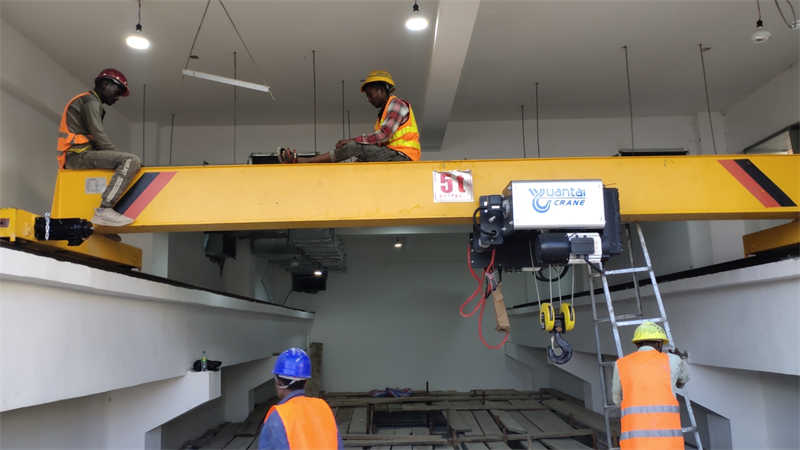
Who We Are: Dongqi Crane is a Sino-New Zealand joint venture headquartered in Henan Province, China—the renowned “Cradleland of Cranes.” With a 240,000-square-meter manufacturing facility, over 3,600 employees including 500 technicians and more than 70 senior engineers, and an annual production capacity exceeding 10,000 crane sets, we bring European design philosophy and rigorous quality standards to every project we undertake. Our cranes operate in steel mills, automotive assembly lines, petrochemical plants, ports, power stations, and specialized environments including nuclear facilities and cleanrooms.
Part 1: Why Building Structure Is the Foundation of Crane Performance
1.1 The Crane-Building System: An Interdependent Relationship
An overhead crane is not a standalone machine. It is one half of a load-bearing system, with the building structure serving as the other half. The crane generates forces—vertical, lateral, and longitudinal—that travel through the wheels into the runway beams, then through the runway beams into the support columns, and finally through the columns into the building foundation. Every component in this chain must be capable of handling the loads imposed upon it, or the entire system is compromised.
Design loads for runway beams must include the maximum wheel loads of the crane as well as vertical impact, lateral, and longitudinal forces induced by the moving crane. These forces are not static; they vary with acceleration, braking, load swing, and operational patterns.
The consequences of structural mismatch manifest in several ways:
- Excessive Deflection: When runway beams deflect beyond design limits under load, the crane experiences rail misalignment. This causes accelerated wheel and rail wear, increased rolling resistance, and in severe cases, the crane may “stick” or resist smooth travel.
- Structural Fatigue: A building structure that is marginally adequate for static loads may be entirely inadequate for the cyclic, dynamic loads that a crane imposes over years of operation. Fatigue cracks can develop in runway beams, connection brackets, and column bases—often invisible until a catastrophic failure occurs.
- Operational Degradation: Even when structural failure does not occur, excessive deflection degrades crane performance. Positioning accuracy suffers. Load swing increases. Operators compensate by reducing speed, which reduces throughput. The crane never delivers its designed productivity.
- Premature Component Wear: Misaligned runways cause uneven wheel loading. This accelerates wear on wheel treads, bearings, and gearboxes. A crane that should run smoothly for 15 years may require major component replacement within 5—not because of any defect in the crane, but because of structural issues in the building.
1.2 The Most Common Structural Oversight: Duty Cycle and Deflection
One of the most consequential misunderstandings in crane procurement is the assumption that a building “designed for a crane” is automatically adequate for any crane of the specified capacity. In reality, two different 10-ton cranes can impose dramatically different demands on the same building structure.
Most international standards, including FEM, EN, ISO, and AISC, recommend vertical runway beam deflection limits ranging from L/600 to L/1000, depending on crane duty class, span length, structural stiffness, and required positioning accuracy. CMAA standards further specify that for top-running cranes with classifications E or F (heavy and severe duty), vertical deflection of runway beams with 100 percent of maximum wheel loads without impact shall not exceed L/1000 of the runway beam span.
For under-running cranes, the deflection limit is typically L/450—a less stringent standard that reflects the different structural dynamics of underslung configurations.
What this means in practice: a building with runway beams sized for a light-duty, infrequently used traditional crane may deflect excessively under a high-speed, high-frequency European-standard crane, even if both are rated for the same lifting capacity. The European crane’s lighter self-weight is an advantage, but its higher operating speeds and more frequent usage generate different fatigue loading patterns that must be accounted for in the structural design.
Part 2: Assessing Your Building—The Pre-Purchase Structural Checklist
Before specifying a crane, procurement teams should gather comprehensive data about the existing or planned building structure. For new construction, this data informs the building design. For crane installations in existing buildings, this data determines whether the building can accommodate the desired crane—or what modifications are required.
2.1 Column Spacing and Runway Beam Span
The distance between building columns determines the maximum unsupported span of the runway beams. Longer spans require deeper, heavier runway beams to maintain acceptable deflection limits. This is a key cost variable that is often overlooked in initial budgeting.
When column spacing exceeds 8 to 10 meters, runway beam size and cost increase substantially. In existing buildings, column spacing is fixed; the crane supplier must work within this constraint. In new construction, there is an opportunity to optimize column spacing for both building cost and crane performance.
Dongqi Crane’s Approach: During the inquiry phase, our engineering team requests detailed building drawings including column grid layouts, column section properties, and foundation details. We model the full crane-building interaction using finite element analysis to verify structural adequacy before any equipment is specified.
2.2 Roof Truss Load-Bearing Capacity for Suspended Cranes
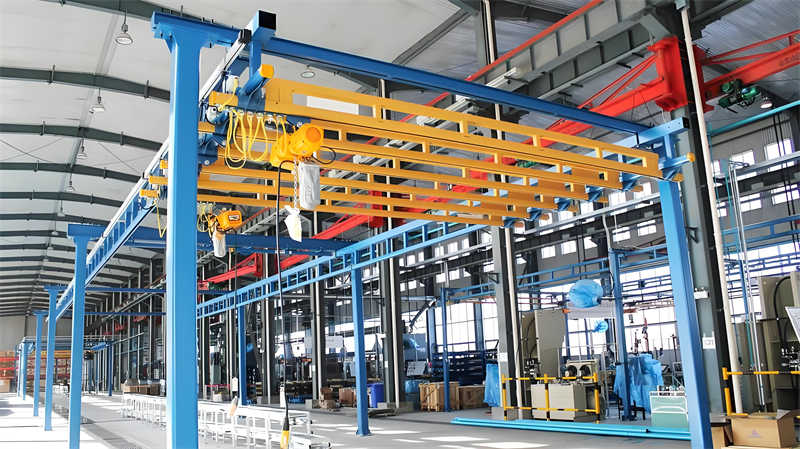
For under-running (suspended) cranes and KBK flexible track systems, the crane is supported directly by the roof structure rather than by dedicated runway beams on columns. This configuration requires careful assessment of the roof truss or beam capacity to support both the dead load of the crane system and the dynamic loads of operation.
KBK crane systems, for example, are suspended from the roof structure and occupy zero floor space—a major advantage in space-constrained facilities. However, every suspension point must be verified for load-bearing adequacy. A standard roof truss designed for snow load and roof cladding weight may not have capacity for the additional concentrated loads from a crane system.
Key Questions to Ask:
- What is the design load capacity of each roof truss or beam at potential suspension points?
- Are there existing suspension points, or will new connections need to be engineered?
- Can the roof structure accommodate the horizontal forces generated during acceleration and braking?
- For multi-span KBK systems, can intermediate support columns be added if roof capacity is insufficient?
2.3 Foundation and Ground Conditions
All crane loads ultimately travel to the ground through the building foundation. Column foundations must resist not only the vertical dead and live loads but also the overturning moments generated by crane operation. Inadequate foundations can lead to differential settlement, column tilting, and progressive runway misalignment over time.
For gantry cranes running on floor-level rails, the ground-bearing capacity of the floor slab and subgrade is critical. Gantry crane rail foundations require proper design to prevent settlement, which causes rail misalignment and operational problems.
2.4 Building Height and Headroom
Available headroom—the vertical distance between the floor and the lowest roof obstruction—determines the maximum lifting height achievable with any crane configuration. This is where European-standard cranes offer a distinct advantage: their low-headroom design minimizes the distance between the hook and the runway beam, maximizing usable lifting height within a given building envelope.
Traditional cranes typically require more vertical clearance because the hoist hangs lower relative to the bridge girder. In renovation projects where building height is fixed, this difference can determine whether a crane can be installed without expensive roof modifications. The compact structure of European cranes sits tight against the main beam, maximizing effective lifting height.
Part 3: Crane Design Philosophy and Its Structural Implications
3.1 European Standard (FEM/DIN) vs. Traditional Cranes: Structural Impact
The choice between European-standard and traditional crane design is not merely a matter of equipment preference—it directly affects the structural demands placed on the building.
European standard overhead cranes, designed to FEM and DIN standards, embody three core principles that reduce structural impact: lightweight design through finite element analysis optimization, modular construction that improves serviceability, and high-performance variable frequency drive technology for smooth operation.
The practical implications for building structure are significant:
Lower Wheel Loads: European cranes typically achieve 30-50% weight reduction compared to traditional designs of equivalent capacity. This translates directly to lower wheel loads on the runway beams and reduced stress on building columns and foundations. For a 10-ton crane, the lighter structure can mean the difference between using existing runway beams and requiring expensive reinforcement.
Energy Efficiency: European overhead cranes are 25-40% more energy-efficient than traditional bridge cranes during normal operation, due to optimized motor sizing and standard variable frequency drives. This reduced energy consumption is not just an operational cost benefit—it also means lower heat generation and less thermal stress on building electrical systems.
Reduced Dynamic Impact: Variable frequency drives provide smooth acceleration and deceleration, eliminating the jerky starts and stops that characterize traditional contactor-controlled cranes. This reduces impact loading on the building structure, which is particularly important for fatigue life.
Traditional cranes follow a different design philosophy. They emphasize robust structures with ample safety factors, which is appropriate for some applications but results in heavier self-weight and higher wheel loads. A traditional crane may weigh 1.5 times or more than a European equivalent, imposing proportionally greater demands on the building structure.
3.2 The Initial Cost vs. Total Structural Cost Equation
A narrow focus on equipment purchase price often leads to suboptimal decisions. While a traditional 10-ton overhead crane may cost $32,500–$47,500 compared to $42,500–$60,000 for a European design, the total project cost picture tells a different story.
When runway beams, installation, and building modifications are included, the total investment for a European system can be comparable or even lower:
- European crane runway beams: $22,500–$32,500
- Traditional crane runway beams: $30,000–$42,500
The lower wheel pressure of European cranes often eliminates the need for structural reinforcement, offsetting the equipment price premium. In many cases, the total installed project cost difference narrows to as little as 3-7%.
Furthermore, European low-headroom designs can save $40–$80 per square foot in building height costs for new construction—savings that dwarf the equipment cost difference.
Dongqi Crane’s Guidance: We recommend that procurement teams evaluate crane options on a total-installed-cost basis, including all structural implications. Our engineering team provides comparative analyses showing the full structural and cost implications of different crane design approaches for each project.
Part 4: Matching Crane Type to Building Configuration
4.1 Top-Running Overhead Cranes: The Standard Solution
Top-running overhead cranes travel on rails mounted atop runway beams supported by building columns. This configuration is the most common for medium to heavy industrial applications and provides the highest lifting capacities—up to 500 tons or more in Dongqi Crane’s product range.
Structural Requirements:
- Adequate column spacing and runway beam depth to maintain deflection within limits
- Column foundations designed for combined vertical and horizontal loads
- Sufficient building height for the crane bridge, hoist, and lifted load
- Bracing to resist longitudinal forces from crane travel
Best Applications: Steel mills, heavy machinery manufacturing, large assembly halls, warehouses with high-bay storage.
4.2 Under-Running (Suspended) Cranes: Space-Efficient Solutions
Under-running cranes travel on the bottom flange of runway beams suspended from the roof structure. They offer several advantages: lighter runway beam requirements (since beams are supported from above rather than cantilevered from columns), the ability to serve areas beyond the column line, and compatibility with buildings where column-mounted runways are impractical.
However, the suspended configuration limits lifting capacity compared to top-running designs, and the roof structure must have adequate capacity at every suspension point.
4.3 KBK Flexible Track Systems: Maximum Adaptability
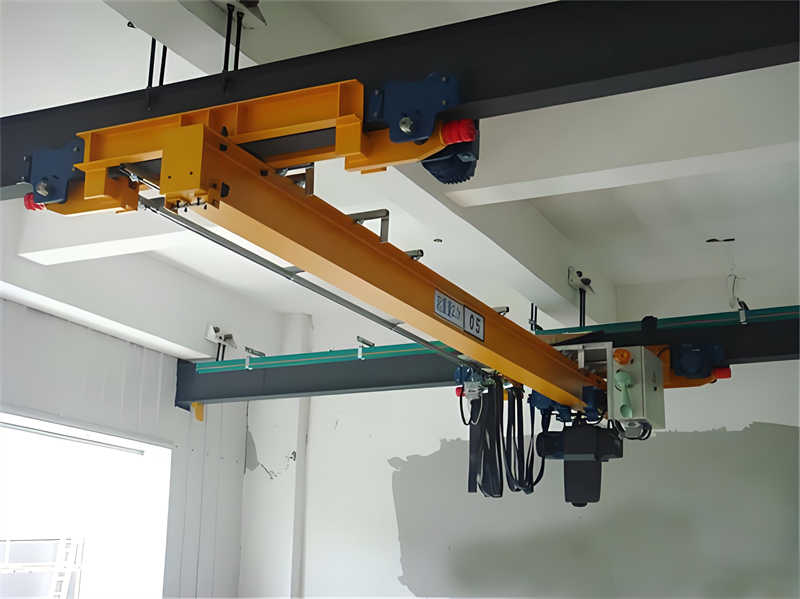
KBK flexible crane systems represent a fundamentally different approach to material handling. These modular systems use standardized track sections, suspension components, trolleys, and hoists that can be configured into monorail, single-girder, or double-girder arrangements with straight, curved, or branching track layouts.
The defining advantage of KBK systems for building compatibility is their suspended installation method. Track is fixed to roof steel beams or concrete structures, occupying zero floor space. This makes KBK systems ideal for:
- Existing buildings where column-mounted runway beams are impractical
- Facilities with limited floor space
- Operations requiring material transfer between multiple workstations
- Applications where the handling pattern may change over time
Critically, KBK systems can often be installed without major structural modifications to the building. A KBK retrofit project in an existing machine shop increased space utilization by 45% by moving material handling to the ceiling level, freeing floor space for two additional production lines.
Dongqi Crane’s KBK Capability: We design and supply complete KBK systems with capacities from 80 kg to 3,200 kg, including all track components, trolleys, hoists, controls, and safety devices. Our engineering team evaluates your building structure and designs the suspension system to match.
4.4 Free-Standing vs. Building-Tied Runway Structures
In some situations, the existing building structure is simply incapable of supporting the required crane loads. The alternatives are structural reinforcement, which may be costly and disruptive, or a free-standing runway structure.
Free-standing runway structures are independent steel frameworks that support the crane runway beams without relying on the building structure. They require considerably more steel than building-tied designs but offer complete independence from building structural limitations.
Semi-free-standing configurations offer a middle ground, using the building for lateral stability while carrying vertical loads independently. This approach can reduce the steel requirement while still accommodating buildings with limited vertical load capacity.
Dongqi Crane’s Guidance: When evaluating options, we consider both the immediate structural feasibility and the long-term implications. A free-standing structure may cost more initially but eliminates dependency on the building, which may have unknown load history or future modifications that could affect crane operation.
Part 5: Total Cost of Ownership Through a Structural Lens
5.1 The TCO Framework for Crane Procurement
Total Cost of Ownership (TCO) provides a comprehensive assessment of all costs associated with owning and operating a crane—not just the upfront purchase price but also operational, maintenance, and end-of-life expenses. For a typical 10-ton overhead crane operating at 60% duty cycle in a manufacturing plant, the 10-year lifecycle cost can reach $200,000 to $500,000.
What is frequently overlooked is how many TCO elements are influenced by the crane-building structural relationship:
Energy Costs: A crane running on misaligned runways requires more energy to overcome increased rolling resistance. European-style cranes with lightweight design and efficient drives already consume 25-40% less energy than traditional equivalents; that advantage is eroded if structural problems force the motors to work harder.
Maintenance Costs: Structural issues accelerate wear on crane components. Wheel flanges, bearings, gearboxes, and rail systems all deteriorate faster when the runway is not within tolerance. Our operational data shows that facilities investing in properly engineered structural interfaces achieve 40% lower post-commissioning repair costs.
Downtime Costs: Production losses from unplanned crane downtime can exceed the original equipment cost within a few years. Many of these downtime events trace back to structural root causes—a cracked runway beam weld, a settled column foundation, or rail that has crept out of alignment.
Building Modification Costs: These costs are often treated as separate from the crane budget but should be considered part of the total investment. A crane that can be installed with minimal structural modification delivers a lower total project cost, even if the equipment price is higher.
5.2 The Long-Term Economics: Dongqi Crane’s Engineering Approach
Dongqi Crane’s engineering philosophy treats initial configuration as the most powerful lever for controlling lifetime costs. Our European Standard cranes employ S355JR or S420ML high-tensile steel with yield strengths of 355-420 MPa, achieving 25-30% weight reduction without sacrificing structural integrity while extending structural fatigue life by 40-50%.
This material upgrade, combined with precision manufacturing and strict quality control, delivers deflection control under load at ≤L/1000 compared to the industry standard of L/800. The result is a crane that runs smoothly on lighter runway structures, imposes less fatigue loading on the building, and maintains alignment and performance over decades of operation.
When viewed through a lifecycle lens, the initial procurement decision has compounding effects. A properly matched crane and building system accumulates lower energy costs, reduced maintenance expenditure, less downtime, and longer component life—differences that may total hundreds of thousands of dollars over a 20-year service life.
Part 6: How Dongqi Crane’s Engineering Support Makes the Difference
6.1 Comprehensive Pre-Purchase Structural Assessment
At Dongqi Crane, we do not simply take an order and ship equipment. For every project, our engineering team conducts a thorough assessment of the building structure and operating environment before finalizing the crane specification.
This assessment includes:
- Review of building structural drawings, including column layouts, foundation details, and roof structure design
- Calculation of runway beam adequacy for the proposed crane’s wheel loads, operating speeds, and duty classification
- Finite element analysis of critical structural interfaces
- Evaluation of foundation capacity for combined loading conditions
- Recommendations for structural modifications or alternative crane configurations where needed
This engineering support is provided at no cost during the inquiry and quotation phase. We believe it is in both our interest and our client’s interest to get the specification right before any commitment is made.
6.2 Factory Verification: The Dongqi Crane Inspection Experience
We actively encourage prospective clients to visit our 240,000-square-meter manufacturing facility in Changyuan, Henan Province—China’s renowned “Cradleland of Cranes”. A factory visit allows procurement teams to verify our manufacturing capabilities, quality control processes, and testing procedures firsthand.
During a factory inspection, buyers can observe:
- Our state-of-the-art manufacturing equipment, including four-gun air protection portal-shaped welding machines, impeller blasting descaling equipment, digital control plant drills, and automated spray-paint lines
- Our quality control processes, which penetrate every stage from design through manufacturing to testing
- Load testing of completed cranes at 125% of rated capacity (static) and 110% of rated capacity (dynamic)
- Our ISO 9001, ISO 14001, ISO 45001, and CE certification documentation
Every Dongqi crane undergoes factory assembly and testing before disassembly for shipment. Load testing is performed to verify structural integrity, mechanism function, and control system operation under full-load conditions.
6.3 Global Service and Support Infrastructure
A crane is a long-term investment, and ongoing support is essential to maintaining performance and safety. Dongqi Crane has established overseas offices and service networks to provide responsive support to international clients.
In Pakistan, we have set up a dedicated overseas office to provide convenient service and cost-effective crane equipment to the Pakistani market. Our products have been exported to 96 countries worldwide.
Once you choose Dongqi lifting equipment, you will have over 3,600 people at your service, including 500 technicians and over 70 senior engineers, plus a dedicated overseas team of 36 professionals providing services in English, Arabic, Spanish, Russian, Korean, and other languages.
Part 7: Case Studies—Lessons from Real Projects
7.1 Pakistan Steel Plant: Adapting to a Constrained Building
In July 2025, Dongqi Crane delivered four sets of 5-ton European standard double-girder overhead crane kits to a steel processing plant in Lahore, Pakistan. The client’s existing building presented significant challenges: low ceiling clearance and limited installation space that ruled out a standard full-crane delivery.
The Solution: Dongqi Crane supplied complete crane kits without main beams—the client fabricated the main beams locally to our engineering drawings. Our kits included FEM-standard double girder hoist trolleys, end carriages with drive mechanisms, advanced control systems, and all electrical components. The European low-headroom design maximized lifting height within the constrained building envelope.
The Result: The client achieved a fully functional crane system that fit precisely within their building constraints, with shipping costs reduced by 30-50% by eliminating the main beam from international freight. Dongqi provided all fabrication drawings, electrical diagrams, installation manuals, and remote commissioning support.
7.2 Papua New Guinea: European Crane Retrofit for Heavy Steel Handling
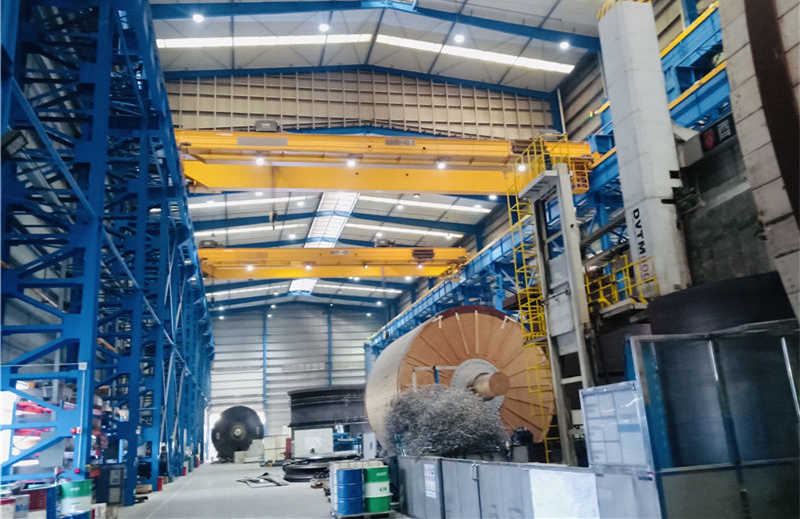
A metal processing factory in Papua New Guinea faced the challenge of safely handling heavy steel coils in an existing building. In 2025, they turned to Dongqi Crane for a solution.
The Challenge: The factory needed to handle heavy loads but operated in an existing building with structural limitations. A traditional heavy crane would have required costly building reinforcement.
The Solution: Dongqi Crane supplied a 10-ton European-style overhead crane with lightweight design that reduced wheel loads while maintaining full lifting capacity. The compact, low-headroom configuration required no building modifications, preserving the existing structure while delivering the needed lifting performance.
7.3 Indonesia Waste-to-Fuel Plant: Customized Integration with Local Fabrication
An innovative waste processing plant in Indonesia required specialized crane systems for handling municipal and industrial waste in a demanding, corrosive environment. The client wanted to combine Dongqi’s precision-engineered components with locally fabricated main girders to optimize costs.
The Solution: Dongqi Crane engineered and supplied complete component packages for six bridge cranes—three QZ grab bridge cranes (6.3-ton, 24-meter span, 17-meter lifting height) and three HD European-style single girder cranes (7.5-ton, 24-meter span, 12.5-meter lifting height). All components were designed for seamless integration with locally manufactured main girders operating on 400V/50Hz/3-phase power.
Why This Matters for Building Compatibility: This project demonstrates Dongqi Crane’s ability to adapt our solutions to the specific structural and logistical requirements of each project. The client received European-quality drive systems, controls, and safety devices while leveraging local fabrication for the large structural components. The building interface was engineered from both sides to ensure proper fit and performance.
Part 8: Future-Proofing Your Crane Investment
8.1 Designing for Tomorrow’s Needs, Not Just Today’s
One of the most common mistakes in crane specification is designing for current requirements without considering future needs. Facilities evolve—production volumes increase, new product lines are introduced, and handling patterns change. A crane designed only for today’s loads and duty cycles can quickly become a bottleneck.
Dongqi Crane’s Recommendations for Future-Proofing:
- Specify a crane with a duty classification at least one level above current requirements to accommodate future production increases.
- Consider building structure capacity for potential future upgrades—it is far less expensive to install slightly heavier runway beams during initial construction than to reinforce them later.
- Select control systems with upgrade paths for automation, remote monitoring, and integration with plant management systems.
8.2 Intelligent Technology and Predictive Maintenance
The crane industry is entering an era of data-driven operation. In 2026, smart crane technology is transitioning from optional to standard, with systems integrating real-time load monitoring, predictive maintenance alerts, duty-cycle analytics, and overload prevention sensors.
These technologies are particularly relevant to the crane-building interface. Sensors monitoring structural deflection, vibration, and alignment can detect developing problems before they cause operational disruptions or safety incidents. By shifting from reactive to proactive maintenance, plants reduce downtime and extend equipment life—often significantly.
Dongqi Crane is integrating intelligent monitoring capabilities into our crane systems, enabling our clients to track the health of both their crane and the supporting structure over time. This data-driven approach transforms maintenance from a calendar-based activity to a condition-based strategy, reducing costs while improving safety and reliability.
8.3 Sustainability and Energy Efficiency
As manufacturers worldwide pursue sustainability goals, crane energy efficiency is receiving increased attention. European-style cranes with lightweight design, regenerative drives, and high-efficiency motors consume significantly less energy than traditional alternatives.
The sustainability impact extends to the building structure as well. Lighter cranes require less structural steel in runway beams and columns—reducing the embodied carbon of the total installation. European designs allow building heights to be reduced by 20-40%, directly saving construction materials and long-term heating/cooling energy.
For clients evaluating crane investments with an eye toward environmental performance and regulatory compliance, Dongqi Crane’s European-standard product line offers measurable sustainability advantages over traditional alternatives.
Conclusion: A Partnership Approach to Getting It Right
Crane selection is not a transaction—it is the beginning of a relationship that will span decades. The decisions made during specification and procurement echo through years of operation, affecting safety, productivity, maintenance costs, and capital efficiency.
At Dongqi Crane, we approach every project as a partnership. Our engineering team works alongside your project team from the earliest stages, ensuring that the crane and the building are designed as an integrated system rather than two independent components that meet for the first time during installation.
Take the Next Step:
If you are planning a crane procurement or evaluating options for your facility, we invite you to engage our engineering team for a complimentary structural assessment and crane recommendation.
Contact Dongqi Crane today:
- Website: pk.craneyt.com
- Email: sales010@cranesdq.com
- Factory Visit: Schedule a visit to our 240,000-square-meter manufacturing facility in Changyuan, Henan Province, China
- Response Time: Customized proposal and consultation within 24 hours
With Dongqi Crane, you gain more than lifting equipment—you gain a partner committed to the long-term success of your material handling operations. Our products are backed by ISO 9001, ISO 14001, ISO 45001, and CE certifications, with documentation available for client review.
© 2026 Dongqi Crane. All rights reserved. This guide is provided for general informational purposes. Specific structural assessments should be performed by qualified engineers for each individual project.
