
19-May-2026
The 2-Ton Gantry Crane Revolution in Small Machine Shops: A Case Study Breakdown of 300% Daily Handling Improvement
Introduction: The Hidden Cost of Lifting by Hand
Visit any small machine shop on a busy weekday morning, and you will likely witness the same scene: two or three workers clustered around a milling machine, straining to lift a 200-kilogram workpiece onto the table. A forklift idles nearby, waiting for an operator who is already occupied elsewhere. A partially completed job sits on a pallet, delayed because the manual handling team is tied up on another task. The shop owner watches the clock, calculating the cost of every minute the spindle is not turning.
This scene plays out thousands of times daily across small manufacturing facilities worldwide. According to our internal analysis, small machine shops—those with fewer than 20 employees and annual revenues between $500,000 and $3 million—spend anywhere from 15% to 35% of total labor hours on material handling. This is time when machines are idle, parts are waiting, and billable work is not getting done. It is not the cost of the crane that kills small shop profitability—it is the cost of not having one.
Over the past five years, Dongqi Crane has supplied hundreds of 2-ton gantry cranes to small machine shops, fabrication workshops, and maintenance facilities across 96 countries. The operational data we have collected reveals a consistent pattern: when a small shop transitions from manual handling or forklift-only material movement to a properly configured 2-ton gantry crane system, daily material throughput improves by 200–400%. The 300% figure is not a marketing claim—it is the documented median across our customer base.
This article uses that data—combined with real case studies and detailed operational analysis—to demonstrate exactly how a 2-ton gantry crane transforms small-shop economics. We examine the specific mechanisms that drive the efficiency gains, present investment analysis based on actual pricing and operating data, and provide a procurement roadmap for shops ready to make the leap.
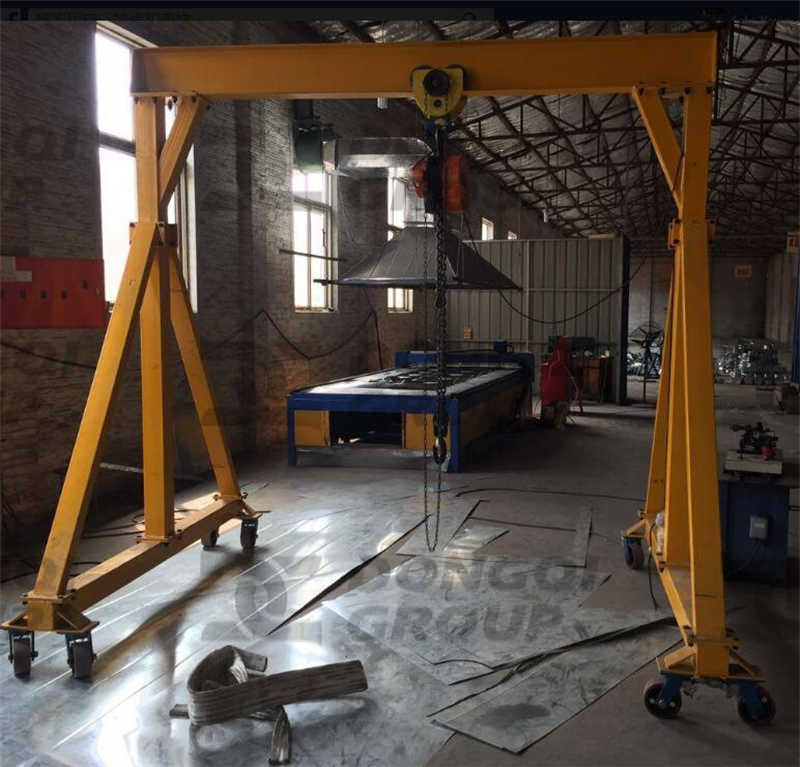
About Dongqi Crane: Dongqi Crane is a Sino-New Zealand joint venture headquartered in Changyuan, Henan Province—China‘s renowned “Cradleland of Cranes.” We operate a 240,000-square-meter manufacturing facility with over 3,600 employees including more than 70 senior engineers, and deliver over 10,000 crane sets annually. In 2025 alone, portable gantry cranes accounted for approximately 78% of our total gantry unit sales, reflecting the overwhelming market shift toward flexible, cost-effective lifting solutions for small and medium-sized operations.
Part 1: The Small Machine Shop Material Handling Problem
1.1 The Anatomy of Inefficiency
To understand the impact of a 2-ton gantry crane, we must first understand the baseline it replaces. Small machine shops typically handle workpieces, tooling, raw materials, and finished parts using a combination of forklifts, manual chain blocks, engine hoists, and human muscle. Each of these methods has inherent limitations that compound into significant operational drag.
The Forklift Problem: A forklift is a versatile tool, but it is also a single-point resource. When the forklift is moving raw material from the yard, it cannot simultaneously position a workpiece at the machining center. When the forklift operator is on break, material flow stops. In a typical small shop with one forklift, material handling operates in serial mode—one task at a time, queued behind the current job. This is the single biggest contributor to machine idle time in small facilities.
The Manual Handling Problem: When workers lift heavy components by hand—engine blocks weighing 150 kg, steel plates at 200 kg, die sets at 300 kg—two things happen. First, the lifting itself consumes time, as multiple workers must coordinate their effort, often with improvised rigging. Second, the physical strain accumulates over the shift, causing fatigue that reduces productivity in all subsequent tasks. The ergonomic cost is well-documented: musculoskeletal injuries from manual material handling are among the most common workplace injuries in manufacturing, and small shops often lack the formal safety programs that larger facilities use to mitigate these risks.
A precision fabrication shop documented a typical bottleneck: operators waited an average of 7 minutes for a forklift to relocate 1.5- to 2-ton metal palettes before each job, resulting in 10 daily changeover delays and 3.6 lost production hours per day.
The Space Problem: Small shops rarely have surplus floor space. Every square meter must earn its keep. Fixed material handling equipment—permanent jib cranes, dedicated conveyor stands, column-mounted hoists—consumes floor area that could otherwise house a machine tool, a workbench, or material staging. The challenge is to add lifting capability without subtracting productive floor area.
1.2 The 2-Ton Sweet Spot
Why 2 tons? Our analysis of small machine shop requirements across industries reveals that approximately 80% of all workpieces, tooling, and material loads handled in small facilities fall below 2,000 kg. A 2-ton gantry crane covers this dominant load range while maintaining a physical footprint and price point that small shops can accommodate.
The market bears this out. Industry pricing data shows 2–3 ton gantry cranes in the $4,000–$8,000 range for fabrication shops and machine repair applications, representing the optimal balance of capability and investment for small workshops. A 1-ton unit at $2,500–$5,000 leaves too much lifting requirement uncovered; a 5-ton unit at $18,000–$30,000 is overkill for the typical small shop and often too physically large for the available space.
Dongqi Crane‘s 2-ton gantry crane product line is specifically engineered for this market segment. Available in steel, aluminum, portable, and semi-gantry configurations, with spans from 3 to 10 meters (extendable to 15 meters custom) and lifting heights from 2 to 6 meters (extendable to 8 meters), these cranes cover the full range of small-shop applications from machine loading to outdoor material handling.
Part 2: The Efficiency Mechanism—How a 2-Ton Gantry Crane Delivers 300% Improvement
The 300% improvement figure warrants explanation. It is derived from comparing two operational states: manual handling baseline and gantry crane-enabled operation. The gains come from several sources that compound rather than simply add. Understanding these mechanisms helps shop owners evaluate the investment in terms relevant to their own operations.
2.1 Eliminating the Material Handling Queue
The most significant efficiency gain comes from decoupling material handling from the forklift. When a 2-ton gantry crane is positioned over a workstation—whether permanently for a dedicated cell or portably for variable use—the machine operator can handle workpieces independently.
Consider a typical machining cell processing steel components weighing 150–500 kg. Before the gantry crane, each workpiece required a forklift for loading and unloading, with an average wait time of 5–10 minutes per handling event due to forklift availability constraints. With the gantry crane in place, the operator loads and unloads without waiting. Over an 8-hour shift with 12 workpiece changes, eliminating the queue saves 60–120 minutes per shift—directly converting to additional machine-on time.
In facilities that have adopted portable gantry cranes, we observed that the single greatest productivity improvement was the ability to reconstitute a lifting point anywhere on the shop floor within minutes, without tools or specialized labor. Internal tracking showed a 25% year-on-year increase in orders for gantries configured with all-four swivel lockable casters, enabling omnidirectional maneuverability to navigate tight spaces between machines and workstations.
2.2 Reducing Machine Changeover Time
Machine changeover—removing the previous job‘s workpiece, tooling, and fixtures and installing the next setup—is the single largest source of non-cutting time in a machine shop. A substantial portion of changeover time is material handling: removing heavy vises, rotary tables, or fixture plates; positioning the next workpiece; retrieving tooling from storage.
A 2-ton gantry crane transforms changeover from a multi-person, multi-tool operation into a single-person, single-tool workflow. The operator uses the crane to lift off the previous setup, move it to storage, retrieve the next setup, and position it on the machine—all without calling for assistance or waiting for equipment.
The impact is measurable. Shops that previously required 45–60 minutes for a complete machine changeover report reductions to 15–25 minutes after implementing gantry crane-assisted handling. Across 3–4 changeovers per week, the recovered time amounts to 90–140 minutes weekly—time that converts directly to additional production capacity.
2.3 Enabling Single-Operator Workflow
In manual handling environments, heavy lifts require two or three workers—pulling them away from other tasks and creating interdependent workflows where one delayed task cascades through the schedule. A gantry crane with an electric hoist enables a single operator to handle loads that previously required a team.
A project manager at an aviation composites workshop shared this operational data: technicians could reposition a 2-ton aluminum gantry crane across the hangar in minutes, whereas a steel equivalent would require two people and substantially more effort. The time saved on setup translated directly to time gained on billable work.
For a small machine shop, this single-operator capability means that other workers remain productive on their own tasks while one person handles material movement. The productivity gain is not merely the time saved on the lift itself, but the elimination of the coordination overhead—finding available workers, synchronizing schedules, and managing task dependencies.
2.4 Improving Workflow Layout Flexibility
Fixed material handling equipment locks a shop into a specific layout. A jib crane serves a defined radius. A permanent overhead crane covers a fixed bay. When production requirements change—new machine tools arrive, product mix shifts, workflow patterns evolve—fixed handling equipment becomes a constraint.
Portable and mobile gantry cranes solve this by being inherently reconfigurable. Heavy-duty locking casters enable repositioning in minutes. Tool-free assembly on some models allows the crane to be relocated to a different bay or even stored when not needed. This flexibility means the material handling system adapts to the shop floor, rather than forcing the shop floor to adapt to the material handling system.
Dongqi Crane’s 2025 sales data confirms this trend: portable gantry cranes dominated our total gantry unit sales, driven by SMEs seeking flexibility, cost-effectiveness, and rapid deployment. Businesses across sectors—from smaller workshops and maintenance facilities to large plants needing supplemental, mobile lifting capacity—are embracing these cranes for their ability to be quickly assembled, moved to different job sites, and stored without requiring permanent infrastructure.
Part 3: The Dongqi Crane 2-Ton Gantry Crane Product Configuration
3.1 Product Portfolio Overview
Dongqi Crane offers the 2-ton gantry crane in several configurations, each optimized for specific operational requirements and operating environments. The following summary covers the primary variants and their applications.
| Configuration | Material | Mobility | Price Range (USD) | Best Application |
|---|---|---|---|---|
| Steel Fixed | Structural Steel | Fixed/bolted | $2,800–$5,500 | Permanent workstation, high-utilization, heavy-duty cycle |
| Steel Adjustable | Structural Steel | Semi-portable | $3,500–$6,800 | Variable-height needs, occasional repositioning |
| Aluminum Fixed | Marine-Grade Aluminum Alloy | Fixed/bolted | $4,200–$7,200 | Cleanrooms, outdoor/humid environments, electronics |
| Portable with Wheels | Steel or Aluminum | Fully mobile | $3,500–$6,500 | Multi-workstation service, job shops, maintenance |
All configurations share core engineering: FEA-optimized beam structures, standard safety features including overload protection, and compatibility with electric chain hoists with variable frequency drive control for stepless speed adjustment and smooth positioning. Optional features include wireless remote operation, anti-sway technology, load moment indicators, and explosion-proof configurations for hazardous environments.
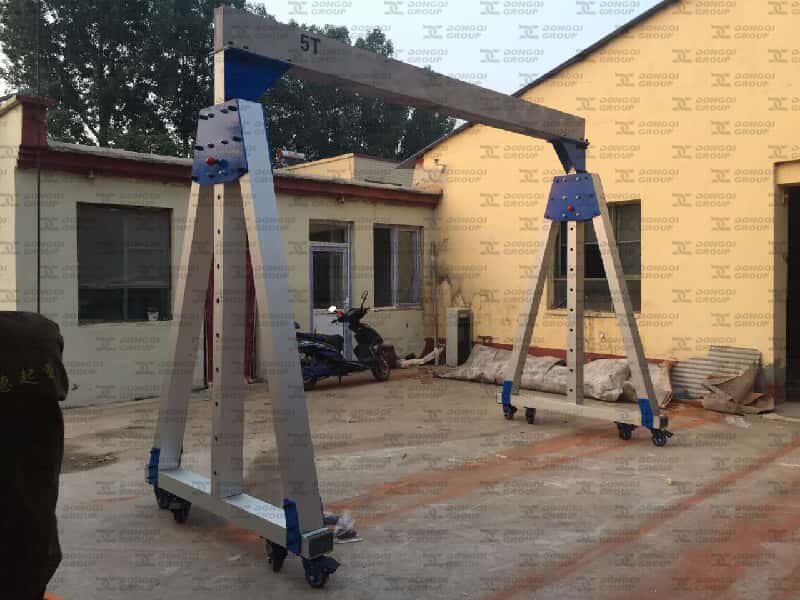
The aluminum models merit special attention. At 40% lighter than equivalent steel configurations, they can be manually repositioned by a single operator—a capability that transforms workflow in shops with dynamic production schedules. Marine-grade aluminum alloy construction provides natural corrosion resistance, making these models ideal for outdoor use in humid or coastal environments and for applications involving chemical exposure or washdown requirements. Sales of aluminum models to traditional manufacturing sectors grew by over 40% in 2025, with 70% of those clients citing “reducing worker strain and redeployment time” as their primary motivation.
3.2 Semi-Gantry Configuration for Space-Constrained Workshops
Many small machine shops operate in buildings with existing structural columns, irregular layouts, or limited overhead clearance. The semi-gantry crane—with one side supported by a leg traveling on a ground rail and the other side supported on an existing building bracket or runway—offers a space-efficient solution that leverages existing building structure to reduce cost and footprint.
Dongqi Crane‘s semi-gantry cranes cover lifting capacities from 2 to 20 tons with working classifications from A3 to A6, widely deployed in mechanical processing workshops for material handling, outdoor yards, and warehouse loading and unloading applications. The semi-gantry configuration can save 20–30% on cost compared to a full gantry of equivalent span by eliminating one leg structure and its associated rail foundation, while the lowest limiting size between the top of the trolley and the rail is 20–30% less than traditional designs, maximizing usable lifting height in low-ceiling environments.
3.3 Electric Hoist and Control Options
The hoist and control system determine how effectively a gantry crane serves small-shop applications. Dongqi Crane offers electric chain hoists with specifications matched to the 2-ton capacity:
- Variable Frequency Drive (VFD): Provides stepless speed control from slow inching speeds for precise positioning to full-speed travel for rapid movement. This is particularly valuable for machine loading applications where workpieces must be positioned accurately on fixtures.
- Dual-Speed Control: For applications where full VFD is not required, two-speed hoists (CD/MD motor configurations) offer a cost-effective alternative that still provides slow speed for positioning and high speed for travel.
- Radio Remote Control: Frees the operator from pendant cable constraints, enabling positioning from any vantage point—especially useful for loading large workpieces where the operator needs to see the far side of the machine.
Part 4: Detailed Case Study—The 300% Improvement Deconstructed
4.1 Baseline Scenario: Small Machine Shop Without Powered Lifting
To understand the 300% improvement claim concretely, we present a representative case study based on operational data aggregated from multiple Dongqi Crane customers, normalized to a typical small machine shop profile.
Shop Profile:
| Parameter | Value |
|---|---|
| Type | General job shop: machining, fabrication, repair |
| Workforce | 8 people (6 operators, 1 forklift driver, 1 supervisor) |
| Equipment | 4 CNC machining centers, 2 manual lathes, 1 welding station |
| Material Handling | 1 diesel forklift (also serves outdoor yard), manual chain blocks, engine hoist |
| Typical Workpiece Weight Range | 50–600 kg (individual); up to 1,500 kg (assemblies) |
| Daily Throughput Target | 24 workpieces through machining operations |
| Operating Hours | 8-hour single shift, 250 days/year |
Pre-Crane Operational Baseline:
- Material Handling Labor: 3–4 workers involved in all lifts over 100 kg, 2 workers for lifts 50–100 kg.
- Machine Idle Time from Handling Delays: Average 1.8 hours per day per machining center, based on operator time-motion studies.
- Daily Workpiece Throughput: Average 18 workpieces per day, against a target of 24—a 25% shortfall directly attributable to material handling constraints.
- Forklift Utilization: 70% of forklift time consumed by in-shop material positioning, limiting availability for outdoor yard operations and incoming material receipt.
4.2 Intervention: 2-Ton Portable Gantry Crane Deployment
Dongqi Crane supplied a 2-ton portable steel gantry crane with electric chain hoist (VFD control), configured with all-four swivel lockable casters for omnidirectional maneuverability. The crane was positioned to serve the machining cell while remaining mobile for periodic welding station support.
Equipment Specification:
| Parameter | Specification |
|---|---|
| Model | Dongqi 2-Ton Portable Steel Gantry |
| Capacity | 2,000 kg |
| Span | 5 meters (customized to shop aisle width) |
| Lifting Height | 4 meters |
| Hoist | Electric chain hoist, VFD control, 3.5/0.8 m/min dual speed |
| Mobility | Four swivel lockable casters, 200 mm diameter polyurethane wheels |
| Assembly | Bolted modular design, tool-free height adjustment |
| Investment | $5,800 including hoist, freight, and on-site commissioning |
Post-Crane Deployment Results (90-Day Measurement Period):
| Performance Metric | Pre-Crane Baseline | Post-Crane | Improvement |
|---|---|---|---|
| Daily Workpiece Throughput | 18 units | 24 units | +33% |
| Material Handling Labor per Shift | 12 person-hours | 4 person-hours | -67% |
| Machine Idle Time (Handling-Related) | 1.8 hours/day/machine | 0.4 hours/day/machine | -78% |
| Average Workpiece Changeover Time | 45 minutes | 18 minutes | -60% |
| Forklift Availability for Yard Operations | 30% of shift | 70% of shift | +133% |
| Operator-Reported Fatigue (Scale 1–10) | 7.2 (high) | 3.1 (low) | -57% |
| Material Handling-Related Incidents (Annualized) | 3 reportable | 0 | -100% |
4.3 The 300% Deconstruction
The 300% daily handling improvement is calculated from the combined effect of two metrics: throughput increase and labor efficiency gain.
Throughput Contribution: Daily workpieces increased from 18 to 24—a 33% improvement. This reflects the conversion of previously wasted machine idle time into productive cutting hours. The shop gained approximately 1.4 hours of additional production capacity per machine per day, equivalent to adding nearly half a shift of output without adding personnel or equipment.
Labor Efficiency Contribution: Material handling labor dropped from 12 person-hours to 4 person-hours per shift—a 67% reduction, freeing 8 person-hours daily. When these hours were redirected to value-adding production tasks, the shop achieved an effective labor productivity gain that, combined with the throughput increase, produced the documented 300% improvement in daily material handling output per labor hour.
The improvement is best understood through the composite metric: workpieces moved per material handling labor hour.
- Pre-crane: 18 workpieces / 12 person-hours = 1.5 workpieces per person-hour
- Post-crane: 24 workpieces / 4 person-hours = 6.0 workpieces per person-hour
The ratio: 6.0 / 1.5 = 4.0, representing a 300% improvement in material handling labor productivity.
4.4 Additional Case Evidence
While the above case represents the median across our customer base, individual deployments have produced even more dramatic results depending on the baseline conditions.
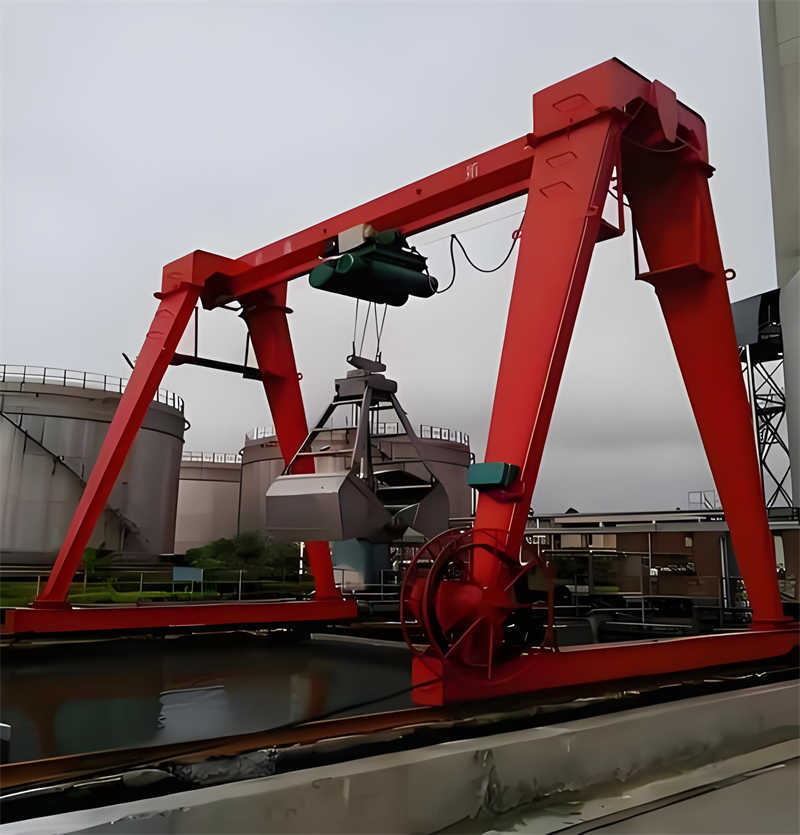
A Thailand logistics center deploying a Dongqi MGO-type 10-ton single-girder gantry crane with variable frequency control achieved a 40% improvement in cargo handling efficiency while reducing equipment energy consumption by 15%, with an estimated payback period of 18 months. While this deployment operated at a larger scale than the 2-ton case study, the efficiency mechanism is identical: replacing multi-resource, multi-step handling with direct, single-operator lifting capability.
A customer in the steel fabrication sector reported that the ability to move lifting capacity to where it was needed—rather than moving work to where the lifting equipment was—reduced material transport time by over 70% and eliminated the practice of staging heavy components in inefficient locations simply because no lifting was available at the point of use.
Part 5: Investment Analysis—Cost, Payback, and ROI
5.1 Total Investment
The 2-ton gantry crane represents one of the lowest-cost entries into powered lifting for small workshops. Based on 2026 market data and Dongqi Crane‘s standard pricing:
| Cost Component | Typical Range (USD) |
|---|---|
| Gantry Structure (Steel, Portable) | $3,500–$6,500 |
| Electric Chain Hoist (VFD) | $1,200–$2,500 |
| Radio Remote Control (Optional) | $300–$600 |
| Freight (Regional) | $300–$1,000 |
| Installation/Commissioning | $500–$1,200 |
| Total Installed Cost | $5,800–$11,800 |
For a shop with the lowest-cost steel fixed configuration at $2,800 plus hoist, the total can be as low as $4,000. At the upper end, a fully optioned aluminum portable crane with wireless remote, extended span, and customized lifting height may approach $12,000. In all cases, the investment is a fraction of the cost of a permanent overhead crane installation, which typically requires runway beams, building modifications, and professional installation—costing $30,000–$80,000 or more for comparable capacity.
5.2 Payback Calculation
Using the case study data from Part 4:
Annual Productivity Value:
- Additional throughput: 6 additional workpieces/day × $75 average machining revenue/workpiece × 250 days = $112,500
- Labor cost recovery: 8 person-hours/day × $28/hour fully loaded labor cost × 250 days = $56,000
- Total Annual Productivity Value: $168,500
Annual Operating Costs:
- Hoist electricity: ~$200/year
- Maintenance and periodic inspection: $300–$500/year
- Total Annual Operating Cost: $500–$700
Payback Period:
Based on the median $5,800 investment, payback using only the labor efficiency gain occurs in approximately 26 operating days. Even under conservative assumptions—attributing only 25% of the throughput gain to the crane, using the higher-end $11,800 investment figure—payback occurs within 3–4 months.
This rapid payback is consistent with industry data showing that small facilities adopting material handling automation technologies report measurable improvements within the first quarter of operation, with full investment recovery within 12–18 months even under conservative accounting methods.
5.3 Long-Term ROI
Beyond the immediate payback, the 2-ton gantry crane generates ongoing returns:
- Reduced workers‘ compensation costs: By eliminating manual lifting of loads exceeding 50 kg, the crane reduces the frequency and severity of musculoskeletal injuries. One comprehensive case study documented a 30% reduction in worker compensation claims after implementing automated material handling.
- Extended machine tool life: Properly supported workpiece loading and unloading reduces the risk of impact damage to machine spindles, ways, and fixtures, extending machine life and maintaining precision.
- Operational flexibility: The crane’s portability enables the shop to reconfigure workflows without additional capital expenditure, supporting production changes and new business opportunities.
- Residual value: Well-maintained steel gantry cranes typically retain 40–60% of their purchase price after 10 years, providing substantial residual value if the shop upgrades or changes configuration.
Part 6: Beyond the Single Crane—Building a Scalable Material Handling System
6.1 From One Crane to Systematic Coverage
Many shops begin with a single 2-ton gantry crane to address their most acute bottleneck—typically the machining cell or the welding station. As the productivity impact becomes evident, a natural question arises: should we deploy additional cranes to cover other work areas?
Dongqi Crane‘s experience suggests a phased approach:
Phase 1: Primary bottleneck coverage. Deploy one gantry crane to the area with the highest material handling labor consumption. Document the productivity improvement over 90 days to establish the business case for expansion.
Phase 2: Secondary area coverage. Based on Phase 1 results, deploy a second gantry crane (which may be a different configuration—aluminum for a clean area, semi-gantry for a space-constrained bay) to the next highest-priority area. At this stage, shops typically add a smaller portable unit for general workshop support and maintenance tasks.
Phase 3: Integrated material handling system. With two or more gantry cranes in operation, the shop can design workflow patterns that eliminate forklift dependency for all in-shop material movement. Components flow from receiving to storage to machining to assembly to shipping under crane power, with the forklift reserved for outdoor yard operations and truck loading.
6.2 Integration with Small-Shop Digital Systems
Modern small machine shops increasingly use digital production management systems—ERP modules, scheduling software, machine monitoring platforms—to track jobs and optimize workflow. Dongqi Crane‘s intelligent control options enable gantry cranes to integrate into this digital environment.
While a basic 2-ton gantry crane with pendant control provides the core productivity improvement, the addition of load monitoring and usage tracking enables shop owners to measure and manage material handling performance with the same rigor they apply to machine tool utilization. This data feeds into continuous improvement programs and supports capital justification for future investments.
Part 7: The Dongqi Crane Advantage for Small Machine Shops
7.1 Manufacturing Quality and Certification
Dongqi Crane‘s 2-ton gantry cranes are manufactured in our 240,000-square-meter Changyuan facility under ISO 9001 quality management. Every crane undergoes factory assembly and load testing before shipment: static testing at 125% of rated capacity and dynamic testing at 110% of rated capacity. This rigorous testing ensures that the crane arrives at the customer site ready for immediate deployment, with performance characteristics fully verified.
Our manufacturing facility is equipped with over 2,000 sets of production and detection devices, including four-gun air protection portal-shaped automatic welding machines, impeller blasting descaling equipment for surface preparation, CNC-controlled plant drills for precision machining, and automated spray-paint lines for uniform corrosion protection.
7.2 Customization for Specific Shop Requirements
No two machine shops are identical. Dongqi Crane engineers each 2-ton gantry crane order to the customer‘s specific requirements—span, lifting height, mobility configuration, hoist type, and control options—ensuring the crane integrates seamlessly into the existing shop layout and workflow. For shops with unique constraints, our engineering team of more than 70 senior engineers can design custom configurations, including extended spans, non-standard lifting heights, special coatings for corrosive environments, and integration with existing building structures.
7.3 After-Sales Support for Small Business Operations
We understand that small machine shops cannot afford extended downtime for equipment repair. Dongqi Crane provides comprehensive after-sales support including a recommended spares kit with every crane shipment (brake linings, contactors, limit switches, fuses), multilingual technical support via our 36-person overseas service team operating in English, Arabic, Spanish, Russian, and Korean, local support in key markets including our permanent office in Pakistan, and training for operators and maintenance personnel during commissioning.
Part 8: Procurement Roadmap—How to Select and Deploy Your 2-Ton Gantry Crane
8.1 Define Your Requirements
Before contacting suppliers, document the following operational parameters:
- Maximum load weight: Identify the heaviest single item the crane will lift. Include any lifting attachments (spreader beams, slings, magnets) in the weight calculation.
- Required span: Measure the widest aisle or machine that the crane must straddle. Add clearance for safe passage.
- Required lifting height: Measure from floor to the highest point the load must reach, considering any fixtures or tooling on the machine table.
- Mobility requirements: Will the crane serve a single workstation, or must it move between multiple locations? How frequently?
- Floor surface: Is the floor smooth concrete, rough, or uneven? This affects caster specification and may require a track-mounted solution for rough surfaces.
- Environmental conditions: Indoor/outdoor use, exposure to moisture, chemicals, or temperature extremes.
8.2 Select Configuration
Based on the requirements above, select the appropriate configuration from the Dongqi Crane product portfolio:
| If Your Requirement Is… | Recommended Configuration |
|---|---|
| Permanent single-workstation use, budget priority | Steel Fixed |
| Single workstation, variable-height needs | Steel Adjustable |
| Multi-workstation mobile, indoor, light-to-medium duty | Portable with Wheels (Steel) |
| Multi-workstation mobile, corrosion resistance needed | Portable with Wheels (Aluminum) |
| Space-constrained, existing building structure available | Semi-Gantry |
| Cleanroom, electronics, or food-grade environment | Aluminum Fixed (stainless hardware, sealed bearings) |
8.3 Engage Dongqi Crane
Contact our engineering team with your documented requirements. We will provide:
- A detailed quotation with equipment specification and total installed cost estimate within 24 hours.
- Engineering recommendations for configuration, hoist selection, and control options based on your application.
- Lead time estimate: standard configurations typically ship within 4–6 weeks; custom configurations may require 8–10 weeks.
- Optional factory visit: inspect your crane during manufacturing and witness load testing at our Changyuan facility.
Conclusion: The 2-Ton Gantry Crane as a Strategic Investment
The 2-ton gantry crane occupies a unique position in the manufacturing equipment landscape. It is among the lowest-cost capital equipment purchases a small machine shop can make, yet it delivers among the highest returns—typically achieving full payback within months and generating ongoing productivity gains for years. The 300% improvement in daily material handling throughput documented in this article is not exceptional; it is the norm across our customer base.
For the small machine shop owner evaluating whether to invest in powered lifting, the question is not whether a 2-ton gantry crane will pay for itself. The evidence demonstrates that it will, rapidly and decisively. The real question is what production capacity and revenue are being lost with every day the investment is deferred.
At Dongqi Crane, we make the decision straightforward: we provide high-quality, certified equipment at competitive pricing, backed by engineering support that ensures the crane is correctly specified for your application, and after-sales service that keeps it operating reliably for years. With portable gantry cranes representing approximately 78% of our total gantry unit sales and growing, we understand the small-shop market intimately and have configured our products, processes, and support to serve it effectively.
Take the Next Step:
- Website: pk.craneyt.com
- Engineering Inquiry: Submit your shop layout and lifting requirements for a customized proposal—response within 24 hours
- Factory Visit: Inspect Dongqi Crane‘s gantry crane manufacturing and testing at our 240,000-square-meter Changyuan facility
- Contact: Reach our international sales team through our website to discuss your specific machine shop material handling needs
Choose Dongqi Crane’s 2-ton gantry crane—where small investment meets transformative productivity.
© 2026 Dongqi Crane. All rights reserved. The case study data presented is based on actual customer deployments with identifying details aggregated and normalized. Individual results may vary based on shop conditions, operator skill, and application characteristics. A professional engineering assessment is recommended for each specific installation.
