
20-May-2026
Crane Components Pitfall-Proof Guide: How to Identify High-Quality Wire Ropes, Sheaves, and Brakes
Introduction: The Components That Determine Everything
A crane is only as reliable as its most vulnerable component. This engineering axiom carries more weight than most procurement professionals realize. An overhead crane may have a beautifully welded box girder and a sophisticated PLC control system, but if the wire rope is substandard, the sheave groove is worn, or the brake cannot hold the load during a power failure, the entire capital investment is compromised.
The stakes are not theoretical. Industry data reveals that brake-related failures alone account for approximately 73% of unplanned crane downtime across manufacturing facilities, with each incident carrying significant production loss costs. Wire rope failures—often traceable to improper selection, counterfeit products, or neglected inspection—can result in dropped loads with catastrophic safety and financial consequences. Sheave deterioration, while less visible, accelerates rope wear and shortens component life across the entire lifting system.
At Dongqi Crane, we have seen the consequences of component quality failures across thousands of installations in 96 countries. We have also seen how properly specified, genuine, and well-maintained components deliver decades of safe, productive service. This guide draws on that experience to provide procurement professionals with a practical, technically grounded framework for evaluating the three most critical crane consumables: wire ropes, sheaves (pulleys), and brakes. For each component, we explain what quality looks like, how to verify it, what common pitfalls to avoid, and how Dongqi Crane ensures component integrity in every crane we manufacture.
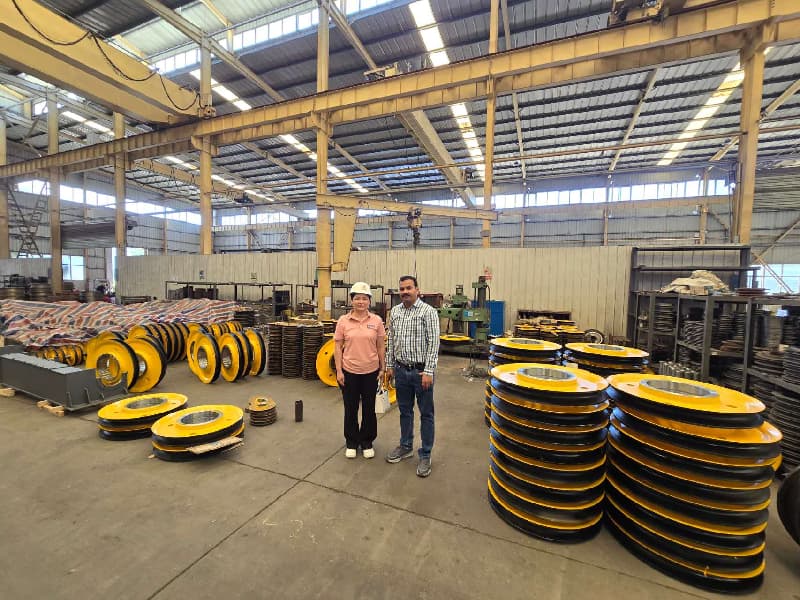
About Dongqi Crane: As a Sino-New Zealand joint venture headquartered in China’s “Cradleland of Cranes” in Changyuan, Henan Province, Dongqi Crane operates a 240,000-square-meter manufacturing facility with over 3,600 employees including more than 70 senior engineers. Certified to ISO 9001, ISO 14001, ISO 45001, and CE standards, we produce over 10,000 crane sets annually and export to 96 countries. Our component philosophy is built on the principle that genuine, properly specified, and rigorously tested parts are the foundation of crane safety and longevity. Every crane we deliver incorporates components selected and tested to meet or exceed applicable international standards.
Part 1: The Hidden Epidemic of Counterfeit and Substandard Components
1.1 A Problem That Demands Attention
Before examining individual components, we must address a systemic issue that affects procurement decisions across the global crane industry: the prevalence of counterfeit, substandard, and misrepresented spare parts.
As one industry observer has bluntly stated: “Our industry is absolutely infested with fakes, and we don’t care”. The problem extends across all categories of crane components. Counterfeit parts may be manufactured by a third party but packaged identically to the genuine article—extremely difficult to distinguish until they fail. Copy spares manufactured to the correct specification under license may be acceptable, but the more dangerous category consists of “those marketed as OEM replacements but not fulfilling the original requirements”.
1.2 The Price of False Economy
Aftermarket or non-genuine parts may share the same shape and size as OEM components, but they rarely undergo the same rigorous quality testing. Metal density, tolerance specifications, and material composition are difficult to accurately replicate, meaning that aftermarket parts cannot withstand the same physical stresses, leading to multiple problems and high costs.
The cost differential that tempts procurement teams toward non-genuine components is almost always dwarfed by the downstream costs of failure. A wire rope that fails under load can destroy workpieces worth thousands of dollars, damage machine tools, and most critically, endanger lives. A brake pad that wears out in half the expected service life may save a few hundred dollars on the purchase but cost tens of thousands in unplanned downtime and emergency replacement labor.
At Dongqi Crane, we have established our position on this issue clearly: KBK crane standard components can only use original components, and lost parts such as screws, cotter pins, pins, and similar items must be replaced with genuine equivalents. This is not a commercial policy designed to sell more parts—it is a safety requirement grounded in engineering reality.
1.3 Recognizing the Warning Signs
Counterfeit components can often be identified through careful examination of packaging and markings. Misspellings, poor printing quality, out-of-date company logos, and inconsistent part numbering are common indicators of counterfeit parts. Genuine components from reputable manufacturers come with full traceability documentation—material certificates, manufacturing batch numbers, and inspection records. Any supplier that cannot provide such documentation should be treated with skepticism.
Part 2: Wire Ropes—The Lifeline of Every Lift
2.1 Why Wire Rope Quality Cannot Be Compromised
The wire rope is the sole connection between the crane and the load. Every kilogram of lifting force travels through the rope’s individual wires, strands, and core. A failure at any point in the rope system releases the full suspended load with potentially catastrophic consequences. Beyond catastrophic failure, substandard wire ropes degrade crane performance through excessive stretch, poor bending fatigue life, internal corrosion, and abrasive wear that damages sheaves and drums.
Wire rope quality is governed by a comprehensive framework of international standards. ISO 4309 establishes general principles for the care and maintenance, and inspection and discard of steel wire ropes used on cranes and hoists. EN 12385 is a 10-part European safety standard series that specifies the particular materials, manufacturing and testing requirements for steel wire ropes, ensuring that required rope grades are met to ensure safety and long service life.
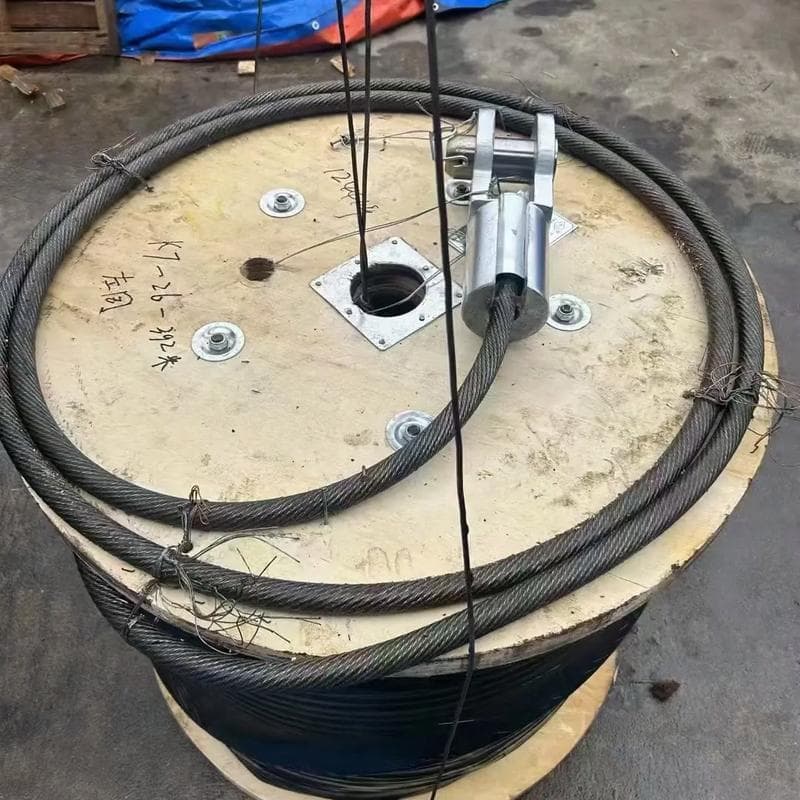
2.2 How to Identify High-Quality Wire Rope
Construction and Core Type
The rope’s construction—the arrangement of wires into strands and strands around a core—directly determines its performance characteristics. For crane hoisting applications, the most commonly specified high-quality construction is the 6×36 classification with an Independent Wire Rope Core (IWRC) . Dongqi Crane specifies 6×36 IWRC rotation-resistant ropes manufactured to DIN 3069 Grade 1960 for our premium hoisting mechanisms. The IWRC provides superior crush resistance compared to fiber cores, maintains rope geometry under high tension, and adds approximately 7% to the rope’s breaking strength.
Rotation-resistant ropes are essential for applications where the load must not spin. EN 12385-4 defines different categories of rotation-resistant ropes—for example, 35×7 construction (three layers of strands) provides stronger anti-rotation characteristics than 18×7 construction (two layers of strands). For single-part hoisting where the rope end is free to rotate, rotation-resistant rope is mandatory to prevent dangerous load spin.
Material Grade and Breaking Strength
Wire rope strength is graded by the tensile strength of the wire material, expressed in N/mm². Common grades include 1770, 1960, and 2160. Higher-grade ropes provide greater strength for the same diameter, allowing lighter, more flexible rope systems. However, higher tensile strength can correlate with reduced ductility and bending fatigue resistance, so the grade must be matched to the application.
Dongqi Crane specifies wire rope grades based on a thorough engineering analysis of the application’s load spectrum, duty classification, and required safety factor. For standard overhead crane applications, we typically specify grade 1960 rope, which provides an optimal balance of strength, flexibility, and fatigue life. For heavy-duty and metallurgical applications, we specify high-performance wire ropes with independent steel cores (IWRC) and often a special coating or material grade designed to maintain integrity and flexibility at elevated temperatures, drastically reducing the risk of unexpected failure.
Surface Finish and Lubrication
A high-quality wire rope should have a uniform surface finish with no visible rust, pitting, or mechanical damage. The rope should be properly lubricated—both externally and internally—to prevent corrosion and reduce internal friction between wires and strands. Insufficient lubrication can cause corrosion, abrasive wear, and stiffening of the wire rope.
However, lubrication quality is about more than quantity. Inappropriate lubrication, especially a thick external coating of grease, prevents proper inspection and is likely to trap moisture and accelerate corrosion. The ideal lubricant penetrates to the rope’s core while leaving the external surface clean enough for visual inspection. Dongqi Crane’s premium hoist wire ropes are delivered with application-appropriate lubrication from the factory, and our documentation includes lubrication maintenance schedules specific to the operating environment.
Documentation and Certification
Every batch of high-quality wire rope should be accompanied by a mill certificate that documents the rope’s construction, material grade, breaking strength test results, and compliance with applicable standards. For applications governed by the Lifts Directive or Machinery Directive in Europe, EN 12385-5 provides a means of complying with essential safety requirements. Procurement teams should insist on receiving these certificates and should verify that the documented specifications match the application requirements.
2.3 Common Pitfalls and How to Avoid Them
Pitfall 1: Ignoring the D/d Ratio
The ratio between the sheave or drum diameter (D) and the rope diameter (d) is one of the most critical factors in rope service life. A sheave that is too small for the rope diameter imposes excessive bending stress on the wires, dramatically accelerating fatigue failure. This is a primary cause of premature rope failure.
Pitfall 2: Accepting Rope Without Traceability
A wire rope without traceability documentation is a gamble. Without knowing the material grade, construction, and breaking strength, you cannot verify that the rope meets the safety factor required by applicable standards. Always insist on full material certificates.
Pitfall 3: Neglecting Inspection and Discard Criteria
Even the highest-quality rope requires regular inspection and eventual replacement. ISO 4309 defines specific discard criteria including visible broken wires, decrease in rope diameter, fracture of strands, corrosion, and deformation. The standard also provides a method for assessing the combined effect of deterioration at any position in the rope.
Pitfall 4: Using Non-Rotation-Resistant Rope Where Required
For single-part hoisting applications where the load can rotate freely, non-rotation-resistant rope creates a dangerous condition where the load spins under tension. This damages the rope, creates handling hazards, and can cause load instability.
Part 3: Sheaves (Pulleys)—The Heart of the Hoist
3.1 The Overlooked Component
While the crane hook is the most visible point of connection, the sheaves (pulleys) are the unseen heart of the lifting system. They are the components that translate the crane’s power into smooth, controlled motion. The design and quality of a sheave have a direct and profound impact not only on lifting efficiency but, most critically, on the lifespan of the wire rope.
A worn or poorly manufactured sheave will rapidly destroy a brand-new wire rope. If the groove is too small, it will pinch and deform the rope, crushing the internal core and dramatically shortening its life. If the groove is too large, the rope flattens under load, leading to internal friction, broken strands, and rapid fatigue.
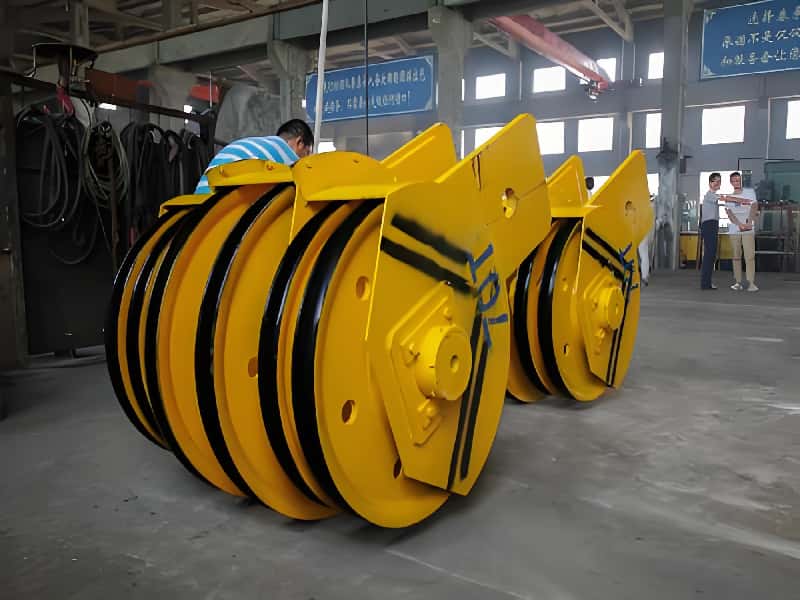
3.2 How to Identify High-Quality Sheaves
Material Selection
The choice of sheave material represents a balance between sheave durability and wire rope preservation:
- Cast Iron: A common, cost-effective material for standard-duty cranes and general applications where loads and speeds are moderate.
- Ductile/Nodular Iron: Offers superior strength and wear resistance compared to standard cast iron.
- Cast or Forged Steel: Used for high-load, high-speed, or extreme-duty applications. These sheaves are often heat-treated (flame or induction hardened) in the groove to maximize service life.
- Nylon / MC Plastic: A modern solution for specific applications. Lightweight, self-lubricating, exceptionally kind to wire rope, corrosion-proof, and quiet-running.
Dongqi Crane selects sheave materials based on the application’s duty classification, operating environment, and load characteristics. For our premium hoisting mechanisms, we specify diamond-groove sheaves with hardened surfaces achieving HRC 45-50 hardness. For specialized environments such as marine applications or food processing, we may specify nylon sheaves that eliminate corrosion risk and reduce rope wear.
Groove Profile—The Critical Dimension
The single most important quality indicator for any sheave is its groove profile. The relationship between the groove and the rope diameter is a precise science. The groove must provide a perfect saddle of support for the rope, which is why precision machining—adhering to strict engineering tolerances—is not a luxury but a necessity for any quality sheave.
The sheave should adopt a design compliant with DIN 15401 or FEM standards, where the groove radius is approximately 1.07 times the diameter of the wire rope. This ensures that the contact area of the wire rope is maximized and prevents jumping grooves.
Dongqi Crane’s sheave manufacturing process includes CNC machining of grooves to exact specifications, followed by quality verification using precision gauges. Our internal standards specify that the bottom and lateral clearance shall not be greater than 0.5mm, the deviation between the sheave groove center line and the sheave center line shall not be greater than 0.2mm, and the contour end face deviation shall not be greater than 1mm. These tolerances ensure that every sheave we produce supports the rope correctly and maintains alignment throughout its service life.
Bearing Quality
Sheave bearings determine rotational smoothness and maintenance requirements. High-quality sheaves use premium bearings—such as SKF or FAG tapered roller bearings with L10 ratings exceeding 50,000 hours. Internal spherical roller bearings or bronze bushings should reduce rotational friction to a coefficient of ≤ 0.015 and maintain smooth operation even under partial load conditions.
Visual and Dimensional Inspection
A high-quality sheave should exhibit:
- Uniform surface finish on the groove, flanges, and hub with no casting defects, cracks, or porosity
- Smooth, consistent groove profile with no tool marks or surface irregularities
- Properly aligned and adequately sized oil holes and oil sinks on spacer bushes between bearings
- No visible damage to flanges that could indicate mishandling
3.3 Common Pitfalls and How to Avoid Them
Pitfall 1: Worn Groove Profile
A worn sheave will rapidly destroy a new wire rope. Use a sheave gauge (a “go/no-go” tool) to check the groove profile during routine inspection. If the groove is worn, the sheave must be re-machined or replaced.
Pitfall 2: Ignoring Wear Limits
Industry standards define clear sheave wear limits. The radial direction of the pulley rope groove should not abrade more than 30% of the rope diameter, and the pulley groove wall should not abrade more than 30% of the original wall thickness. When wear exceeds these limits, the sheave must be discarded. Additionally, the wear depth of the wheel groove exceeding 20% of the wire rope diameter requires replacement. Continuing to operate with a worn sheave accelerates rope deterioration and creates a safety hazard.
Pitfall 3: Misalignment
Pulley misalignment causes the wire rope to rub against the groove walls or flanges, creating abnormal wear patterns on both the rope and the sheave. Regular inspection should include verification of sheave alignment relative to the rope path. Wire rope skipping—where the rope jumps out of the groove—is a clear indicator of alignment problems requiring immediate attention.
Pitfall 4: Neglecting Bearing Lubrication
Sheave bearings require regular lubrication to maintain low rotational friction and prevent seizure. Inadequate bearing lubrication leads to increased friction, which can cause the sheave to stop rotating—effectively turning it into a stationary surface over which the wire rope must slide, causing extremely rapid rope wear. Bearings should be filled with lithium-based grease on a monthly maintenance schedule for standard applications.
Part 4: Brakes—The Safety System That Must Never Fail
4.1 The Brake’s Dual Mission
Crane brakes serve two distinct but equally critical functions: service braking (controlled deceleration during normal operation) and holding/emergency braking (preventing load movement when the crane is stopped, especially during power loss). A brake failure in either mode can have catastrophic consequences—dropped loads, collisions, and in severe cases, injury or loss of life.
Hoist brakes consist of shoe or disc brakes on the high-speed side of the motor, typically thruster disc brakes, thruster drum brakes, or magnetic drum brakes. On the low-speed side, an emergency disc brake system is essential to prevent a load from falling in the event of a low-speed failure, such as gearbox or coupling failure or shaft breaking.
4.2 How to Identify High-Quality Brakes
Brake Type Selection
Different brake types offer different performance characteristics suited to different applications:
- Electromagnetic Disc Brakes: These modern systems excel in high-frequency applications. They operate using electromagnetic forces to engage the brake and offer quick response times, often preferred where precise control over load movements is required. Their heat dissipation capabilities handle continuous duty cycles without fade, making them ideal for automated systems. Response times are typically under 50ms with positioning accuracy of ±2mm.
- Thruster Drum Brakes: The industry stalwart for heavy-duty applications. The braking force is applied to brake shoes by a pre-stressed spring, with shoes pressing on a rotating brake drum. These brakes deliver consistent torque curves across temperature ranges and are well-suited to steel mills, foundries, and heavy manufacturing where robustness is prioritized.
- Electrohydraulic Thruster Systems (ELDRO®/ELHY®): These advanced systems from EMG use electrohydraulic lifting devices to ensure safe and “soft” braking. They guarantee the safety of both personnel and machine, with the ELHY® variant providing proven, robust lifting equipment for particularly demanding applications including steelworks and mining.
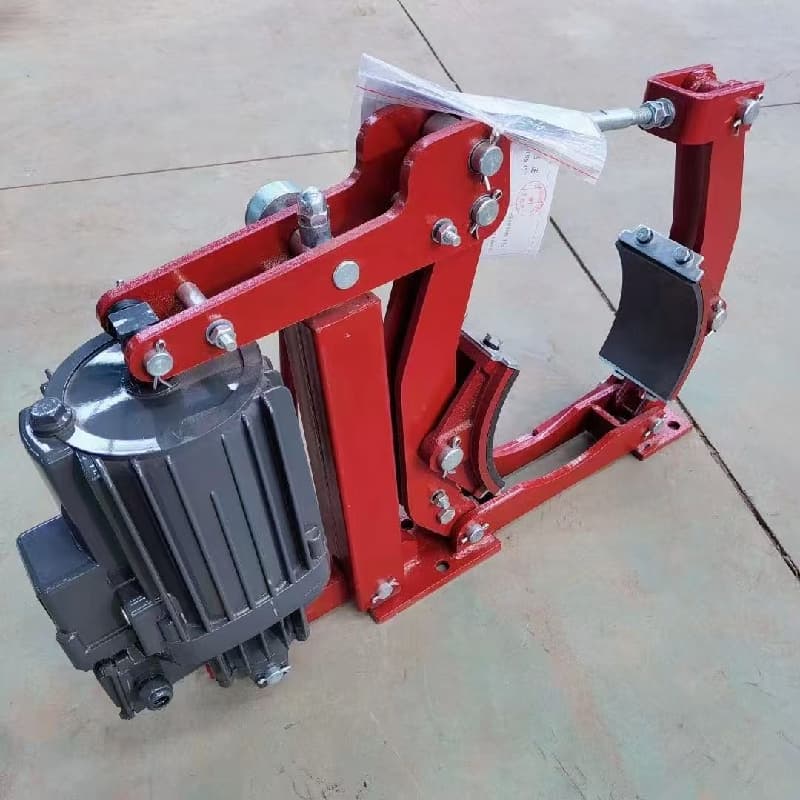
Dongqi Crane selects brake types based on a systematic evaluation of the application’s duty cycle, required stopping accuracy, environmental conditions, and safety requirements. For our standard electric hoists, we specify DC electromagnetic fail-safe brakes that automatically engage upon motor stop to hold the load safely. For metallurgical cranes, we feature a fail-safe dual-braking system: a regenerative/electrical brake for precise control, combined with a mechanical spring-set brake that automatically engages upon power loss, ensuring the load can be safely held under any circumstance.
Certification and Standards Compliance
High-quality brakes should comply with applicable international standards. FEM 1.001 provides general design principles and safety requirements for cranes. ISO 10245 addresses limiting and indicating devices, and relevant local regulations should also be confirmed. For applications in the European market, brakes must demonstrate compliance with the Machinery Directive’s essential health and safety requirements.
In the European context, strict standards have been implemented requiring emergency brakes for hot metal cranes and certain hoist applications. While adoption varies globally, Dongqi Crane follows European practice across our product lines, recognizing that the benefits of emergency brake systems “unequivocally exceed the costs when it comes to equipment protection, downtime, and most importantly, human lives”.
Mechanical Condition Indicators
A high-quality brake should exhibit:
- Smooth, parallel brake lining surfaces with uniform thickness and no glazing, cracking, or contamination
- Clean, rust-free brake drum or disc surfaces with uniform wear patterns
- Proper spring condition—springs with insufficient elasticity due to long-term use or overload require replacement
- All pins, linkages, and pivot points free from excessive wear, with pin wear not exceeding 5% of the original diameter or 0.5mm ovality
- No brake fluid leaks (for hydraulic systems) and properly functioning electrical connections
4.3 Brake Wear Limits and Adjustment
Brake components have defined wear limits beyond which replacement is mandatory, not optional. For brake pads and linings, the standard scrapping criterion is clear: when the brake pads wear up to 2mm remaining thickness or have lost 50% of the original thickness, they must be scrapped and replaced with new pads.
The brake replacement standard for linings is similarly explicit: when the brake shoe reaches the wear limit (50% of original thickness), replacement is mandatory. Additionally, when the lifting mechanism uses dual brakes, each brake must provide a safety factor of at least 1.25 times the rated load to ensure that either brake alone can safely hold the load.
Regular inspection and adjustment are essential. For cranes in normal use, brake inspection should be conducted each shift, covering the condition of key brake components, friction pair contact and separation gap, release mechanism reliability, and overall brake performance. Brake lining wear should be verified periodically based on actual usage, as even minimal wear can compound across the brake linkage and affect performance.
4.4 Common Pitfalls and How to Avoid Them
Pitfall 1: Contaminated Friction Surfaces
Oil, grease, or moisture contamination on brake drums or disc surfaces dramatically reduces braking torque. If contamination is detected, clean the brake wheel and pads with appropriate solvent to remove contaminants immediately. In environments where contamination risk is high—such as near machining centers with coolant mist—consider specifying enclosed or shielded brake configurations.
Pitfall 2: Electromagnet and Coil Failure
A disconnected coil or failed electromagnet prevents the brake from releasing, resulting in a stalled motor. Electromagnet-related failures are common in poorly maintained brake systems and require prompt diagnosis and replacement.
Pitfall 3: Ignoring Adjustment and Airgap
Improperly adjusted brakes either fail to hold the load securely or drag during operation, causing overheating and accelerated wear. The proper method to verify brake condition is to measure the brake airgap using appropriate tools, with adjustments or replacements made when the airgap exceeds specifications. Brake adjustments should be verified periodically based on the crane’s actual usage patterns.
Pitfall 4: Neglecting the Low-Speed Emergency Brake
The low-speed emergency brake system, typically a caliper brake mounted on the drum flange, is often overlooked during routine inspections. This is a critical error. The emergency brake is the last line of defense against a dropped load in the event of a gearbox, coupling, or shaft failure. Low-speed brakes should be specified according to full motor torque plus a service factor, and their condition should be verified during every scheduled crane inspection.
Part 5: Dongqi Crane’s Component Quality Assurance System
5.1 Selection, Not Just Specification
At Dongqi Crane, component quality begins long before manufacturing—it begins with selection. Our engineering team of over 70 senior engineers evaluates every component against the specific demands of each application. This includes:
- Application analysis: Duty classification, load spectrum, operating environment, and regulatory requirements determine the minimum acceptable component specifications.
- Standards compliance verification: Every component is verified against applicable international standards—FEM, ISO, DIN, EN, and where required, CMAA.
- Supplier qualification: We source components only from qualified suppliers with proven quality records and require full material traceability documentation for every batch.
5.2 Manufacturing Quality Control
Our 240,000-square-meter manufacturing facility in Changyuan is equipped with over 2,000 sets of manufacturing and detection devices. Key quality assurance processes include:
- Wire rope verification: Every rope batch is checked for construction, diameter, and surface condition. Mill certificates are verified against order specifications.
- Sheave quality control: Groove profiles are measured using precision gauges. Hardness testing verifies that heat-treated sheaves meet the specified HRC range. Bearing fit and alignment are checked before assembly.
- Brake testing: Every brake undergoes functional testing before crane assembly. For dual-brake hoist systems, each brake is individually tested to verify that it can hold 1.25 times the rated load independently.
5.3 Factory Load Testing and Documentation
Every Dongqi crane undergoes factory assembly and load testing before shipment. Static testing at 125% of rated capacity and dynamic testing at 110% of rated capacity verify not only the structural integrity of the crane but also the performance of every component under load conditions approximating worst-case scenarios.
Documentation provided with every crane includes material certificates for wire ropes and structural steel, sheave material and hardness test reports, brake functional test records, and full traceability documentation that enables component verification throughout the crane’s service life.
5.4 Spare Parts Integrity
For aftermarket support, Dongqi Crane maintains comprehensive spare parts inventories covering wire ropes, bearings, seals, motors, and brakes, with delivery typically within 2 working days of order placement. All spare parts supplied by Dongqi Crane are genuine OEM components manufactured to the same specifications as the originally installed parts.
We strongly advise our customers against substituting non-genuine components. Even wearing parts—which by nature require periodic replacement—must meet the original specifications. The wearing parts of Dongqi equipment are of proven quality, and while their replacement cycle cannot be eliminated, using genuine replacements properly extends their service life.
Part 6: Procurement Checklist for Component Evaluation
Use the following checklist when evaluating crane components during procurement or replacement:
| Component | Quality Indicators | Warning Signs |
|---|---|---|
| Wire Rope | Mill certificate with construction, grade, and breaking strength; proper lubrication; uniform surface; IWRC core for hoisting; rotation-resistant construction where required | Missing documentation; surface rust or pitting; inconsistent diameter; thick external grease preventing inspection; unknown core type |
| Sheaves | CNC-machined groove profile compliant with DIN/FEM; groove radius ~1.07× rope diameter; proper material hardness; premium bearings; smooth surface finish | Rough or inconsistent groove surface; visible casting defects; groove wear exceeding 30% of rope diameter; bearing roughness or noise; misalignment |
| Brakes | Fail-safe design; compliance with FEM/ISO standards; dual braking for critical applications; uniform lining wear; clean friction surfaces; proper airgap | Missing certification; contaminated friction surfaces; excessive lining wear (>50%); incorrect airgap; sticking or dragging; electromagnet noise or failure |
Conclusion: Components Are Your Foundation
The three components examined in this guide—wire ropes, sheaves, and brakes—collectively determine whether a crane performs safely and productively throughout its intended service life or becomes a source of unplanned downtime, unexpected costs, and unacceptable safety risk. The difference between quality and compromise in these components is measured not in purchase price but in consequences.
At Dongqi Crane, our commitment to component integrity is absolute. We specify premium wire ropes manufactured to international standards with full traceability. We machine sheaves to precise tolerances and verify groove profiles with precision gauges. We select brake systems based on rigorous application analysis and test every brake before the crane leaves our factory. When you purchase a Dongqi crane, these components come with documentation that enables you to verify quality at every stage of the equipment’s life.
For procurement professionals managing existing crane fleets, the message is equally clear: genuine OEM components, properly specified and regularly inspected, are the most cost-effective investment in crane safety and reliability. The short-term savings of non-genuine alternatives are almost always erased—often many times over—by the costs of premature failure, unplanned downtime, and compromised safety.
Contact Dongqi Crane:
- Website: pk.craneyt.com
- Spare Parts Inquiry: Submit your component requirements for genuine Dongqi replacement parts—delivery within 2 working days
- Factory Visit: Inspect our component manufacturing and quality control processes at our 240,000-square-meter Changyuan facility
- Technical Support: Reach our engineering team for component specification guidance
Choose Dongqi Crane—where every component is a commitment to your safety and productivity.
© 2026 Dongqi Crane. All rights reserved. This guide provides general technical information. Component selection for specific applications should be based on a detailed engineering evaluation considering all operational and regulatory requirements.
