
20-Jan-2026
2025 Sales Summary & Customer Guide: Dongqi Crane Gantry Cranes
As we close the chapter on 2025, Dongqi Crane reflects on a dynamic year in the gantry crane market. Customer needs continue to evolve, demanding versatile, efficient, and adaptable lifting solutions for a vast array of applications. Our sales data this year reveals clear trends in customer preferences, highlighting which types of gantry cranes are meeting the current demands of industries worldwide. This document will summarize these key trends from the past year and provide guidance for potential customers navigating their purchasing decisions.
2025 Sales Performance Overview: Listening to Market Demand
The sales distribution across our gantry crane categories in 2025 tells a compelling story about the state of industry and infrastructure development. While we protect specific numerical data, the percentage breakdown offers valuable insights into prevalent market movements.
The most significant trend was the overwhelming dominance of Portable Gantry Cranes, which accounted for approximately 78% of our total gantry unit sales. This staggering figure underscores a massive shift towards flexibility, cost-effectiveness, and rapid deployment. Businesses across sectors—from smaller workshops and maintenance facilities to large plants needing supplemental, mobile lifting capacity—are embracing these cranes. Their popularity speaks to the need for solutions that can be quickly assembled, moved to different job sites, and stored without requiring permanent infrastructure or significant investment. The demand for modular and adaptable material handling has never been clearer.
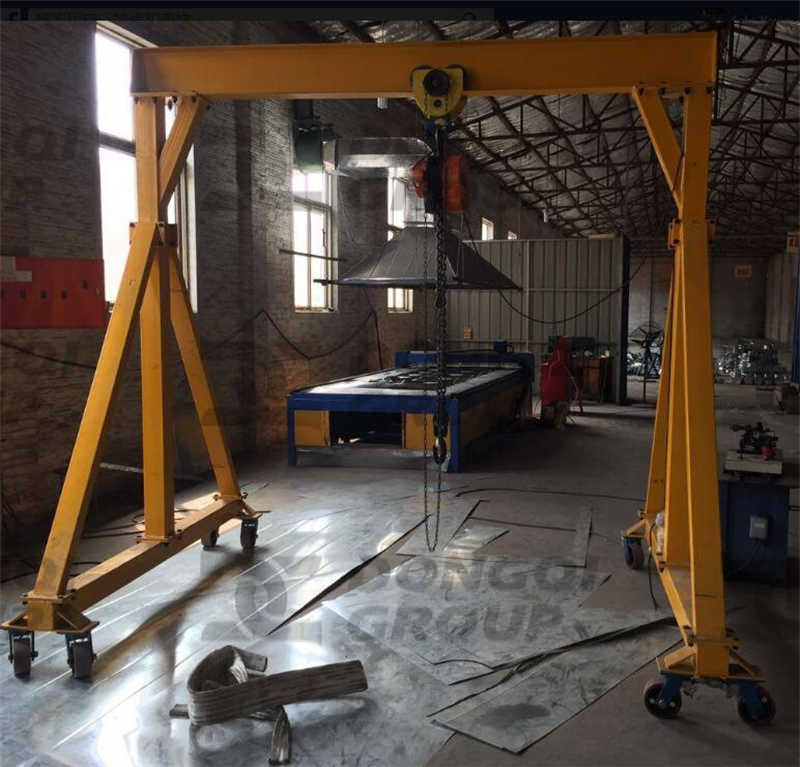
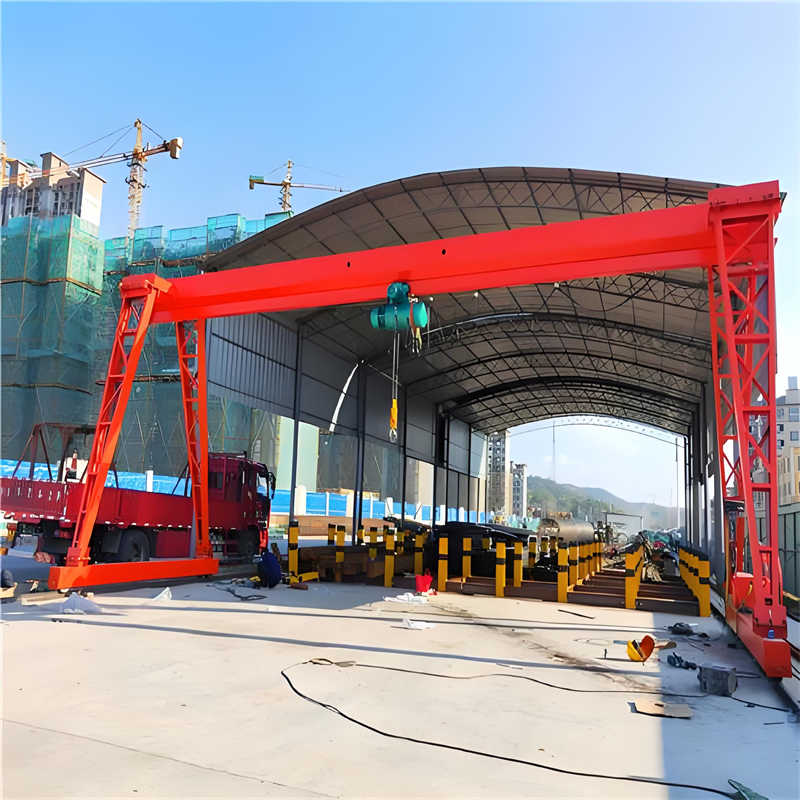
Following distantly, but holding crucial niches, are the MH-type Electric Hoist Gantry Cranes and the MG-type Universal Gantry Cranes, representing roughly 11% and 8% of sales, respectively. The MH-type’s sales indicate a steady demand for reliable, cost-conscious semi-permanent solutions, particularly in manufacturing, assembly lines, and storage yards where a sturdy fixed or semi-fixed structure with a standardized hoist is sufficient for regular tasks. Its balance of simplicity and robustness continues to serve small and medium enterprises well.
The MG-type, our classic double-girder workhorse, maintains its essential role. Its share reflects ongoing projects in traditional heavy-industry sectors—think steel service centers, large outdoor stockyards for bulk materials, and heavy equipment handling facilities. Customers choosing the MG-type are typically making a long-term investment in a permanent, high-capacity lifting asset for intensive, daily operation. Its stable sales percentage confirms that for substantial, continuous material flow of heavy items (5-50 tons), a dedicated, robust gantry remains irreplaceable.
Finally, the specialized Rubber-Tired Gantry (RTG) Crane constituted about 3% of sales. This niche percentage is entirely expected and significant. RTGs are high-capital, specialized machines destined primarily for port container terminals and large, dedicated intermodal logistics yards. Their purchase represents major infrastructure decisions. This figure indicates ongoing, targeted investments in logistics infrastructure and port efficiency, aligning with global trade flows and the expansion of containerized transport.
Interpreting the Trends: What the Numbers Suggest
The 80/20 split, with portable cranes taking the lion’s share, highlights a market prioritizing agility. The global economic landscape encourages businesses to seek lower-risk investments that offer immediate productivity gains. Portable gantries deliver just that. Meanwhile, the sustained interest in MG and MH types shows that core industrial activities continue to drive demand for permanent installations. The presence of RTG sales confirms that large-scale logistical projects are progressing, a positive indicator for related sectors.
Guidance for Potential Customers: Selecting Your Ideal Gantry Crane
Choosing the right gantry crane is a strategic decision that impacts safety, productivity, and your bottom line. Here is a breakdown tailored to different needs, inspired by the 2025 sales patterns.
1. For Maximum Flexibility & Rapid ROI: The Portable Gantry Crane
- Consider this if: Your work is project-based, your workshop layout changes frequently, you need lifting support at multiple temporary sites, or you’re a smaller operation looking for an affordable entry into overhead lifting.
- Why it fits: As the most popular choice, it requires no foundation, minimal assembly time, and can be dismantled for storage or transport. It’s ideal for maintenance, repair, machine installation, or low-volume production. You pay for the lifting capacity and mobility, not for civil engineering.
- Key questions: What is your maximum single-lift weight? What span and lifting height do you require? Do you need adjustable width or height? Aluminum models offer easier portability, while steel provides more rigidity for heavier loads.
2. For Steady, Reliable Performance in Fixed Locations: The MH-type Electric Hoist Gantry
- Consider this if: You have a defined work area like a warehouse bay, a production cell, or a loading dock where loads are consistent and under 20 tons. You need a more permanent solution than a portable crane but don’t require the heavy-duty features of a double-girder crane.
- Why it fits: This crane offers an excellent balance. The box-type design is robust for its class, while the truss-type is excellent for outdoor applications where wind resistance is a concern. Paired with standard CD/MD electric hoists, it provides reliable and precise lifting for A3-A5 duty cycles. It runs on standard industrial power (380V, 50Hz) and is a workhorse for general manufacturing, storage, and assembly.
- Key questions: Will it be used indoors or outdoors? What is your duty cycle (frequency of use)? What level of hoist control (single/multi-speed, precision) is needed?
3. For Heavy-Duty, Intensive Industrial Applications: The MG-type Universal Gantry Crane
- Consider this if: You operate a scrap yard, a heavy machinery warehouse, a railway freight station, or a port bulk cargo area. Your operations involve daily, heavy lifting (5-50 tons) of dense materials, and you need a crane built for endurance, high productivity, and long service life.
- Why it fits: This is the industrial stalwart. The double-girder design provides superior stability, hook height, and capacity for heavy loads. It can be equipped with specialized grabs or hooks for specific materials like coils, lumber, or scrap. It’s designed for high utilization rates in demanding environments.
- Key questions: What is the maximum weight and dimensions of the typical load? What is the required working span and lifting height? Are there specific environmental factors (dust, temperature, humidity)? What special attachments might be needed?
4. For Large-Scale Container Logistics Operations: The RTG (Rubber-Tired Gantry Crane)
- Consider this if: You are managing a container terminal, a large intermodal freight yard, or a logistics hub where stacking, organizing, and moving standard shipping containers is the core activity.
- Why it fits: This is a specialized productivity machine. Its ability to traverse a yard, stack containers multiple high, and precisely handle 20-40 foot containers is unmatched. It offers greater layout flexibility compared to rail-mounted gantries. Its sales, though a smaller percentage, represent major strategic investments for businesses scaling their logistical throughput.
- Key questions: What is the target container stacking height (e.g., 1-over-5, 1-over-6)? What is the size and layout of the yard? What are the required productivity metrics (moves per hour)? Are you considering automation or remote operation capabilities?
Final Recommendations
- Start with the Task: Clearly define what you need to lift, how often, where, and over what distance. The load diagram is the most critical starting point.
- Think Long-Term: Consider not just today’s needs, but potential future requirements. Can the crane be modified or relocated?
- Prioritize Safety and Standards: Always ensure the crane design complies with local and international safety regulations. Consider the operational environment and necessary safety devices.
- Total Cost of Ownership: Look beyond the purchase price. Consider installation costs, energy consumption, maintenance requirements, and the reliability of the supplier for parts and service.
The 2025 sales data demonstrates that Dongqi Crane successfully serves a spectrum of needs, from the highly flexible to the intensely specialized. Whether your priority is agility, reliability, brute strength, or logistical precision, aligning your specific operational requirements with the strengths of each crane type is the key to a successful investment. We are here to help you navigate these choices and equip your business with the optimal lifting solution.
