
24-Apr-2026
2026 Global Bridge & Gantry Crane Procurement Guide: Which Industries Are Buying — and Why
Executive Summary
The global overhead crane market — encompassing bridge cranes, gantry cranes, monorail cranes, and jib cranes — has reached a valuation of $5.01 billion in 2025 and is projected to grow to $5.33 billion in 2026 at a compound annual growth rate (CAGR) of 6.5%, with further expansion to $6.86 billion by 2030. The broader crane market is set to rise from $36.37 billion in 2026 to $54.06 billion by 2035, maintaining a CAGR of 4.5% across this period.
What is driving this sustained procurement activity? The answer is not monolithic. Across continents, a convergence of industrial transformation, infrastructure renewal, energy transition, and supply chain reconfiguration is reshaping which industries buy cranes, what specifications they demand, and how they make purchasing decisions. For procurement managers, project engineers, and business owners, understanding these trends is essential not only to secure the right equipment but also to avoid costly specification errors, compliance failures, and lifecycle cost traps.
This guide, prepared by Dongqi Crane — a Sino-New Zealand joint venture headquartered in Changyuan, Henan Province, China’s recognized “Cradleland of Cranes” — provides a region-by-region, industry-by-industry analysis of who is procuring bridge and gantry cranes in 2026 and the strategic drivers behind their investments. With a 240,000-square-meter manufacturing facility equipped with over 500 sets of production and testing machinery, Dongqi Crane supplies overhead crane solutions to more than 150 countries worldwide and brings firsthand market intelligence from active projects across Asia, Europe, the Middle East, Africa, North America, and Latin America.
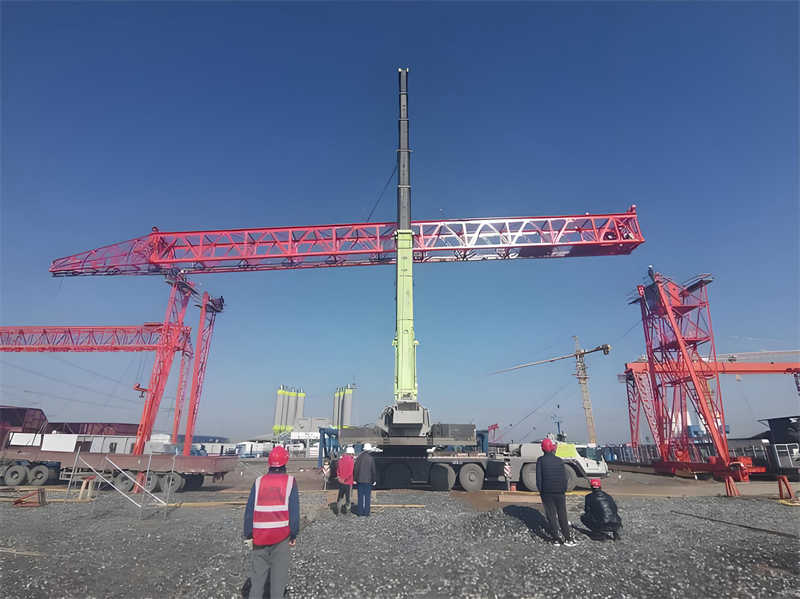
1. The 2026 Global Crane Market at a Glance
Before examining sector-specific demand, it is worth understanding the macroeconomic and structural forces that are shaping crane procurement worldwide in 2026.
Market Size and Trajectory. The global overhead crane market, spanning bridge cranes, gantry cranes, monorail cranes, and jib cranes in both single-girder and double-girder configurations, was valued at $5.01 billion in 2025 and is forecast to reach $6.86 billion by 2030 at a CAGR of 6.5%. Multiple independent research sources corroborate this trajectory, with bridge cranes expected to lead the crane type segment at 48% market share and active anti-sway technology projected to dominate control-type segments at 44%. Asia-Pacific remains the largest regional market, but North America is currently the fastest-growing region.
What Is Driving Growth? The historical growth engine has been the expansion of industrial manufacturing, automotive production facilities, metals and mining operations, and the ever-present demand for more efficient material handling solutions across all sectors. Going forward, growth will be powered by rising investments in factory automation, the proliferation of smart manufacturing facilities, heightened workplace safety regulations, and the expansion of shipbuilding and aerospace manufacturing.
The Tariff Factor. The 2026 market is being shaped by rapid changes in trade relations and tariffs globally. Tariffs have increased the cost of imported steel structures, electric motors, control systems, and mechanical components. Bridge cranes and gantry cranes are the two categories most affected, particularly in Asia-Pacific and North America, due to reliance on global sourcing of heavy components. However, these same tariff pressures are also encouraging local fabrication, regional supply chain development, and innovation in cost-efficient crane designs — creating new opportunities for manufacturers with flexible global supply networks such as Dongqi Crane.
For procurement teams, 2026 represents a year in which understanding total cost of ownership (TCO) — not just upfront purchase price — has become essential. Tariff exposure, shipping costs, delivery timelines, and local compliance requirements must all be factored into a single procurement equation.
2. Automotive Manufacturing: The Steady Powerhouse of Bridge Crane Demand
Who is buying. Passenger vehicle plants, electric vehicle (EV) battery gigafactories, commercial vehicle assembly lines, and Tier-1 automotive component suppliers.
Why they are buying. The automotive industry has historically been one of the largest consumers of overhead bridge cranes, and 2026 continues this pattern. Manufacturing facilities require bridge cranes for die handling in stamping shops, engine and transmission assembly, body shop material flow, and finished vehicle logistics. As automotive production facilities have grown in scale and complexity, so too has the specification of the cranes they deploy.
The defining trend in 2026 is the global energy transition reshaping automotive supply chains. Traditional internal combustion engine manufacturing continues to demand crane capacity, but the explosive growth of EV battery production is creating entirely new demand centers. Battery module assembly requires clean, precise lifting solutions with anti-sway control and ergonomic handling capabilities. Meanwhile, gigafactories — massive facilities producing lithium-ion cells at scale — require overhead cranes for raw material handling, electrode manufacturing, and cell assembly lines with spans often exceeding 30 meters.
Dongqi Crane has observed a marked increase in inquiries from automotive manufacturers seeking cranes with higher working duty classifications — M6 and above per FEM standards — reflecting the fact that EV production facilities often operate at higher utilization rates than traditional automotive plants. The trend toward operational efficiency and safety has led leading companies in the overhead crane industry to innovate with radio remote control and automated positioning solutions, which are increasingly specified by automotive procurement teams.
3. Metals and Mining: Large-Tonnage Gantry Cranes for the Resource Economy
Who is buying. Copper mines in Chile, lithium operations in Argentina, iron ore producers in Australia and West Africa, nickel processing facilities in Indonesia, steel mills globally.
Why they are buying. The metals and mining sector demands the largest, most robust gantry and bridge cranes in the world. In 2026, three converging trends are driving procurement volumes to new highs.
Energy transition minerals. The global shift toward electrification has created unprecedented demand for copper, lithium, nickel, and rare earth minerals. Chile, the world’s largest copper producer, imported 52 bridge cranes valued at $1.196 million and 33 gantry cranes valued at $447,000 from China in 2025 alone — figures that reflect a maturing market where mining operations increasingly recognize the value proposition of reliable, cost-effective lifting equipment. With Chile’s mining investment ranking fourth globally and the industrial sector forecast to grow at 5.9%, demand is projected to sustain through 2026 and beyond.
African mineral export infrastructure. On the African continent, the mining boom is driving port-side crane procurement. In West Africa, the Simandou iron ore project in Guinea has catalyzed the construction of the Mariabaya Port, a deep-water mineral export terminal designed to handle massive bulk carriers. Côte d’Ivoire is investing nearly CFA20 billion (approximately $35 million) to modernize the mineral terminal at the Port of Abidjan, with a first wave of equipment already delivered — including cranes valued at around CFA8 billion designed to increase loading and unloading capacity for bulk carriers transporting gypsum, limestone, and clinker.
Steel mill modernization. The anti-sway overhead crane segment for steel plant logistics is expected to reach $523.4 million in 2026 and grow to $1.01 billion by 2036 at a 6.8% CAGR, as steel producers worldwide upgrade their material handling infrastructure to improve safety and throughput in hot-metal handling, slab yard management, and coil storage.
For procurement teams in this sector, Dongqi Crane emphasizes the critical importance of specifying correct working duty classifications. A crane in a copper mine’s maintenance workshop operates at a very different duty cycle from one handling molten metal in a steel mill. Confusing these specifications is one of the most common — and costliest — procurement mistakes.
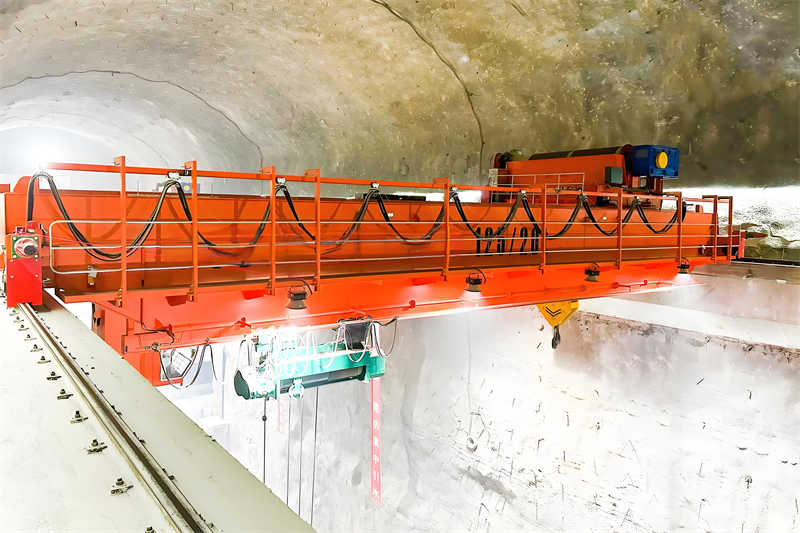
4. Port Infrastructure: The Container Crane Revolution Spanning Continents
Who is buying. Port authorities, terminal operators, national transport ministries, and logistics infrastructure investors.
Why they are buying. Global containerized trade continues to expand, and ports are racing to increase capacity, efficiency, and automation. This is one of the most capital-intensive crane procurement segments, with ship-to-shore (STS) quay cranes and rail-mounted or rubber-tyred gantry (RMG/RTG) yard cranes representing multimillion-dollar investments.
Middle East and North Africa. Egypt is emerging as a major procurement hub. In April 2026, the Safaga 2 multi-purpose terminal on the Red Sea coast received three Super Post-Panamax STS quay cranes and six RTG yard cranes manufactured by ZPMC, marking a key milestone in the Greater Safaga Port development project. The terminal, spanning 810,000 square meters with a 1,000-meter quay wall, is designed to handle 450,000 TEUs of container cargo annually and 5 million tonnes of dry bulk — and AD Ports Group has committed approximately $52.5 million specifically for these cranes alone. The facility is set to commence operations in the second half of 2026.
Southeast Asia. Vietnam imported 339 gantry cranes from China in 2025 — a nearly 195% increase from 115 units in 2024 — reflecting the country’s rapid port and logistics infrastructure expansion. Indonesia, the largest crane importer in the region, brought in 1,337 bridge cranes in 2025, driven by port modernization and mining-related logistics.
Europe. Romania’s Port of Constanța, the country’s largest maritime gateway on the Black Sea, is undergoing substantial modernization. DP World has expanded operations at the Constanța South Container Terminal, adding mobile harbor cranes to boost handling capability toward 810,000 TEU in 2026–2027.
The global container handling equipment market is estimated at $8.94 billion in 2026 and is projected to reach $12.43 billion by 2034, growing at a CAGR of 4.2%. For procurement managers, the priority criteria have shifted. Automated systems that reduce human error, electric-powered equipment aligned with decarbonization targets, and cranes with intelligent remote monitoring capabilities are now standard specifications in port tenders globally. Dongqi Crane offers bridge and gantry crane solutions specifically engineered for port-side material handling, including heavy-lift configurations suitable for bulk cargo, container handling, and general logistics operations.
5. North American Manufacturing Reshoring: The New Growth Engine
Who is buying. Manufacturers relocating production from overseas, new EV and battery plants, semiconductor fabrication facilities, aerospace assembly operations, and expanding warehouse and logistics centers.
Why they are buying. North America is the fastest-growing region for overhead crane demand in 2026, accounting for approximately 20–22% of global revenue — a surge supported by reshoring initiatives and advanced manufacturing investments.
Reshoring — the practice of bringing manufacturing operations back to the United States from overseas — has moved from a strategic talking point to real operational planning. As the American Crane & Equipment Corp. noted in a 2026 analysis, “after years of supply chain disruptions, extended lead times, and shifting global costs, reshoring has moved beyond a strategic talking point and into real operational planning. Companies are no longer just evaluating cost per unit. They’re looking at risk, responsiveness, and long-term stability”.
When production shifts back to North America, facilities feel it first. New product lines, different component sizes, and higher throughput expectations expose the limits of buildings originally designed for different production mixes. This drives demand for bridge cranes to reconfigure material flow, gantry cranes for outdoor storage and shipping yards, and jib cranes for individual workstation support. As reshoring plans take shape, facility expansion is being treated as a long-term investment rather than a short-term fix — and material handling and lifting considerations are entering the conversation much earlier in the planning process.
Key trends in North American procurement include increased automation and robotics integration, growing demand for customization and flexible solutions, rising safety regulations and industry standards, and expansion in emerging manufacturing clusters in the Southeast and Southwest linked to EV and battery production. Dongqi Crane has responded to this market evolution by offering CMAA-compliant bridge crane designs alongside FEM- and ISO-certified systems, providing North American buyers with configurable solutions that meet domestic regulatory requirements while benefiting from the cost-efficiency of globally integrated manufacturing.
6. European Industry 4.0: Smart Factories, Smart Cranes
Who is buying. Automotive EV battery plants, smart factory retrofitters in Germany’s DACH region, Benelux port automation operators, offshore wind farm installers, and nuclear decommissioning projects in the UK.
Why they are buying. The European overhead crane market is navigating a pivotal era shaped by digital transformation, decarbonization mandates, and evolving industrial demands, with the market projected to exceed €2.6 billion.
Several technology trends define European procurement in 2026. Digital twin technology enables pre-deployment testing of crane configurations in virtual environments, reducing installation errors by up to 35%. AI-powered predictive analytics, using sensors monitoring wear patterns in real time, can cut unplanned downtime by 45% in industries such as steelmaking. Hydrogen-powered cranes are gaining traction to meet the EU’s Fit for 55 targets, with hybrid fuel-cell systems paired with lithium batteries reducing CO₂ emissions by 60–70% in heavy-duty applications. And as cranes integrate with Industry 4.0 networks, ISO/SAE 21434 cybersecurity compliance and zero-trust architecture with encrypted data transmission have become non-negotiable specifications.
A 20% skilled operator shortage across the EU is accelerating autonomous crane adoption for repetitive tasks such as warehouse palletizing, while augmented-reality training tools are cutting operator qualification time by 50%. For procurement teams, the strategic imperative is to prioritize vendors offering upgradeable modular designs — such as swappable IoT modules — and to audit suppliers for compliance with EPREL 2025 energy efficiency labeling requirements, as 70% of new cranes in Europe are expected to feature interoperable IIoT connectivity by year-end.
Dongqi Crane serves the European market with FEM-standard cranes designed for Industry 4.0 integration, including IoT-ready control systems, energy-efficient drives, and modular configurations that allow European manufacturers to upgrade their lifting infrastructure incrementally rather than through wholesale replacement.
7. Latin America: Infrastructure, Mining, and Port Expansion
Who is buying. Mining companies in Chile and Peru, port terminal developers in Colombia, manufacturing facilities in Brazil and Mexico, and construction contractors across the region.
Why they are buying. Latin America presents a multifaceted procurement landscape where mining, infrastructure, and port development are creating sustained demand for both bridge and gantry cranes.
Colombia exemplifies the convergence of these forces. The country’s construction industry is projected to grow at an annual average rate of 5.1% between 2026 and 2029, supported by major transport and energy initiatives and a government commitment to deliver 1.18 million new homes between 2025 and 2030. The new Puerto Antioquia container terminal on the Caribbean coast, representing a $764 million investment, received its first gantry cranes in 2025 and is designed to handle 7 million tonnes of cargo annually. Trade data reveals that Colombia imported 23 gantry cranes from China in 2025, up 53% from 15 units the previous year.
In Chile, Dongqi Crane has established itself as a premier supplier with dozens of completed projects across mining operations, manufacturing facilities, warehouse complexes, and port installations. The company’s LD single-girder overhead crane series, with capacities from 1 to 32 tonnes and spans up to 28.5 meters, has proven particularly popular among small-to-medium manufacturing operations seeking cost-effective lifting solutions.
Procurement teams in Latin America face a distinctive set of challenges: voltage and frequency variations (220V/380V/440V at 50Hz or 60Hz), complex import tax structures, and the growing importance of local compliance certifications such as Brazil’s INMETRO and Mexico’s NOM standards. Dongqi Crane’s experience across these markets has demonstrated that successful procurement requires not only competitive pricing — Chinese-manufactured cranes can offer prices 30–50% lower than Western competitors, with production costs 20–30% below world averages — but also deep knowledge of local regulatory landscapes and logistics networks.
8. Infrastructure and Construction: Cranes That Build Cities
Who is buying. Construction contractors, precast concrete manufacturers, steel structure fabricators, bridge and highway builders, railway and metro system developers.
Why they are buying. Large-scale infrastructure projects — bridges, highways, railways, metro systems, water treatment plants, and power generation facilities — require heavy material handling solutions both in the factory (for component prefabrication) and on site (for assembly and erection). Construction activity is accelerating globally, with the construction equipment market projected to grow from $161.4 billion in 2024 to $267.7 billion by 2032, registering a CAGR of 6.53%.
In 2026, several mega-projects are shaping crane procurement. Saudi Arabia’s NEOM and other Vision 2030 giga-projects demand large-capacity gantry cranes for precast concrete yards and bridge beam handling, often in extreme heat environments exceeding 50°C. In Southeast Asia, Vietnam’s construction sector has over 250 large infrastructure projects underway simultaneously, driving gantry crane imports to 339 units in 2025. In Eastern Europe, Romania’s infrastructure investment boom — supported by EU funding programs — has increased heavy construction machinery demand, with bridge cranes playing essential roles at construction sites lifting and positioning heavy components.
Dongqi Crane addresses this sector with custom-engineered gantry crane solutions — including semi-gantry and full-gantry configurations with spans exceeding 35 meters and capacities up to 500 tonnes — designed for precast concrete yards, bridge beam launching, and heavy steel erection. Ruggedized electrical systems with IP65 or higher protection and tropicalized coatings for outdoor exposure are standard offerings for this segment.
9. Energy Sector: From Traditional Oil & Gas to Renewables
Who is buying. Oil refineries, petrochemical complexes, offshore platform support facilities, wind turbine manufacturers, solar panel factories, hydropower dam construction projects, and nuclear power plants.
Why they are buying. The energy sector is experiencing a dual transformation: traditional oil and gas infrastructure continues to require cranes for maintenance, turnaround operations, and expansion, while the renewable energy boom is creating entirely new demand profiles.
In the Middle East, oil and gas remains a dominant procurement driver. Cranes deployed in refinery and petrochemical environments must meet stringent explosion-proof (ATEX/IECEx) certification requirements and be engineered for continuous operation in ambient temperatures that regularly exceed 45°C. Dongqi Crane supplies specialized explosion-proof bridge cranes with spark-resistant features, stainless steel components, and temperature-rated electrical systems designed specifically for these hazardous environments.
On the renewables side, wind turbine manufacturing requires overhead cranes with high precision for handling large-diameter tower sections, nacelles weighing 100–300 tonnes, and blades spanning over 100 meters. Hydropower dam construction demands gantry cranes capable of lifting and positioning turbine components and penstock sections. Solar panel manufacturing facilities utilize clean-room-compatible bridge cranes for material handling in dust-free environments.
The global transition toward cleaner energy is expected to sustain crane procurement in this sector well beyond 2026, making it one of the most resilient demand verticals for the decade ahead.
10. Shipbuilding and Aerospace: High-Precision Heavy Lifting
Who is buying. Shipyards constructing commercial vessels, naval shipbuilding facilities, offshore platform fabricators, and aerospace assembly plants for commercial and defense aircraft.
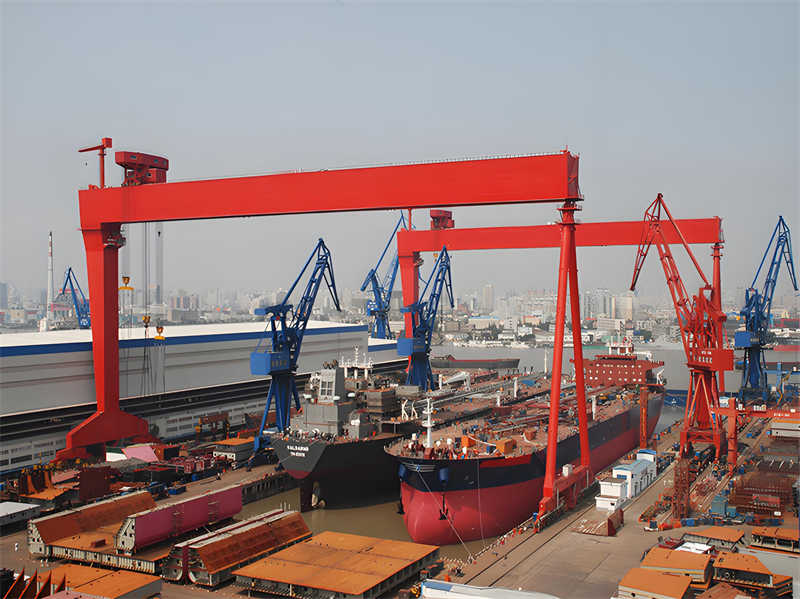
Why they are buying. Shipbuilding requires the heaviest lifting capacities of any industrial sector, with gantry cranes spanning dry docks and bridge cranes covering fabrication workshops. The industry is experiencing a global resurgence driven by fleet renewal cycles, LNG carrier construction, and naval modernization programs. Asia-Pacific shipyards in China, South Korea, and Japan remain the largest consumers, but capacity expansion is occurring in Southeast Asia, the Middle East, and Europe as well.
Aerospace manufacturing, while using smaller-capacity cranes than shipbuilding, demands the highest levels of precision, cleanliness, and reliability. Aircraft assembly requires overhead crane systems with micro-speed control for positioning large fuselage sections and wing assemblies with millimeter-level accuracy. The expansion of commercial aircraft production backlogs — particularly for single-aisle aircraft — is driving sustained procurement of specialized aerospace bridge cranes in 2026.
Dongqi Crane serves both sectors with double-girder overhead cranes featuring independent auxiliary hoists for tandem lifting, automated anti-sway control, and synchronized multi-crane operation capabilities for handling long or irregularly shaped loads.
11. Warehousing and Logistics: Automation at Scale
Who is buying. E-commerce fulfillment centers, third-party logistics providers, cold storage facilities, distribution hubs for retail and consumer goods, and automated warehouses.
Why they are buying. The relentless growth of e-commerce and the restructuring of global supply chains toward regional distribution networks are driving demand for overhead cranes in warehouse and logistics applications. Unlike manufacturing cranes, logistics cranes prioritize speed, automation, and space utilization over raw lifting capacity.
Automated bridge cranes integrated with warehouse management systems enable high-density storage and retrieval. RMG and RTG cranes at inland container depots and intermodal terminals facilitate the transfer of containers between rail, road, and storage. The global port equipment market — which includes cranes as a major segment — is projected to grow to $30.1 billion by 2034, with Asia-Pacific commanding a 39.47% market share in 2025. Demand for automated bridge cranes is set to rise significantly in 2026.
For procurement teams in this sector, the key considerations are cycle time, automation compatibility, energy efficiency (particularly for cold storage facilities where crane-generated heat affects refrigeration loads), and integration with existing warehouse control systems. Dongqi Crane provides semi-automated and fully automated overhead crane solutions with programmable positioning, zone-based anti-collision systems, and energy-regenerative drives that can reduce power consumption by 20–30%.
12. Navigating the Global Standards Landscape: CMAA, FEM, and ISO
A critical challenge in 2026 crane procurement is navigating the three dominant design and classification standards: CMAA (North America), FEM (Europe), and ISO (international).
These systems differ fundamentally in their engineering approaches. CMAA standards grew from North American industrial practice and focus on typical factory usage patterns and service classifications from Class A to F based on load cycles and operating conditions. FEM takes a lifecycle engineering approach, classifying cranes from M1 to M8 based on total working period and load spectrum, emphasizing mechanical lifetime and fatigue stress. ISO integrates both approaches with a classification system that combines utilization levels with load spectrum analysis.
The consequences of selecting the wrong standard can be severe: equipment may fail to meet local compliance requirements, overdesign can inflate costs unnecessarily, or — worse — structural safety risks can emerge from operating a crane under load conditions it was never engineered to handle. Misunderstanding crane standards can lead to “incorrect equipment selection, unnecessary over-design, or even structural safety risks” that may compromise operator safety and increase lifecycle costs significantly.
Dongqi Crane engineers cranes to all three standards — CMAA, FEM, and ISO — and provides procurement teams with clear documentation on which standard applies to each system component. This multi-standard capability is particularly valuable for multinational buyers whose operations span regions with different regulatory environments.
13. The Dongqi Crane Procurement Framework: What Buyers Need to Know
For procurement managers evaluating bridge or gantry crane suppliers in 2026, Dongqi Crane recommends a structured evaluation framework organized around five dimensions:
Manufacturing capability. Verify that your supplier operates its own manufacturing facility — not merely a trading company sourcing from third parties. Dongqi Crane’s 240,000-square-meter production base with over 500 sets of machinery, including advanced CNC machining centers and coordinate measuring equipment, ensures direct quality control from steel plate cutting through final load testing.
Standards compliance. Confirm that the supplier can deliver cranes compliant with the specific standards required in your region — whether CMAA, FEM, or ISO — and request sample calculation books, weld procedure specifications, and non-destructive testing reports as part of your technical evaluation.
Project experience. Review the supplier’s track record in your specific industry and region. Dongqi Crane has completed dozens of projects across Latin America alone, with equipment deployed in mining operations, manufacturing facilities, warehouse complexes, and port installations from Chile to Colombia.
Logistics and installation capability. Crane procurement is not complete until the equipment is installed, commissioned, and operational. Verify that your supplier has demonstrated experience managing the full logistics chain — ocean freight for oversized loads, customs clearance, inland transportation, on-site assembly, and load testing — in your target country.
After-sales service. Downtime is the hidden cost that can destroy the economics of even the most attractively priced crane. Evaluate the supplier’s service network, spare parts availability, remote diagnostic capability, and warranty terms before making your final decision.
Conclusion: The 2026 Procurement Mandate
The global crane market in 2026 is defined by growth, complexity, and opportunity. Industries ranging from automotive and mining to port logistics and renewable energy are investing in bridge and gantry cranes at a scale not seen in a decade. But the procurement landscape has also become more challenging: tariffs are reshaping supply chains, standards vary significantly across regions, and the true cost of a crane can only be understood by looking beyond the initial purchase price to the total cost of ownership over a 10- to 20-year service life.
For procurement teams, the mandate is clear: invest the time to understand which industries are buying, what they are buying, and why — and then use that knowledge to make specification decisions that align your equipment with the actual operational demands it will face.
Dongqi Crane stands ready to support your procurement journey with industry-specific solutions, multi-standard compliance capability, and a global project track record that spans more than 150 countries. Whether your requirement is a single 5-ton bridge crane for a manufacturing workshop or a fleet of 100-ton gantry cranes for a port expansion, we invite you to engage with our engineering team to explore the optimal configuration for your 2026 project.
For a customized crane configuration proposal, technical specifications, or a detailed quote tailored to your specific industry and regional requirements, contact Dongqi Crane’s global sales engineering team.
