
23-Apr-2026
A Buyer’s Guide to Factory Visits: What to Observe, What to Ask, and What to Photograph When Evaluating a Crane Manufacturer
An On-Site Due Diligence Guide from DONGQI CRANE for Procurement Professionals and Plant Managers
When you are investing in an overhead crane or gantry crane that will serve your facility for the next 15 to 25 years, a factory visit is one of the most revealing steps you can take. A glossy brochure can promise world-class quality. A well-written email can assure you of ISO certification. But a factory floor tells the truth.
Whether you are visiting Changyuan, Henan Province—China’s renowned “Cradleland of Cranes”—or a local representative’s assembly site, walking the shop floor allows you to see beyond sales language and evaluate whether the manufacturer truly has the engineering depth, quality controls, and production discipline to deliver a reliable, safe crane.
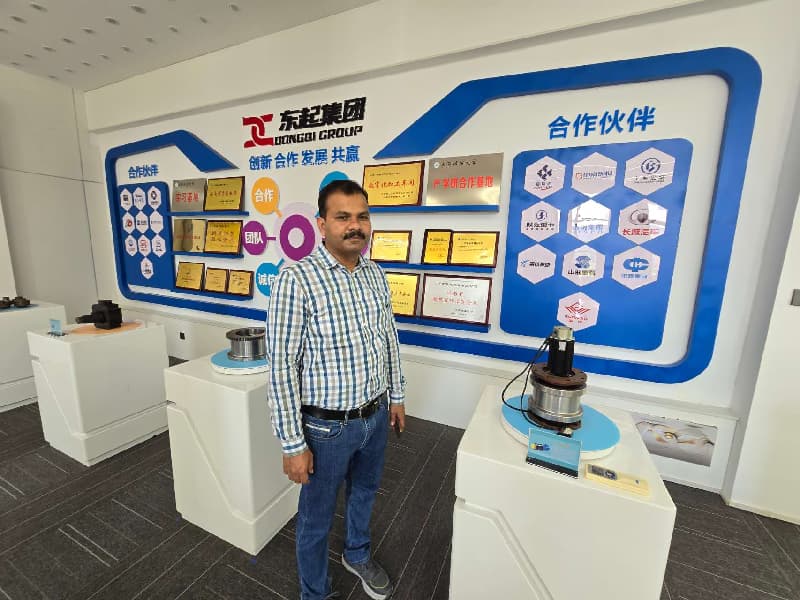
At DONGQI CRANE, a Sino-New Zealand joint venture with over 40 years of manufacturing experience, we actively encourage potential clients to visit our 240,000-square-meter facility, inspect our processes, and ask hard questions. This guide provides a structured framework for conducting a factory visit that yields genuine insight—not just a pleasant tour. We have organized this guide around three essential actions: Observe (what to see), Ask (what to question), and Photograph (what to document). We conclude with a section on reviewing documentation and an exit checklist to ensure you have the information you need.
PART 1: Before You Arrive — Setting the Stage for a Productive Visit
A factory visit should never be a passive walkthrough. It is a structured due diligence exercise. Before you set foot on the manufacturing floor, take three preparatory steps:
Step 1: Request Documentation in Advance
A reputable manufacturer will have no hesitation providing:
- Valid ISO 9001 quality management system certificate and any other applicable certifications (ISO 14001, ISO 45001, CE certification)
- Detailed production process flowcharts
- List of major manufacturing equipment and NDT (Non-Destructive Testing) capabilities
- Sample quality inspection records and material test certificates from recent productions
At DONGQI CRANE, we hold comprehensive international certifications including ISO 9001, ISO 14001, ISO 45001, CE, and GJB9001C, and we provide this documentation to serious buyers before their visit.
Step 2: Understand What Certifications Actually Mean
Many buyers check a box marked “ISO 9001” without understanding what the certification actually verifies. ISO 9001:2015 principally certifies that the manufacturer operates a documented quality management system—not that every individual crane meets a particular standard. A supplier without ISO 9001 certification in 2025 should be viewed with extreme skepticism.
CE marking is essential for any crane entering European markets, confirming compliance with the EU Machinery Directive 2006/42/EC. Additional requirements for European-standard cranes include EN 13001 for structural design.
DONGQI CRANE holds ISO 9001, ISO 14001, ISO 45001, CE, and SGS certifications, with documentation available for inspection in our facility.
Step 3: Prepare a Structured Question List
Too many visitors arrive with a vague intention to “see the factory” and leave without meaningful data. Prepare specific questions organized by category. The most effective approach is to divide your inquiry into three distinct phases, which form the core of this guide: Observe, Ask, and Photograph.
PART 2: What to Observe — Reading the Factory Floor
The factory floor reveals what glossy brochures and polished sales presentations conceal. Here is what to look for systematically.
Observation Point 1: Raw Material Receiving and Storage
Upon entering the factory, observe the raw material yard and incoming material inspection area. What you are truly looking for is evidence of a traceable and validated supply chain.
What to look for:
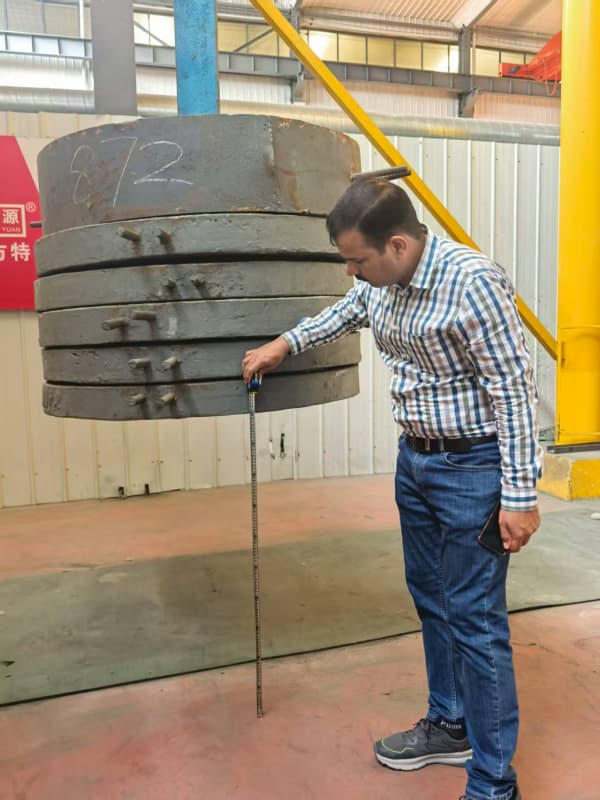
- Steel plate identification: Each plate should have visible markings indicating grade (e.g., Q235B, Q355B), heat number, and mill of origin. These markings are the foundation of traceability. For European-standard cranes, higher-grade steel may be required for structural integrity.
- Organized storage: Plates should be stored by grade and thickness, elevated off the ground on proper racks, not scattered randomly.
- Incoming inspection records: There should be visible documentation at the receiving area showing that incoming materials undergo verification of certifications against national standards and company specifications. Rechecking with random sample inspections of chemical composition and mechanical strength is a sign of a mature quality system.
Red flag: Steel plates with no visible grade markings, or plates of different grades and thicknesses mixed together without clear segregation.
Photograph: The steel plate markings showing grade, heat number, and manufacturer identification. A photo here is the first piece of evidence supporting material traceability claims.
Observation Point 2: Surface Preparation and Blasting
Before any steel can be welded or painted, it must be properly prepared. Observe the surface treatment area.
What to look for:
- Shot blasting equipment: A manufacturer supplying cranes for international markets should operate a shot blasting or grit blasting machine. This process removes mill scale and rust, achieving a surface cleanliness grade. The industry benchmark is Sa 2.5 according to GB8923 or ISO 8501-1 standards.
- Immediate primer application: After blasting, primer should be applied immediately to prevent flash rusting. There should be minimal time—ideally minutes, not hours—between blasting and priming.
What you are verifying: Surface preparation directly determines coating adhesion and long-term corrosion protection. For cranes destined for humid Southeast Asian environments or coastal areas with salt spray, inadequate surface preparation leads to premature structural rust.
Photograph: The shot blasting machine in operation and the freshly blasted surface texture.
Observation Point 3: Cutting, Fit-Up, and Welding — the Heart of the Operation
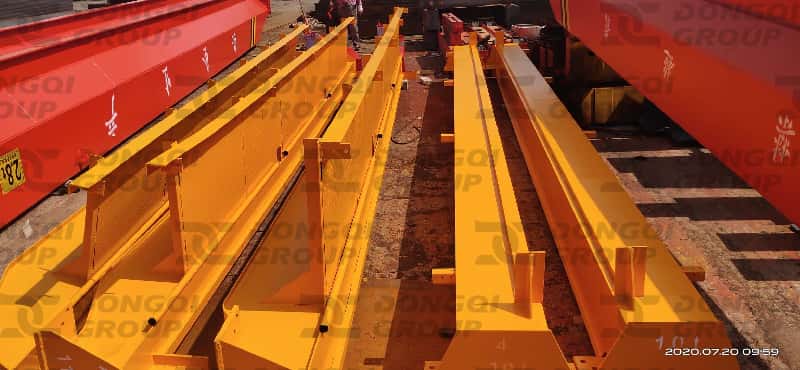
The single most important area of any crane factory is the welding floor. Approximately 70% of a crane’s long-term structural reliability is established here.
What to look for in cutting and preparation:
- CNC-controlled cutting: Plasma or flame cutting should be done with CNC (Computer Numerical Control) equipment, not hand-cut with a torch by eye. CNC cutting ensures that plates fit together with predictable, precise weld gaps—essential for consistent weld penetration.
- Fit-up jigs and fixtures: The main girder assembly should use dedicated fixturing or jigs that maintain precise alignment during tack welding. Welding “by eye” without fixturing leads to dimensional variation and uneven loading.
What to look for in welding execution:
- Automated processes: For the main girder longitudinal seams, you should see automatic submerged-arc welding machines in operation. This is the industry standard for producing deep-penetration, high-quality welds on long structural seams. Manual welding on these critical joints is a significant red flag.
- Visual weld quality: Look at finished welds (not those currently being welded). They should exhibit consistent bead width, smooth ripple pattern, and no visible porosity, undercut, or spatter. The weld profile should be uniform along the entire length.
- Welder certification: Welding stations should display welder qualification certificates. The fabrication craftsmen should be certified and skilled.
Photograph: The CNC cutting machine in operation.
Photograph: The automatic submerged-arc welding equipment running on a main girder.
Photograph: A close-up of a completed weld showing uniform bead profile and clean finish.
Observation Point 4: Non-Destructive Testing (NDT) Station
Walking through the factory, identify where weld inspection occurs. A manufacturer producing cranes for international markets must have internal NDT capability.
What to look for:
- Ultrasonic Testing (UT) equipment: You should see portable UT flaw detectors being used to verify internal weld integrity.
- Magnetic Particle Testing (MT/MPI) equipment: Used for detecting surface and near-surface discontinuities in ferromagnetic materials.
- Radiographic Testing (RT) capability: While RT may not be performed on every weld, a qualified manufacturer should have access to X-ray or gamma-ray inspection for critical joints.
At DONGQI CRANE, we adopt radiographic testing (X-ray or gamma-ray to detect internal discontinuities), ultrasonic testing (UT for detecting internal defects in metal materials), magnetic particle testing (MT for surface and near-surface crack detection), and penetrate testing (PT for non-porous materials). We maintain inspection standards referencing GB/T 3323-2005 and other national standards.
What you are verifying: The manufacturer does not merely claim to inspect welds—they have the equipment and trained personnel on site to do so. Contracting out all NDT is less reliable than maintaining in-house capability.
Photograph: UT equipment being used on a finished girder, showing the inspection in progress.
Observation Point 5: Machining and Component Assembly
Look for the machining area where components such as wheels, gearboxes, and end carriages are produced or prepared.
What to look for:
- CNC machining centers: A serious manufacturer operates multiple CNC machining centers, not just manual lathes. DONGQI CRANE maintains over 500 sets of manufacturing and testing equipment, including 30 CNC machining centers and a high-precision coordinate measuring system.
- Component traceability: Machined components should have identification markings linking them to specific orders or production batches.
Photograph: The CNC machining center—this demonstrates precision manufacturing capability beyond basic fabrication.
Observation Point 6: Assembly and Load Testing
In industrial manufacturing, assembly areas should be clean, organized, and have clear standard operating procedures visible at work stations.
What to look for:
- Crane assembly in progress: You should see cranes in various stages of assembly—not just one or two machines. A factory with a full assembly line demonstrates genuine production throughput.
- Load testing capability: There should be a designated area with test weights and load cells. DONGQI CRANE conducts both static load testing (125% of rated capacity) and dynamic load testing (110% of rated capacity) on completed cranes, with calibrated test weights and certified load cells.
Photograph: A crane undergoing load testing with visible test weights applied.

Observation Point 7: Finished Goods and Packaging
The final area to observe is the finished goods staging and packaging zone.
What to look for:
- Proper preservation: Finished components should be protected with appropriate coatings—not left exposed to the elements. Bolts, pins, and machined surfaces should have rust preventative applied and be wrapped or crated.
- Organized shipping preparation: Export packaging should meet international shipping standards, with clear labeling, fumigation certificates for wood packaging where applicable, and proper securing for container loading.
Photograph: Finished crane components properly wrapped and crated, ready for export shipment.
PART 3: What to Ask — The Questions That Reveal Real Capability
Observing the factory floor gives you visual evidence. Asking the right questions reveals engineering depth, quality philosophy, and after-sales commitment.
Question Category 1: Material Traceability and Quality Assurance
Q1: “May I see a sample Mill Test Certificate (MTC) for a recent production run, specifically for structural steel plates?”
This question cuts to the very heart of your investment‘s integrity and safety. A genuine manufacturer will have MTCs on file for all primary steel plates and structural shapes. These documents, issued by the steel mill, verify the chemical composition and mechanical properties of each heat of steel. Without MTCs, there is no verified link between the steel in your crane and any quality standard.
What you want to hear: “Yes, here is a Mill Test Certificate from our last shipment. All our structural steel is sourced from certified mills, and we maintain full traceability by heat number throughout production.”
Q2: “Can you show me your welding procedure specifications (WPS) and welder qualification records?”
A WPS is a formal document describing exactly how specific welds are to be performed—including base material, filler metal, preheat temperature, welding parameters, and post-weld requirements. Welder qualification records (WPQ) verify that each welder has demonstrated ability to execute those procedures.
What you want to hear: “Yes, we maintain WPS documentation for all joint configurations and WPQ records for all production welders. We can provide these for your review.”
Question Category 2: Certification and Compliance
Q3: “For my destination country in Southeast Asia/Middle East/etc., what specific certification documentation will be provided, and has DONGQI shipped to my country before?”
This question establishes whether the manufacturer understands the specific import requirements of your country. Indonesia requires SNI certification. Thailand requires TISI. Vietnam requires CR (Conformity Certification). Malaysia requires DOSH approval. The Middle East frequently requires SASO compliance. A manufacturer unfamiliar with these requirements may provide equipment that cannot clear customs.
DONGQI CRANE’s answer: We have exported to 96 countries, including Thailand, Vietnam, Indonesia, Saudi Arabia, Malaysia, and across the Middle East and Africa. Our technical documentation team understands the specific requirements for each destination market.
Q4: “When is your current ISO 9001 certificate valid until? May I verify it against the certification body?”
This is a direct, verifiable question. ISO certificates have expiration dates and are issued by accredited certification bodies. A manufacturer who hesitates to provide this information or provides an expired certificate should raise immediate concern.
Question Category 3: Installation, Commissioning, and After-Sales Support
Q5: “If I purchase a crane, exactly who installs it? Who commissions it? Who conducts the load test certification?”
This is where many buyers encounter unexpected costs and confusion. Some manufacturers provide only equipment, leaving all site work to the customer. Others provide complete turnkey installation.
DONGQI CRANE’s answer: We operate a Direct-from-Factory support model. We dispatch our own factory engineers from our Changyuan headquarters to your site anywhere in the world. Our engineers supervise the entire process—overseeing installation performed by your local contractor, conducting alignment checks, managing commissioning, performing the official load test (at 125% static and 110% dynamic), and providing your load test certificate. This ensures your crane is commissioned by the people who built it, not by third parties unfamiliar with the equipment.
Q6: “How do I get spare parts when—not if—they are needed? What are your typical lead times?”
This is a critical question that many buyers neglect to ask, only discovering the answer when a part fails on a Friday afternoon.
DONGQI CRANE’s answer: We do not maintain local spare parts warehouses in destination countries. This is a deliberate choice that eliminates intermediary markups on parts pricing. Instead, we provide Rapid Spare Parts Fulfillment: Parts ship directly from our 240,000-square-meter manufacturing facility in Changyuan via international express courier (DHL, FedEx, UPS). Most standard components ship within 24–48 hours of order confirmation and reach major international destinations within 3–7 business days. For clients who prefer immediate on-site availability, we provide a Recommended Critical Spares List at time of purchase so you can stock high-wear items locally.
Q7: “If I have a technical issue at 10:00 PM my time, what happens?”
This explores the reality of after-hours support.
DONGQI CRANE’s answer: Our engineering team provides remote technical support via WeChat, WhatsApp, or Zoom. Many issues can be diagnosed and resolved through video-assisted troubleshooting without waiting for an engineer to travel. For situations requiring on-site expertise, we dispatch DONGQI factory engineers directly to your facility.
Question Category 4: Production Capacity and Project Management
Q8: “What is your annual production capacity? How many cranes do you produce per year?”
This distinguishes genuine manufacturers from trading companies or small workshops. DONGQI CRANE operates a 240,000-square-meter facility with an annual comprehensive production capacity exceeding 10,000 crane sets. We have over 3,600 employees including 500 technicians and over 70 senior engineers.
Q9: “On my specific order, who will be my primary point of contact from order placement through delivery?”
A competent manufacturer will assign a dedicated project manager who serves as a single communication channel throughout the project lifecycle.
PART 4: What to Photograph — Creating Your Due Diligence Record
Photographs serve as objective evidence that supports—or contradicts—the manufacturer‘s claims. Beyond the specific photo prompts in the Observation section above, capture these additional documentary photos:
Essential Photographs
| What to Photograph | Why This Matters |
|---|---|
| The factory entrance showing the full company name | Verifies you visited the actual manufacturer, not a trading office |
| ISO and CE certificates displayed | Confirms certifications are current and prominently displayed |
| QC inspection station with instruments and records | Documents that quality checks are embedded in the production flow |
| Finished crane undergoing load test with visible test weights | Verifies testing is conducted before shipment, not promised afterward |
| CNC cutting and welding equipment brand nameplates | Confirms the manufacturer uses industrial-grade equipment, not makeshift tools |
| Steel plate identification markings showing grade and heat number | Documents material traceability from source |
| A completed weld showing uniform bead quality | Provides evidence of welding competence |
| The finished goods staging area with equipment prepared for export | Verifies the manufacturer handles international shipping |
PART 5: What to Document — Certification and Paperwork Review
At the conclusion of your tour, request to review the documentation that will accompany any crane purchase. A serious manufacturer can produce these documents on demand.
Documentation Checklist
| Document Type | Purpose |
|---|---|
| ISO 9001 Certificate (current, not expired) | Verifies quality management system is certified |
| ISO 14001 / ISO 45001 Certificates | Environmental and occupational health management |
| CE Certificate / Declaration of Conformity | Required for European market access |
| Mill Test Certificates (sample from recent order) | Confirms steel meets required specifications |
| Welding Procedure Specifications (WPS) | Documents standard welding practices |
| Load Test Certificate (sample from recent crane) | Verifies testing protocol and pass criteria |
| Operation and Maintenance Manual (sample) | Assesses quality of documentation provided |
| Spare Parts Catalog | Confirms parts identification and ordering process |
At DONGQI CRANE, our technical documentation team provides complete certification packages tailored to each destination country’s requirements, including material test certificates, weld procedure specifications, load test reports, and geometric survey documentation.
PART 6: Decoding What You Observed — Walking Away Gracefully
After a thorough factory visit, you may decide the manufacturer is not the right partner. How you exit matters.
If You Are Proceeding to Quote
- Express appreciation for the transparency demonstrated during the visit
- Confirm the next steps in the quotation and design process
- Reiterate your specific requirements to ensure the quote aligns with what you observed
If You Are Declining
- Be professional and specific. Avoid vague statements.
- You may say: “After our visit, we have decided to move forward with a different partner whose capabilities are better aligned with our specific requirements. We appreciate your time and transparency.”
- Do not make promises of future business you do not intend to keep
Post-Visit Follow-Up
Within 48 hours of your visit:
- Send a brief thank-you note to the key contacts you met
- Request any documentation that was promised during the visit
- If proceeding, confirm the timeline for receiving a detailed quotation
Exit Checklist: Could You Answer “Yes” to These Questions?
Before you leave the factory, confirm you have gathered the answers and evidence necessary to make an informed decision:
Observe & Photograph Checklist
- [ ] Did you see the raw material storage area with identifiable grade markings?
- [ ] Did you see shot blasting equipment in operation?
- [ ] Did you see CNC cutting and automatic submerged-arc welding?
- [ ] Did you see NDT equipment (UT, MT, or RT) and inspection records?
- [ ] Did you see a crane undergoing load testing?
- [ ] Did you photograph the key items listed in Part 4?
Question Checklist
- [ ] Did you ask to see a Mill Test Certificate?
- [ ] Did you ask about Welding Procedure Specifications?
- [ ] Did you verify ISO certificate validity?
- [ ] Did you clarify exactly who performs installation and commissioning?
- [ ] Did you fully understand the spare parts ordering process and lead times?
- [ ] Did you confirm after-hours technical support availability?
If you can answer “yes” to all items on both checklists, you are prepared to make a well-informed procurement decision. If you encountered resistance, vague answers, or an unwillingness to provide documentation, consider those significant red flags in your supplier evaluation.
Conclusion
A factory visit is the single most effective tool for separating genuine crane manufacturers from trading companies and marketing operations. By systematically observing production processes, asking targeted technical questions, and photographing key evidence, you can verify—or disprove—the claims made during the sales process.
At DONGQI CRANE, we welcome the scrutiny of a factory visit. Our 240,000-square-meter facility in Changyuan, Henan Province—China’s “Cradleland of Cranes”—houses over 2,000 sets of advanced manufacturing and detection equipment. Our 3,600 employees include 500 technicians and over 70 senior engineers. With ISO 9001, ISO 14001, ISO 45001, CE, and SGS certifications and products operating in 96 countries, we are confident that what you see on our factory floor will confirm the quality we deliver to your facility.
Ready to schedule your factory visit to DONGQI CRANE?
[Contact our international sales team to arrange an on-site tour of our 240,000-square-meter manufacturing facility, meet our engineering staff, and conduct your own due diligence audit.]
DONGQI CRANE: Your Direct-from-Factory Partner for Overhead Cranes, Gantry Cranes, and Custom Lifting Solutions Since 1985.
ISO 9001 • ISO 14001 • ISO 45001 • CE • SGS Certified
240,000m² Manufacturing Facility • 10,000+ Annual Capacity • Exports to 96+ Countries
Direct Engineer Dispatch Worldwide • Express Spare Parts Delivery • Remote Technical Support
