
13-Jan-2026
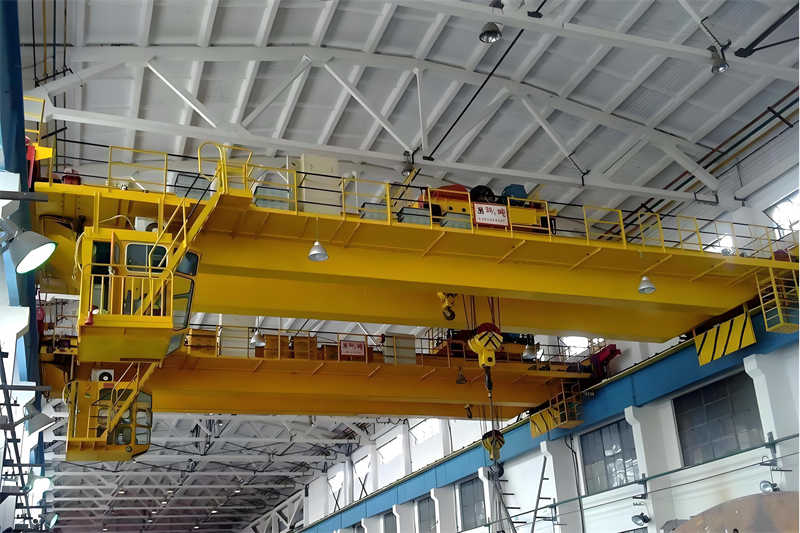
Customized Type 50t Double Beam EOT Overhead Crane: The Pinnacle of Engineered Heavy-Lift Systems
Introduction: The Definitive Solution for Megaload Mastery
The 50-ton capacity represents the apex of standard industrial double girder crane engineering—a domain reserved for the most critical, high-stakes lifting operations that define industries. Here, the crane is not merely a tool but the central nervous system of production in mega-foundries, heavy shipyards, and major power generation facilities. Off-the-shelf solutions are fundamentally inadequate. A Customized Type 50t Double Beam EOT Overhead Crane is therefore a capital-intensive engineering project, representing the pinnacle of integration between structural ballistics, intelligent drive philosophy, and failsafe operational protocols. It is designed to master megaloads with a combination of immense power and micro-scale precision, ensuring uninterrupted, safe operation in the world’s most demanding industrial environments.
This guide outlines the systems-engineering approach required to deploy a 50-ton crane that operates with the reliability of fixed plant infrastructure while maintaining the flexibility of a critical production asset.

The Foundational Imperative for 50-Ton Customization: Engineering for Margin
At 50 tons, engineering moves from optimization to the creation of performance and safety margins. Every design decision is governed by the laws of scale, where forces are monumental and the consequences of failure are unacceptable.
- Architecting for Gigantic Dynamic Loads: The kinetic energy and momentum of a 50-ton moving mass require a structure designed as a damped dynamic system, not just a static beam. Customization involves advanced computational fluid dynamics (CFD) for wind loading (if applicable) and transient dynamic FEA to simulate emergency stops, side-pulls, and load swings, ensuring the entire system possesses inherent stability and vibration damping characteristics.
- Precision as a Systems Engineering Discipline: Controlling a 50-ton load to millimeter accuracy is a feat of integrated cyber-physical systems. It necessitates the co-engineering of heavy-duty mechanics with industrial servo-grade motion control networks. Customization allows for the implementation of active load stabilization, inertial measurement unit (IMU)-based positioning, and adaptive drive tuning that compensates for mechanical wear and thermal expansion in real-time.
- Designing for Survivability and Lifecycle Value: In M8 (Mill Duty) and beyond, the primary cost driver is operational availability. A custom 50-ton crane is engineered for survivability. This includes specifying components with derated operational parameters (e.g., motors and gearboxes operating at 70-80% of rated capacity under normal load), implementing modular and redundant subsystems for hot-swapping, and integrating a comprehensive Condition-Based Monitoring (CBM) system to predict and preempt failures.
Core Engineering Philosophy: The Integration of Ballistic Structure, Deterministic Control, and a Defensive Safety Architecture
Our design paradigm for a 50-ton crane is built on a trinity of overarching principles: creating a ballistically resilient structure, a deterministic and intelligent control network, and a defensive, multi-barrier safety architecture.
- Ballistically Resilient Structural System:
- The girders are super-heavy, multi-cellular box sections fabricated from quenched and tempered high-yield steel (e.g., S690QL or equivalent). Their design is validated through non-linear FEA and fatigue life analysis across millions of load cycles, ensuring they withstand combined bending, torsion, and shock loads while maintaining deflection within L/1200 or stricter tolerances.
- The end carriage system is a four-point, low-inertia design with hydraulic or spring-loaded equalization beams on each side. This ensures uniform wheel load distribution even on imperfect runways, dramatically reducing rail and wheel flange wear while preventing derailment.
- Multi-Drive, High-Redundancy Hoist System:
- A dual-motor, dual-gearbox, dual-brake hoist configuration is standard. This “2×2” architecture provides full redundancy; the system can operate at half speed with one complete drivetrain offline. Motors are typically water-cooled AC synchronous types for maximum power density and thermal management.
- The system incorporates integrated weighing instrumentation with accuracy within 0.1% of full scale and a hook rotation drive for precise angular positioning of the load.
- Deterministic, Networked Motion Control:
- Motion is governed by a synchronized, fiber-optic Ethernet-based drive network (e.g., PROFINET IRT, EtherCAT). Each drive (hoist, trolley, bridge left, bridge right) is an intelligent node, allowing for virtual master-slave synchronization, electronic gearing, and centralized trajectory planning.
- The bridge travel utilizes active steering control, where individual wheel drives are automatically adjusted to correct skew in real-time based on laser or encoder feedback, ensuring perfectly parallel travel regardless of rail condition or load position.
- Tiered, Context-Aware Operational Interface:
- Primary operation is from a suspended, vibration-isolated, and pressurised operator’s cab with full environmental control. The interface is a multi-touch industrial PC running a custom SCADA/HMI, providing a 3D digital twin view of the crane, load, and obstacle zones.
- Secondary control is via a hardwired, portable remote control station with a dedicated fiber-optic link for ultimate reliability in electromagnetically noisy environments, supplemented by a backup radio remote.
- Defensive, Multi-Barrier Safety Architecture:
- Safety is designed as independent, overlapping layers of protection (the “Swiss Cheese” model). It features a SIL-3 certified, triplicated safety controller managing all critical safety functions (overload, limits, brakes).
- Advanced defensive systems include 3D LiDAR-based intrusion protection creating dynamic exclusion zones, acoustic emission monitoring for early detection of micro-cracks in critical welds, wire rope integrity monitoring, and an independent hydraulic emergency lowering system powered by a dedicated diesel-hydraulic power unit.
Technical Specifications at a Glance
The table below details the engineered foundation of our Customized Type 50t Double Beam EOT Overhead Crane, representing the baseline for a premier megaload handling system.
| Parameter | Specification | Details / Customizable Options |
|---|---|---|
| Capacity | 50 Tons | Designed, analyzed, and certified per global standards for the most severe duty (FEM M8, CMAA Class F, HISO). |
| Span | Customized (e.g., 25m to 80m+) | Girder design is a study in dynamic stiffness and mass optimization to control natural frequency and avoid operational harmonics. |
| Lifting Height | Customized (e.g., 20m to 50m+) | Configurations for extreme lifts, such as in nuclear reactor buildings or large component assembly halls. |
| Work Duty Class | A8 / Special Mill Duty (M8) / Class F (Continuous Severe Duty) | The benchmark for extreme industrial service. All component service factors exceed minimum requirements by a significant margin. |
| Speed (Governed by Networked Drive System) | Orchestrated movement prioritizing stability over raw speed. | |
| – Hoisting (Main) | 1.5 – 3.5 m/min (adjustable, multi-range) | Programmable “micro-inch” mode for sub-millimeter final positioning. |
| – Traversing (Crab) | 7.0 – 12.0 m/min (adjustable) | Active trolley stabilization to minimize load pendulum. |
| – Traveling (Bridge) | 15.0 – 25.0 m/min (adjustable) | Active skew control and synchronized four-corner drive are non-optional. |
| Control & Power Voltage | 3.3kV / 6.6kV Medium Voltage AC, 50/60Hz | Medium voltage is standard for efficiency, reduced cable size, and improved motor starting performance. |
| Control Mode | Multi-Tiered: Isolated Cab + Hardwired Remote + Backup Radio + Maintenance Pendant | Designed for mission-critical operational flexibility and redundancy. |
| Drive Motors | Water-cooled AC synchronous or high-torque vector motors, IP68 where applicable, Class H+/N insulation. | Fitted with embedded temperature, vibration, and partial discharge monitoring sensors. |
| Braking System | Quintuple-system: 1) Regenerative (drive) 2) Spring-applied mechanical 3) Hydraulic disc (service) 4) Emergency hydraulic disc (fail-safe) 5) Aerodynamic/eddy current retarder (for long down-travel). | A fully independent, automatically tested emergency braking circuit is mandatory. |
| Girder Type | Super-Heavy, Multi-Chambered Box Girder with Integral Stiffening | Fabricated from ultra-high-strength steel, with all primary welds 100% NDT (UT/RT) inspected and stress-relieved. |
| Key Safety & Health Features | Defensive Systems Architecture | – SIL-3 Safety Controller with Redundant Logic Solvers – Independent Wire Rope & Hook Load Path Monitoring – Real-Time Structural Fatigue Life Tracking – Dynamic Load Chart & Anti-Tip Calculation – Black Box Event Recorder (Audio/Video/Data) |
| Ambient Consideration | -45°C to +85°C | Survival-engineered packages: Ultra-High Temperature (ceramic insulation, >+120°C), Cryogenic (specialized steels/elastomers), Corrosive (duplex stainless steel components, monolithic coatings). |
| Protective Finish | SA 3.0 blasting, thermal-sprayed zinc/aluminum (TSZ/TSA) base, sealed with high-performance polysiloxane topcoat. | Multi-layer defense system certified for the specific aggressive industrial atmosphere, providing a 25+ year corrosion warranty. |
Typical Applications: The Engine of Global Heavy Industry
This crane is engineered as the central handling system for the most monumental industrial and engineering challenges:
- Primary Steelmaking & Integrated Mills: Charging basic oxygen furnaces (BOF), handling torpedo ladle cars, and manipulating massive slag pots in continuous 24/7 operations.
- Heavy Press & Forging Lines (50,000-ton+): Feeding and manipulating mega-forgings for aerospace, defense, and energy sectors, where precision and reliability are non-negotiable.
- Nuclear Island Component Handling: Installing steam generators, pressurizers, and reactor vessel heads within containment buildings, requiring absolute precision and safety under nuclear quality assurance (NQA-1) protocols.
- Mega-Shipyard Goliath Cranes (as auxiliary/transfer cranes): Working in tandem with larger gantry cranes to position mega-blocks, main engines, and offshore platform topsides.
- Heavy Hydroelectric & Thermal Power Plant Maintenance: Lifting and replacing entire turbine runners, generator rotors, and supercritical boiler sections.
Your Specification Checklist: The Foundation for a 50-Ton Engineering Partnership
The development of a 50-ton crane is a major capital project. To initiate a meaningful Front-End Engineering Design (FEED) study, the following exhaustive data is essential:
- Complete Site Master Dossier: Geotechnical survey reports, certified structural calculations for the building and crane runway (including fatigue analysis), as-built drawings of all interfaces, and seismic hazard analysis if applicable.
- Quantified Mission Profile: A detailed operational simulation model defining the exact duty cycle (FEM M8 profile), including statistical distribution of load weights, lift heights, travel distances, and the frequency and magnitude of any atypical shock or side-load events.
- Definitive Load & Process Integration Protocol: Complete 3D models and mass properties of all critical loads. Detailed specifications for all automated below-the-hook devices and the exact interface requirements (mechanical, electrical, data) with any external automation or manufacturing execution systems (MES).
- Environmental & Regulatory Compliance Matrix: A definitive matrix of all applicable environmental conditions and the complete set of mandatory and voluntary codes, standards, and client-specific specifications that will govern the design, manufacture, and commissioning (e.g., ISO, FEM, ASME, client-specific N-Stamp).
- Systems Integration & Digital Twin Mandate: Requirements for integration into the plant’s digital ecosystem (e.g., data via OPC UA), the desired level of fidelity for the digital twin (for simulation and training), and specifications for remote expert support and predictive maintenance platforms.
- Lifecycle Management & Validation Master Plan: Requirements for staged design reviews (PDR, CDR), comprehensive Factory Acceptance Testing (FAT) including dynamic load testing, Site Acceptance Testing (SAT) protocols, and a detailed plan for long-term spare parts management, operator training simulators, and technical support.
Commission Your Pinnacle Heavy-Lift Asset
A 50-ton crane is a legacy investment, defining your facility’s capability for a generation. A Customized Type 50t Double Beam EOT Crane is more than machinery; it is the culmination of mechanical, electrical, and software engineering excellence, designed to deliver unparalleled performance, safety, and intelligence at the very frontier of industrial lifting.
Contact our Executive Engineering & Major Projects Group to commission a full FEED study and receive a definitive project specification that transforms your most ambitious lifting challenges into a reliable, daily operation.
Explore Our Full Range of Solutions:
- For other severe mill-duty applications, review our [Customized Type 40t Double Beam EOT Crane].
