
25-Mar-2025
Double-Girder European-style Electric Hoist Overhead Crane User Manual
1. Introduction
1.1 Product Overview
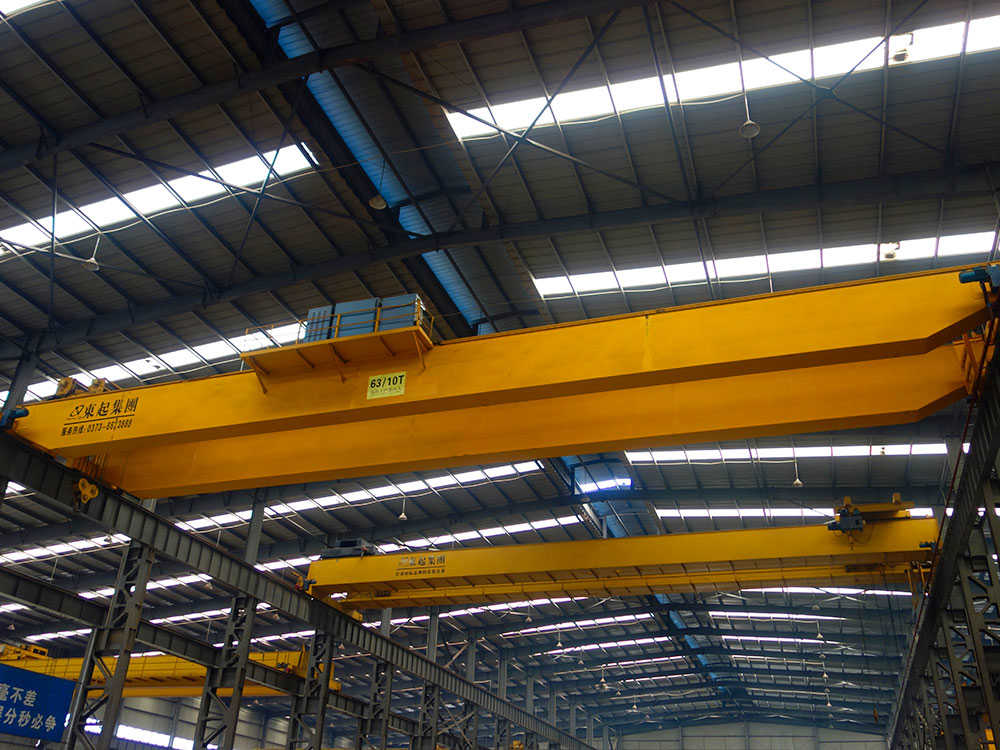
The Double-Girder European-style Electric Hoist Overhead Crane is a high-performance lifting solution designed for modern industrial applications. Combining advanced European engineering with robust construction, this crane delivers superior load-handling capacity, precision control, and long-term reliability—ideal for the demanding environments of Singapore, Malaysia, Indonesia, Thailand, Vietnam, and other Southeast Asian markets.
1.2 Key Features & Benefits
✔ High Efficiency & Stability
- Double-girder design ensures greater load-bearing capacity (up to 20T or customizable).
- European-style electric hoist with low noise, energy-saving motors, and variable-speed lifting.
✔ Smart & Automated Operation
- PLC control system for precise positioning, automated workflows, and remote monitoring.
- Optional anti-sway technology for delicate or confined-space lifting.
✔ Safety & Durability
- Multiple safety mechanisms: Overload protection, emergency stop, limit switches, and anti-collision sensors.
- Corrosion-resistant coating for humid, tropical climates.
✔ Compliance & Certification
- Meets Singapore SS 536:2008, CE, ISO 9001, and regional safety standards.
2. Structural Components & Specifications
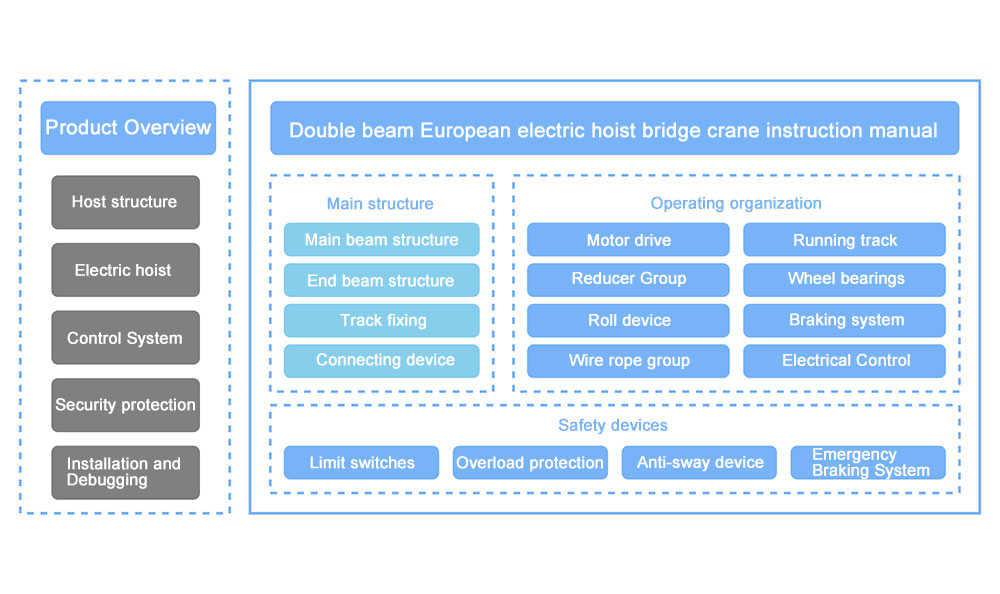
2.1 Main Structure
| Component | Description |
|---|---|
| Main Girders | High-strength welded steel, optimized for long-span applications (up to 30m). |
| End Carriages | Reinforced design with double-wheel configuration for smooth rail travel. |
| Electric Hoist | German/Italian-made motor, IP55 protection, thermal overload prevention. |
| Control System | Radio remote control (optional), touchscreen interface, real-time diagnostics. |
| Safety Devices | Redundant braking, load moment indicator (LMI), emergency power-off. |
2.2 Technical Specifications
- Lifting Capacity: 1T ~ 20T (customizable up to 50T).
- Span: 10m ~ 30m (adjustable per facility layout).
- Lifting Speed: 0.5m/min ~ 10m/min (variable frequency drive optional).
- Ambient Temperature: -20°C to +50°C (tropicalized version available).
3. Installation & Commissioning
3.1 Pre-Installation Preparation
3.1.1 Site Assessment
- Verify foundation strength (minimum load-bearing capacity: 1.5 x SWL).
- Ensure adequate clearance (≥500mm from walls/obstructions).
- Check runway beam straightness (≤3mm deviation per 10m).
3.1.2 Tools & Equipment
| Item | Specification |
|---|---|
| Laser Level | Accuracy ±0.1mm/m |
| Torque Wrench | 100–500 Nm (calibrated) |
| Load Cells | ±1% accuracy for test weights |
3.1.3 Safety Precautions
- Erect barricades with warning signs.
- Confirm lockout/tagout (LOTO) procedures for electrical work.
3.2 Step-by-Step Installation
3.2.1 Runway Beam Alignment
- Laser Survey: Map beam elevation (tolerance: ±2mm across span).
- Shim Adjustment: Use stainless steel shims (0.5–5mm) to correct misalignment.
- Bolt Torquing:
- M20 bolts: 250 Nm (Grade 8.8)
- Apply anti-seize compound in coastal areas.
3.2.2 Crane Assembly
- Main Girder Erection
- Use mobile crane (≥120% of girder weight) for lifting.
- Temporary bracing required if wind speed >8 m/s.
- End Truck Installation
- Align wheel flanges symmetrically (gap: 10–15mm from rail).
- Verify wheel concentricity (runout ≤1mm).
3.2.3 Hoist Mounting
- Parallelism Check: Measure diagonal distances (difference ≤3mm).
- Wire Rope Threading:
- Apply red grease at drum contact points.
- Minimum 3 dead wraps on drum.
3.2.4 Electrical Wiring
- Power Supply:
- Singapore: 400V/50Hz, TN-S earthing.
- Indonesia: 380V/50Hz, IT earthing (insulation monitoring required).
- Cable Management:
- Festoon cables: 15% extra slack for travel.
- IP65-rated junction boxes in humid zones.
3.3 Commissioning Procedures
3.3.1 Pre-Operational Tests
| Test | Method | Acceptance Criteria |
|---|---|---|
| Insulation Resistance | 500V megger test | ≥1MΩ (motors), ≥10MΩ (control circuits) |
| Limit Switch Function | Manual triggering | Stops motion within 100mm of target |
| Brake Performance | 100% SWL hold for 15 mins | ≤5mm slippage |
3.3.2 Load Testing
- Static Test
- 125% SWL for 10 minutes.
- Inspect for permanent deformation (max 0.1% span deflection).
- Dynamic Test
- 110% SWL at all speed ranges.
- Monitor vibration levels (<2.5mm/s RMS).
3.3.3 Final Adjustments
- Creep Speed Calibration: 1–5% rated speed for precision positioning.
- Anti-Sway Tuning (if equipped): Adjust PID parameters via HMI.
3.4 Documentation & Handover
- As-Built Drawings: Updated with field modifications.
- Certification Package:
- Factory Acceptance Test (FAT) reports.
- Singapore MOM Form PM-07 (for registered cranes).
- Training Records:
- 8-hour hands-on session covering:
- Emergency recovery procedures.
- Daily inspection checklist.
- 8-hour hands-on session covering:
3.5 Regional Adaptations
- Monsoon Season (Malaysia/Thailand):
- Apply VCI (Vapor Corrosion Inhibitor) coating on bolts.
- Weekly drainage checks for runway beams.
- High-Temperature (Middle East exports):
- Upgrade to Class H insulation (180°C rating).
- Install sunshades for control panels.
4. Operating Procedures
This section provides detailed, step-by-step instructions for the safe and efficient operation of the Double-Girder European-style Electric Hoist Overhead Crane. It covers pre-operation checks, standard lifting procedures, emergency protocols, and specialized operations to ensure compliance with Singapore and Southeast Asian safety regulations.
4.1 Pre-Operation Checks
4.1.1 Daily Inspection Checklist
Before starting the crane, the operator must perform the following checks:
| Check Item | Acceptance Criteria | Action if Failed |
|---|---|---|
| Wire Rope & Hook | No broken wires, no deformation | Replace if damage exceeds 10% of strands |
| Brake System | No abnormal noise, full engagement | Adjust or replace brake pads |
| Limit Switches | Functional at all travel extremes | Recalibrate or replace |
| Control Panel | No error codes, buttons responsive | Reset PLC or call technician |
| Rail & Wheel Condition | No cracks, proper lubrication | Clean debris, re-grease |
| Emergency Stop | Immediate shutdown when pressed | Check wiring, replace if faulty |
4.1.2 Power-Up Sequence
- Switch on main power supply (ensure voltage matches local standards).
- Initialize PLC control system (wait for “Ready” status on HMI).
- Test all motions at low speed (hoist up/down, trolley left/right, bridge forward/back).
- Verify safety interlocks (e.g., overload alarm, anti-collision sensors).
4.2 Standard Lifting Procedures
4.2.1 Load Handling Best Practices
✔ Correct Slinging Techniques
- Use approved lifting gear (e.g., wire rope slings, shackles).
- Ensure load balance (center of gravity below hook).
- Avoid side-loading or dragging (strictly vertical lifting).
✔ Lifting Sequence
- Position crane directly above load (use laser guide if available).
- Attach slings/rigging (check securement before lifting).
- Lift slowly (5–10 cm) to confirm stability.
- Hoist to desired height, then move smoothly along travel path.
✔ Traveling with Load
- Maintain low speed (<50% max speed for heavy loads).
- Keep load minimum 1m above obstacles.
- Use spotter for blind spots.
4.2.2 Operator Controls
- Pendant Control:
- Joystick Operation:
- Up/Down: Hoist control (variable speed).
- Left/Right: Trolley traverse.
- Emergency Stop: Mushroom button (halts all functions).
- Radio Remote (Optional):
- Safe Operating Distance: ≤30m (clear line of sight required).
4.3 Emergency Procedures
4.3.1 Immediate Response Actions
| Emergency Scenario | Corrective Action |
|---|---|
| Power Failure | Engage backup power (if equipped) or use manual lowering. |
| Mechanical Failure | Activate E-stop, secure load with secondary brakes. |
| Load Slippage | Lower load slowly to ground, inspect rigging. |
| Fire/Electrical Hazard | Cut power, use CO₂ extinguisher (never water). |
4.3.2 Rescue Protocols
- Personnel trapped:
- Isolate crane power.
- Use manual release to lower load (see Section 4.4.2).
- Structural damage:
- Evacuate area, notify safety officer.
4.4 Specialized Operations
4.4.1 Heavy/Outsize Loads
- Permit-to-Work Required: For loads >80% SWL.
- Additional Precautions:
- Use two spotters for guidance.
- Anti-sway mode (if equipped) to minimize oscillations.
4.4.2 Manual Override (Fail-Safe Mode)
- Locate manual release lever (typically near hoist motor).
- Engage release while applying hand brake.
- Lower load gradually (max speed 0.5m/min).
4.4.3 Multi-Crane Lifts
- Coordinated by a single supervisor.
- Load sharing devices mandatory for balanced distribution.
4.5 Post-Operation Protocol
- Park crane in designated area (away from walkways).
- Lower hook to lowest safe position.
- Complete logbook entries:
- Hours operated.
- Any malfunctions observed.
- Report defects via maintenance request system.
4.6 Regional Adaptations
- Singapore (MOM Compliance):
- Daily inspection logs must be retained for 3 years.
- Malaysia (DOSH):
- Tagging system for defective cranes (red tag = out of service).
- Tropical Environments:
- Weekly corrosion checks on wire ropes.
Summary of Key Rules
🚫 NEVER override safety devices.
🚫 NEVER lift people or unstable loads.
✅ ALWAYS use PPE (hard hat, safety shoes, high-vis vest).
5. Maintenance & Troubleshooting
5.1 Preventive Maintenance Schedule
| Task | Frequency | Procedure |
|---|---|---|
| Lubricate Rails | Weekly | Use EP2 grease on rail contact surfaces. |
| Inspect Electricals | Monthly | Tighten terminals, check insulation (≥1MΩ). |
| Load Test | Annually | 110% SWL test with certified weights. |
5.2 Common Faults & Solutions
🔧 Hoist Not Responding
- Check fuses → Reset thermal protector → Verify control voltage.
🔧 Uneven Travel
- Adjust wheel alignment → Clean rail debris → Balance load.
🔧 Overload Alarm
- Reduce load → Verify LMI calibration → Inspect load cell.
6. Safety & Compliance
6.1 Workplace Safety Rules
🚫 No modifications without manufacturer approval.
🚫 No unauthorized personnel in lifting zone.
🚫 No side-pulling—always lift vertically.
6.2 Legal Requirements
- Singapore: MOM inspections every 12 months.
- Thailand: Factory Act B.E. 2535 compliance.
7. Accessories & Customization
7.1 Optional Upgrades
- Storm Locking Device: For typhoon-prone areas (Philippines/Vietnam).
- Explosion-Proof Kit: For oil/gas industries (ATEX certification).
7.2 Spare Parts Supply
- Regional warehouses in Singapore & Malaysia (48-hour delivery).
- Genuine parts: Wire ropes (DIN 3060), Brake pads (EN 13155).
