
20-Apr-2026
Electric Hoist Procurement: CD Type vs. MD Type vs. European Hoist – A Complete Decision Guide for Buyers
A Technical Selection Resource from DONGQI CRANE for Procurement Managers and Plant Engineers
The electric hoist is the heart of any overhead crane system. It generates the lifting force, controls the speed, and ultimately determines whether your material handling operation runs smoothly, safely, and economically. Yet many buyers treat hoist selection as an afterthought—simply matching a rated capacity to a crane and moving on.
That approach is costly. Selecting the wrong hoist type can mean overspending on features you will never use, or worse, underspecifying for a demanding application and facing premature failures, unplanned downtime, and warranty disputes.
At DONGQI CRANE, a Sino-New Zealand joint venture with over 40 years of manufacturing experience and products operating in 96 countries, we manufacture and supply all three major categories of electric wire rope hoists: CD type (single-speed), MD type (dual-speed), and European-style hoists. We do not have a vested interest in selling you the most expensive option. Our goal is to help you select the right hoist for your specific application, duty cycle, and budget.
This guide provides a comprehensive, technically grounded comparison to help you make an informed procurement decision.
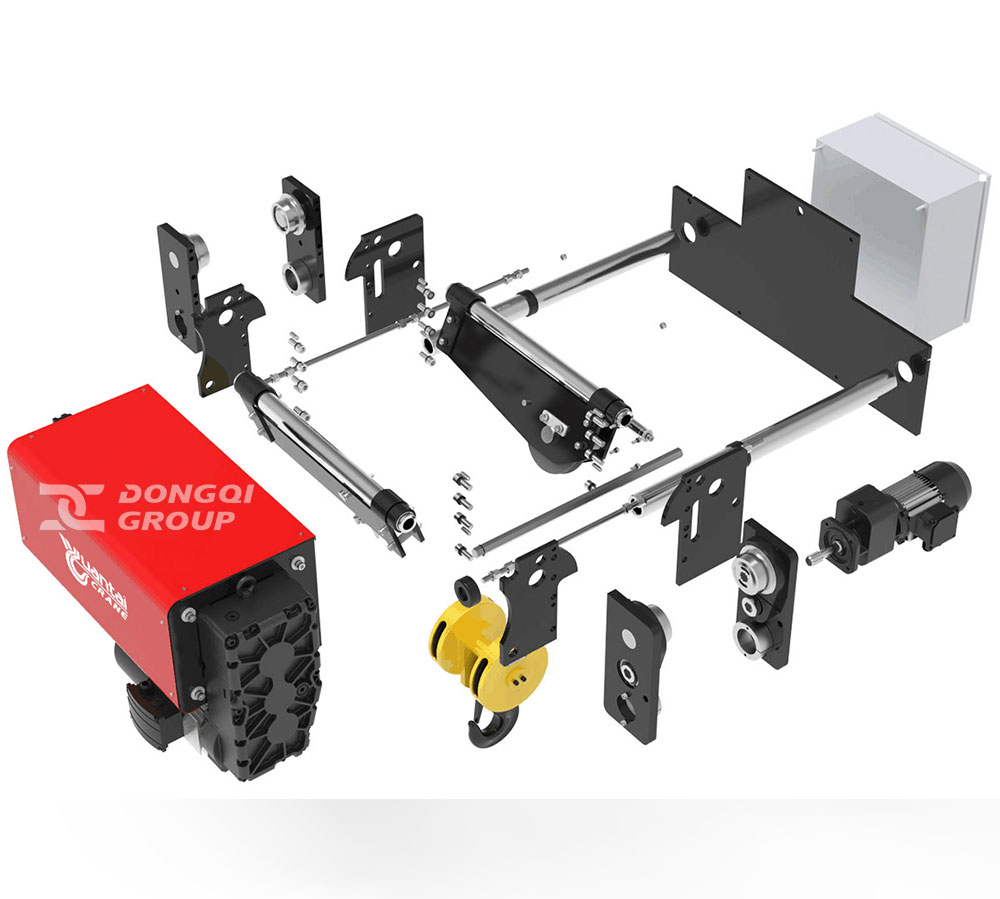
The Three Hoist Types at a Glance
Before diving into detailed specifications, here is a quick reference to orient you:
| Criteria | CD Type (Single-Speed) | MD Type (Dual-Speed) | European-Style Hoist |
|---|---|---|---|
| Core Distinction | One lifting speed | Two lifting speeds (fast + slow, typically 10:1 ratio) | FEM/DIN standard design with advanced VFD control |
| Typical Capacity Range | 0.5 – 32 tons | 0.5 – 20 tons | 1 – 80+ tons |
| Typical Work Duty | M3 – M4 (light to medium duty) | M3 – M4 (medium duty with precision needs) | M5 – M7 (medium to heavy/continuous duty) |
| Speed Control | Fixed speed only | Fast/slow toggle | Variable frequency drive (VVVF) – stepless speed regulation |
| Price Positioning | Most economical | 10–20% higher than CD type | 30–50%+ higher than CD/MD types |
| Best For | General-purpose lifting where speed precision is not critical | Applications requiring precise positioning (mold handling, assembly, maintenance) | High-frequency production, heavy industry, automation integration |
Section 1: CD Type Electric Hoist – The Economical Workhorse
What Is a CD Type Hoist?
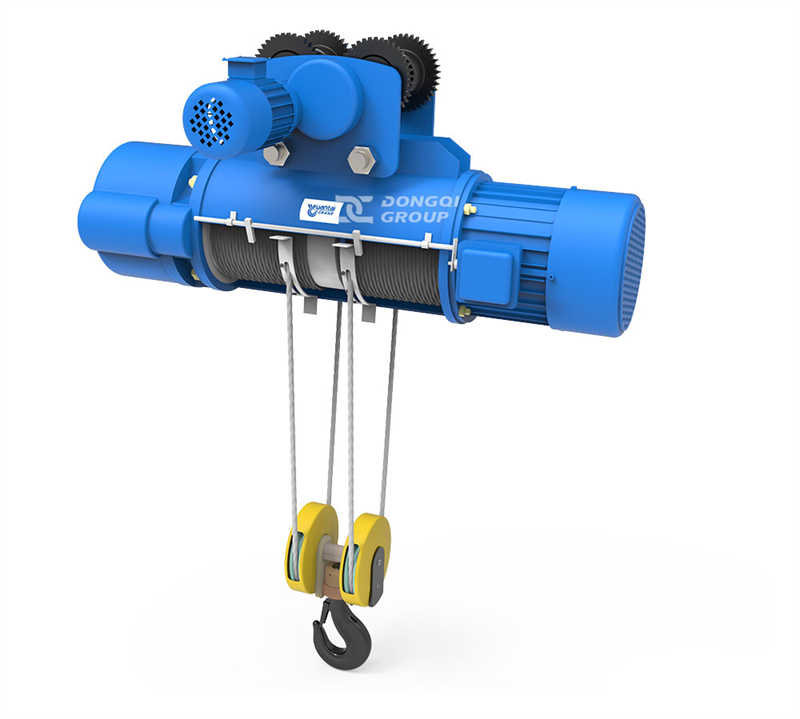
The CD type (CD1 series) wire rope electric hoist is the industry standard for general-purpose lifting applications worldwide. It is a compact, reliable, and cost-effective solution that has served as the backbone of factory lifting operations for decades. The CD1 model wire rope electric hoist is equipped with a ZD-style single-speed motor, providing one consistent lifting speed. Standard lifting speeds are typically 8 m/min for capacities up to 5 tons, 7 m/min for 10 tons, and 3.5 m/min for 16–20 tons.
The hoist features a conical rotor motor that integrates power and braking in a single unit, eliminating the need for an external brake system. This design contributes to the hoist’s compact size, light weight, and ease of maintenance. Components are standardized and highly interchangeable, making repairs straightforward and spare parts readily available.
Technical Specifications of DONGQI CRANE CD Type Hoists
| Parameter | Specification |
|---|---|
| Lifting Capacity | 0.5 – 32 tons |
| Lifting Height | 3 – 30 meters (custom heights available) |
| Lifting Speed | 8 m/min (0.5–5T), 7 m/min (10T), 3.5 m/min (16–20T) |
| Travel Speed | 20 m/min or 30 m/min |
| Work Duty | M3 (JC25%) or M4 |
| Power Supply | 380V–660V, 50Hz or 60Hz, 3-phase |
| Protection Class | IP44 / IP54 |
| Insulation Class | B or F |
| Operating Temperature | -20°C to +40°C |
Ideal Applications for CD Type Hoists
CD type hoists are the right choice when your operation fits the following profile:
- General manufacturing and assembly: Moving raw materials, work-in-progress components, and finished goods in standard production environments
- Warehousing and logistics: Loading and unloading trucks, staging materials, inventory management
- Maintenance workshops: Occasional equipment changeouts, pump and motor repairs
- Light to medium duty cycles: Operations with fewer than 50 lifts per day and typical loads below 70% of rated capacity
When CD type is sufficient: If your lifting operations are straightforward—pick up a load, move it, set it down—and you do not require millimeter-level positioning accuracy, a CD type hoist provides reliable performance at the lowest capital cost. The hoist can be mounted on single girder overhead cranes, single girder gantry cranes, jib cranes, and monorail systems.
Limitations to Understand
The single fixed speed of CD type hoists means they cannot provide slow, controlled positioning. When approaching a precise placement location, operators must “jog” the hoist—repeatedly starting and stopping—which accelerates wear on contactors and brakes. For applications requiring precise load placement, this limitation becomes a productivity constraint and a maintenance cost driver.

Section 2: MD Type Electric Hoist – Precision When You Need It
What Is an MD Type Hoist?
The MD type (MD1 series) wire rope electric hoist builds upon the CD type foundation by adding a second lifting speed—a slow speed typically operating at approximately one-tenth of the fast speed. The MD1 is equipped with a ZDS-style double-speed motor, which incorporates both a main motor and a smaller auxiliary motor for slow-speed operation.
This dual-speed capability transforms how operators handle loads requiring precise placement. For most of the lift, the hoist operates at full speed for efficiency. As the load approaches its destination, the operator switches to slow speed, allowing controlled, incremental positioning. This eliminates the need for jogging, reduces mechanical stress, and significantly improves placement accuracy.
Technical Specifications of DONGQI CRANE MD Type Hoists
| Parameter | Specification |
|---|---|
| Lifting Capacity | 0.5 – 20 tons |
| Lifting Height | 3 – 30 meters (custom heights available) |
| Lifting Speed | Fast: 8/7/3.5 m/min (depending on capacity); Slow: ~0.8/0.7/0.35 m/min (10:1 ratio) |
| Travel Speed | 20 m/min or 30 m/min |
| Work Duty | M3 – M4 |
| Power Supply | 380V–660V, 50Hz or 60Hz, 3-phase |
| Motor Configuration | Dual motor set (main motor + auxiliary slow-speed motor) |
| Control Options | Pendant control, wireless remote control |
Ideal Applications for MD Type Hoists
MD type hoists are the right choice when your operation requires both productivity and precision:
- Mold handling and die changes: Positioning heavy tooling into presses with millimeter accuracy
- Machine tool maintenance: Installing and removing spindles, motors, and precision components
- Assembly operations: Aligning heavy components during equipment assembly
- Sand casting and foundry work: Precise mold closing and core placement
- Sensitive load handling: Moving fragile or expensive equipment where impact must be minimized
The precision advantage: The MD type hoist allows operators to approach the target position gradually, reducing the risk of load swing, collision, or misalignment. This is particularly valuable in applications where workpiece or tooling damage from inaccurate placement would be costly. The dual-speed configuration makes the MD type significantly more versatile than the CD type, justifying its modest price premium—typically 10–20% higher.
CD vs. MD: Making the Right Choice
| Selection Factor | Choose CD Type If… | Choose MD Type If… |
|---|---|---|
| Positioning Accuracy Required | General placement is acceptable; jogging is tolerable | Precise positioning is required; jogging would damage equipment or slow production |
| Load Sensitivity | Loads are robust and tolerate minor positioning errors | Loads are fragile, precision-machined, or require careful alignment |
| Operator Skill Level | Experienced operators can jog accurately | Less experienced operators need controlled slow speed for safety |
| Production Throughput | Cycle times are not critical | Slow-speed positioning prevents rework and improves overall cycle efficiency |
| Maintenance Budget | Contactors and brakes can be replaced as needed | Reducing jogging extends component life and reduces maintenance frequency |
Bottom line: If your application involves any scenario where the operator routinely says “just a little more… a little more…” while jogging the hoist, you should strongly consider upgrading from CD to MD type. The incremental cost is small compared to the productivity gains and reduced maintenance.
Section 3: European-Style Hoist – The Premium Performance Tier
What Is a European-Style Hoist?
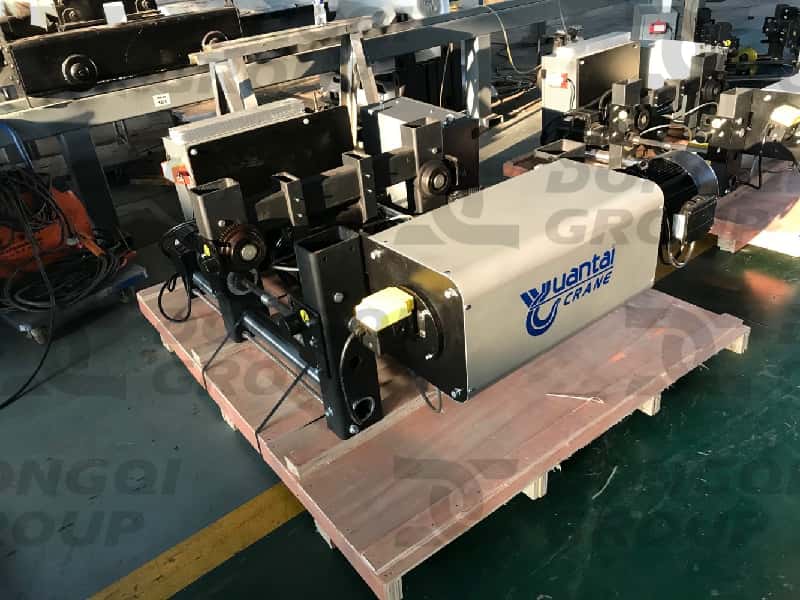
European-style electric wire rope hoists represent the current state of the art in industrial lifting technology. Designed according to FEM (European Federation of Material Handling) and DIN (German Institute for Standardization) standards, these hoists incorporate advanced engineering features that deliver superior performance, higher duty cycles, and lower total cost of ownership in demanding applications.
European-style hoists are designed according to FEM and DIN standards. These certifications ensure that the product design, manufacturing, and testing processes comply with the highest international standards for compact structure, low noise, energy efficiency, and environmental protection.
Key design characteristics include:
- Motor-Gearbox-Brake Integration: The hoisting mechanism combines the motor, gearbox, and brake into a single compact unit, reducing weight, minimizing maintenance points, and improving reliability
- Modular Architecture: Components are standardized and interchangeable across the product range, simplifying spare parts management and reducing repair complexity
- Variable Frequency Drive (VVVF) Control: Stepless speed regulation provides smooth acceleration and deceleration, eliminating mechanical shock and enabling precise load positioning without separate slow-speed motors
- Low-Headroom Design: The compact configuration maximizes available hook height in constrained buildings—critical for facilities with limited ceiling clearance
Technical Specifications of DONGQI CRANE European-Style Hoists
| Parameter | Specification |
|---|---|
| Lifting Capacity | 1 – 80+ tons (customizable) |
| Lifting Height | 6 – 50+ meters (customizable) |
| Lifting Speed | Variable: 0.5/3 m/min to 1.4/8.5 m/min (VVVF stepless or dual-speed options) |
| Travel Speed | 5 – 20 m/min (variable frequency controlled) |
| Work Duty | M5 – M7 (FEM standard) |
| Power Supply | 220V–480V, 50/60Hz, 3-phase |
| Protection Class | IP54 / IP55 (motor and drive); IP65 (control box) |
| Insulation Class | F |
| Control Options | Pendant control, wireless remote, PLC integration, automation interface |
| Operating Temperature | -25°C to +40°C |
The European Hoist Advantage: Performance That Pays Back
European-style wire rope electric hoists usually use high-efficiency motors and variable frequency speed regulation technologies to reduce energy consumption and operating costs. The working levels of M5 and M6 make them suitable for medium frequency and medium load lifting operations. Compared with standard CD/MD hoists, European-style hoists offer significantly higher continuous power connection rates—up to 60%—meeting the needs of high-frequency material handling.
Energy Efficiency: European-style hoists with VFD control and high-efficiency motors reduce energy consumption by 30–40% compared to traditional fixed-speed hoists in comparable duty cycles. This translates to thousands of dollars in annual electricity savings for high-utilization applications.
Extended Service Life: The combination of soft-start/soft-stop operation, premium components, and higher duty cycle ratings means European hoists experience significantly less mechanical wear. Failure rates can be 50% lower than standard hoists in equivalent applications, and component service intervals are extended.
Space Optimization: The low-headroom design recovers valuable vertical lifting height. In facilities with ceiling constraints, this can mean the difference between a viable crane installation and a costly building modification.
Automation Readiness: European hoists are designed for integration with automated crane systems, warehouse management software, and Industry 4.0 monitoring platforms. This future-proofing is increasingly valuable as manufacturing facilities adopt smart factory technologies.
Ideal Applications for European-Style Hoists
European-style hoists are the right choice when your operation demands high frequency, high reliability, or high precision:
- Continuous production lines: Automotive assembly, steel processing, paper mills
- Heavy industrial applications: Steel mills, foundries, shipyards, heavy equipment manufacturing
- High-bay warehousing: Automated storage and retrieval systems, tall racking operations
- Precision manufacturing: Aerospace components, semiconductor equipment, medical device production
- Hazardous environments: Explosion-proof configurations for chemical, petrochemical, and paint applications
- Cleanroom operations: Pharmaceutical production, electronics manufacturing
Section 4: Head-to-Head Comparison Matrix
| Selection Criteria | CD Type (Single-Speed) | MD Type (Dual-Speed) | European-Style Hoist |
|---|---|---|---|
| Lifting Speed Control | Fixed single speed | Two discrete speeds (10:1 ratio) | Stepless VFD control |
| Positioning Accuracy | Limited (requires jogging) | Good (slow speed enables precise placement) | Excellent (smooth acceleration and precise positioning) |
| Duty Cycle Capability | M3–M4 (JC25%) | M3–M4 (JC25%) | M5–M7 (up to 60% continuous) |
| Energy Efficiency | Baseline | Baseline | 30–40% energy savings in comparable duty |
| Initial Equipment Cost | Lowest | 10–20% premium over CD | 30–50%+ premium over CD/MD |
| Installation Complexity | Simple | Simple | Moderate (may require VFD commissioning) |
| Maintenance Frequency | Moderate | Moderate | Low (premium components, soft-start reduces wear) |
| Spare Parts Availability | Widely available | Widely available | Manufacturer-specific; DONGQI provides express global delivery |
| Automation Compatibility | Limited | Limited | Full PLC and WMS integration capable |
| Typical Lifespan | 10–15 years (light/medium duty) | 10–15 years (light/medium duty) | 15–25 years (heavy duty applications) |
Section 5: The Decision Framework – How to Choose the Right Hoist
Selecting the right hoist requires systematic evaluation of your operational requirements. Use this framework to guide your decision.
Step 1: Define Your Load Profile
| Question | CD Type | MD Type | European |
|---|---|---|---|
| Maximum lift weight? | Up to 32 tons | Up to 20 tons | Up to 80+ tons |
| Lifts per day? | < 50 lifts | 50–100 lifts | > 100 lifts |
| Continuous operation hours? | < 4 hours/day | 4–8 hours/day | > 8 hours/day |
| Typical load (% of capacity)? | < 70% | < 70% | > 70% or highly variable |
Step 2: Assess Your Precision Requirements
| Question | If Yes → | Recommended Hoist Type |
|---|---|---|
| Does positioning require millimeter-level accuracy? | Yes | MD Type or European |
| Are loads fragile or precision-machined? | Yes | MD Type or European |
| Do operators frequently jog the hoist for placement? | Yes | MD Type (minimum) |
| Is load swing a safety or productivity concern? | Yes | European (VFD anti-sway) |
Step 3: Evaluate Your Total Cost of Ownership
| Cost Factor | CD/MD Type | European |
|---|---|---|
| Initial Equipment Cost | Lower | Higher (15–50% premium) |
| Annual Electricity Cost | Baseline | 30–40% lower |
| Maintenance Cost (5-year) | Baseline | 50% lower failure rate, extended intervals |
| Downtime Risk | Higher in heavy-duty applications | Lower due to higher duty rating |
| Component Replacement Frequency | More frequent | Less frequent |
| Typical Payback Period | Immediate lower cost | 2–3 years through operational savings |
Step 4: The Quick Reference Decision Tree
START HERE: What is your maximum lift weight?
│
├─ > 20 tons → EUROPEAN HOIST
│
└─ ≤ 20 tons → Continue...
        │
        ├─ Is precise positioning required?
        │     │
        │     ├─ YES → Do you operate > 8 hours/day or > 100 lifts/day?
        │     │         ├─ YES → EUROPEAN HOIST (VFD control)
        │     │         └─ NO  → MD TYPE (dual-speed sufficient)
        │     │
        │     └─ NO → Do you operate > 8 hours/day or > 100 lifts/day?
        │               ├─ YES → EUROPEAN HOIST (duty cycle requires M5+)
        │               └─ NO  → CD TYPE (single-speed sufficient)
Section 6: The DONGQI CRANE Support Model – Global Reach, Direct Expertise
DONGQI CRANE operates a fundamentally different support model than many buyers expect—and we are completely transparent about what we do and do not provide.
What We Do Not Provide
DONGQI CRANE does not maintain local sales agencies or spare parts warehouses in destination countries. Our business model is direct-from-factory. This eliminates intermediary markups and ensures you receive factory-direct pricing. It also means you work directly with our engineers, not third-party representatives with limited technical knowledge.
What We Do Provide
Direct Engineer Dispatch: When your crane and hoist arrive at your facility, we dispatch experienced DONGQI CRANE engineers directly from our China headquarters to your site anywhere in the world. Our engineers supervise installation, oversee commissioning, conduct load testing, and provide operator training. You receive support from the engineers who designed and built your equipment—not subcontractors reading a manual for the first time.
Rapid Spare Parts Fulfillment: Need a replacement component? We ship directly from our 240,000-square-meter manufacturing facility to your door via international express courier (DHL, FedEx, UPS). Most standard parts ship within 24–48 hours and reach major global destinations within 3–7 business days. For clients who prefer immediate on-site availability, we provide a recommended critical spares list at the time of purchase.
Remote Technical Support: Our engineering team provides video-assisted troubleshooting via WeChat, WhatsApp, or Zoom. Many operational questions and minor issues can be resolved remotely, minimizing downtime and avoiding unnecessary travel costs.
Comprehensive Certification Support: DONGQI CRANE holds ISO 9001, ISO 14001, ISO 45001, and CE certifications. Our technical documentation team ensures every shipment includes complete certification packages—material test certificates, weld procedure specifications, load test reports, and geometric survey documentation—that satisfy local regulatory authorities worldwide.
Section 7: Common Mistakes in Hoist Selection – And How to Avoid Them
Mistake 1: Selecting Hoist Type Based on Price Alone
Many buyers default to CD type hoists because they offer the lowest initial cost. But in applications requiring precise positioning or higher duty cycles, this “saving” is quickly erased by productivity losses, rework, and premature component wear. A European-style hoist may cost 30–50% more upfront but typically recovers that premium within 2–3 years through energy savings and reduced maintenance.
Mistake 2: Ignoring Work Duty Classification
Capacity (tons) tells only part of the story. A 10-ton hoist used twice a week for maintenance is completely different from a 10-ton hoist used continuously in production. CD and MD type hoists are rated for M3–M4 duty (light to medium). For M5 duty and above, European-style hoists are required. Operating a standard hoist beyond its rated duty cycle voids warranties and leads to premature gearbox and motor failures.
Mistake 3: Underestimating the Value of Precision
In assembly, mold handling, and maintenance applications, the ability to position loads accurately directly impacts productivity, quality, and safety. The modest price premium for MD type dual-speed capability pays for itself quickly through faster cycle times and reduced rework. In a recent Southeast Asian manufacturing case, upgrading from CD to MD type reduced mold change time by 40% and eliminated positioning-related mold damage entirely.
Mistake 4: Overlooking Long-Term Energy Costs
A 10-ton CD/MD hoist operating 120 cycles per day consumes approximately $10,000 in electricity annually. European hoists with VFD control and high-efficiency motors can reduce this by $3,000–$4,000 per year. Over a 10-year lifespan, that difference alone justifies the higher initial investment—without even accounting for reduced maintenance and extended service life.
Conclusion: The Right Hoist for the Right Application
Electric hoist selection is not complicated—but it requires getting five things right: load capacity, lifting height, duty class, operating environment, and hoist type. Choosing the correct hoist type—CD, MD, or European—is a decision that affects your operation’s productivity, maintenance budget, and safety record for years to come.
Choose CD Type when: Your application involves straightforward lifting with general placement requirements, moderate duty cycles, and budget is a primary consideration. CD hoists deliver reliable, cost-effective performance for the majority of general industrial applications.
Choose MD Type when: Your application requires both productivity and precision. The dual-speed capability enables efficient lifting with controlled final positioning, making MD hoists ideal for mold handling, assembly, maintenance, and any scenario where accurate placement matters.
Choose European-Style when: Your application demands high-frequency operation, heavy-duty cycles, automation integration, or maximum energy efficiency. European hoists represent the performance tier for demanding industrial environments, delivering lower total cost of ownership through reduced energy consumption, extended service life, and higher reliability.
At DONGQI CRANE, we manufacture all three hoist types to the same exacting standards—ISO 9001 certified, CE marked, and backed by over 40 years of manufacturing excellence. Our commitment is not to sell you the most expensive hoist, but to help you select the right hoist for your specific application.
Ready to determine the optimal hoist configuration for your facility?
[Contact DONGQI CRANE’s engineering team today for a complimentary application review and custom proposal.]
DONGQI CRANE: Your Direct-from-Factory Partner for Electric Hoists, Overhead Cranes, Gantry Cranes, and Custom Lifting Solutions Since 1985.
CD Type • MD Type • European-Style • Explosion-Proof • Metallurgical • Custom Solutions
ISO 9001 • ISO 14001 • ISO 45001 • CE Certified
240,000m² Manufacturing Facility • 10,000+ Annual Capacity • Exports to 96+ Countries
Direct Engineer Dispatch Worldwide • Express Spare Parts Delivery • Remote Technical Support
