
7-Jul-2025
Electric Hoist vs. Chain Hoist: How to Choose for Your Single Girder Crane?
Introduction
When configuring a single girder overhead crane, one of the most critical decisions is selecting the right hoist. The hoist determines your crane’s lifting capacity, speed, and overall efficiency. Two primary options dominate the market: electric hoists and chain hoists.
At Dongqi Crane, we understand that choosing between these hoist types can be challenging. This guide provides a detailed comparison of electric hoists vs. chain hoists, helping you make the best choice for your material handling needs.
1. What is an Electric Hoist?
An electric hoist is a motor-driven lifting device that uses either a wire rope or chain to move loads vertically. It is commonly paired with single girder cranes in industrial settings where speed, precision, and automation are priorities.

Key Features of Electric Hoists
✔ Lifting Capacity: 0.25–100 tons
✔ Lifting Speed: 8–20 m/min (adjustable with Variable Frequency Drive – VFD)
✔ Power Source: 3-phase electric (AC/DC options available)
✔ Control Options: Pendant, remote, or automated systems
Types of Electric Hoists
- Wire Rope Hoists (CD/MD Type): Best for heavy loads (5–100 tons)
- European Electric Chain Hoists: Compact and ideal for medium-duty lifting (0.25–20 tons)
Advantages of Electric Hoists
✅ Faster lifting speeds – Ideal for high-efficiency operations
✅ Smoother operation – Better for precision tasks
✅ Reduced manual labor – Automated controls improve productivity
✅ Higher load capacities – Suitable for industrial heavy lifting
Disadvantages of Electric Hoists
❌ Higher initial cost – More expensive than chain hoists
❌ Requires power supply – Not suitable for remote locations without electricity
❌ More complex maintenance – Needs periodic inspections and servicing
Best Applications for Electric Hoists
- Manufacturing plants (automotive, steel, machinery)
- Warehouses with frequent lifting needs
- High-precision assembly lines
- Heavy-duty industrial environments
2. What is a Chain Hoist?
A chain hoist is a lifting device that operates using a manual hand chain or an electric motor-driven chain. It is a cost-effective solution for light to medium-duty lifting.
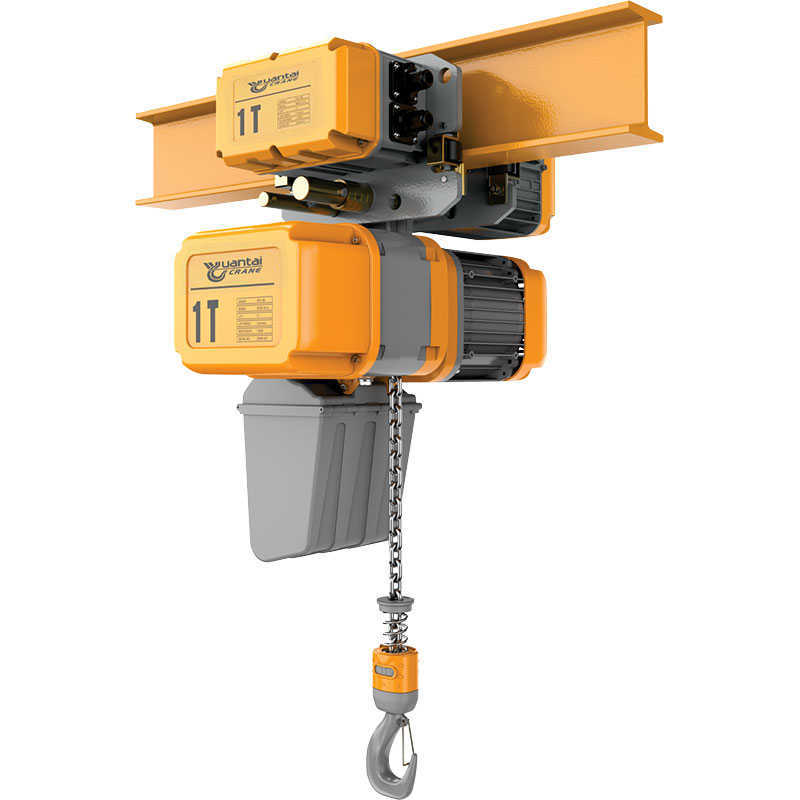
Key Features of Chain Hoists
✔ Lifting Capacity: 0.5–20 tons
✔ Lifting Speed: 3–8 m/min (slower than electric hoists)
✔ Power Source: Manual (hand chain) or electric
✔ Compact & Lightweight – Fits in tight spaces
Types of Chain Hoists
- Manual Chain Hoists: Operated by hand, no electricity needed
- Electric Chain Hoists: Motor-driven for easier operation
Advantages of Chain Hoists
✅ Lower cost – More affordable than electric hoists
✅ No power dependency (manual versions) – Works in remote locations
✅ Simple maintenance – Fewer mechanical parts
✅ Compact design – Ideal for small workshops
Disadvantages of Chain Hoists
❌ Slower operation – Less efficient for frequent lifting
❌ Limited load capacity – Not suitable for heavy industrial use
❌ Manual versions require labor effort – Can be tiring for workers
Best Applications for Chain Hoists
- Workshops with occasional lifting needs
- Maintenance and repair tasks
- Construction sites without power
- Budget-conscious operations
3. Key Comparison: Electric Hoist vs. Chain Hoist
| Factor | Electric Hoist | Chain Hoist |
|---|---|---|
| Lifting Speed | Fast (8–20 m/min) | Slow (3–8 m/min) |
| Load Capacity | Up to 100 tons | Up to 20 tons |
| Precision Control | High (VFD options) | Moderate |
| Installation Cost | Higher | Lower |
| Maintenance | More complex | Simpler |
| Power Dependency | Requires electricity | Manual = no power needed |
4. How to Choose the Right Hoist for Your Single Girder Crane
1. Consider Your Lifting Needs
- Frequent, heavy-duty lifting? → Electric hoist (higher speed & capacity)
- Occasional, light-duty lifting? → Chain hoist (cost-effective & simple)
2. Evaluate Workspace Conditions
- Power available? → Electric hoist (best for automation)
- No electricity? → Manual chain hoist (works anywhere)
- Limited space? → Compact chain hoist (lightweight design)
3. Budget & Long-Term Costs
- Upfront savings? → Chain hoist (lower initial cost)
- Long-term efficiency? → Electric hoist (higher productivity)
4. Safety & Compliance
- High safety standards? → Electric hoist with overload protection
- Basic lifting needs? → Manual chain hoist (with proper training)
5. Why Choose Dongqi Crane Hoists?
At Dongqi Crane, we provide:
✔ Custom Hoist Solutions – Tailored for your single girder crane
✔ High-Quality Manufacturing – ISO & CE certified
✔ Reliable Performance – Built for durability in industrial environments
✔ After-Sales Support – Maintenance, spare parts, and operator training
6. Conclusion
Choosing between an electric hoist and a chain hoist depends on your lifting requirements, workspace, and budget.
- For heavy, frequent, and automated lifting → Electric hoist
- For light, occasional, or manual lifting → Chain hoist
Need expert advice? Contact Dongqi Crane today for a free consultation!
