
22-Jan-2026
Empowering the Globe with Technology: Analysis of the Rise and Global Impact of Chinese Bridge Cranes in 2026
Chinese-made cranes have become indispensable equipment for local infrastructure construction in road projects and mining operations in Kenya, Nigeria, South Africa, and other regions.
From January to September 2025, China’s import and export trade of construction machinery increased by 12.8% year-on-year, significantly surpassing the global market’s expected average annual growth of 5.2%. Among this, exports reached $43.855 billion.
At the same time, Taiyuan Heavy Industry Group once again secured the leading role in revising international standards for bridge and gantry cranes in 2025, marking a significant enhancement of China’s heavy equipment manufacturing industry’s voice in formulating international technical standards.
01 Global Footprint and Contributions of Chinese Bridge Cranes
Chinese bridge crane manufacturers have successfully introduced their products and services to over 120 countries and regions worldwide. Taking Dongqi Crane as an example, this company, established in 1984, has completed over 1,000 crane projects and employs a team of 570 professional engineers.
In these projects, they provide not only equipment but also customized integrated solutions. From 7.5-ton single girder bridge cranes meeting European standards to 550-ton double girder bridge cranes, Chinese manufacturers can offer tailor-made products based on specific customer requirements.
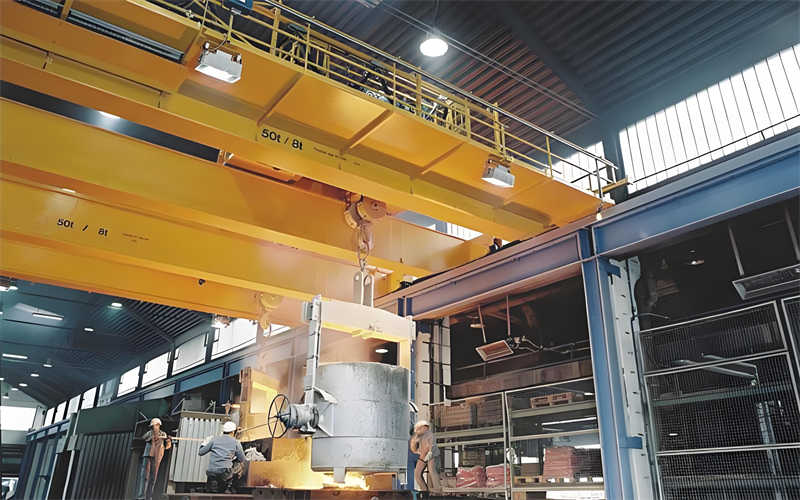
This “turnkey solution” export model has made Chinese bridge cranes an “accelerator” in the industrialization process of many developing countries.
The concentrated commencement of large-scale infrastructure projects such as bridges and ports in Southeast Asia and the Middle East has provided a broad market for Chinese construction machinery. A representative from Sinotruk Group stated that the company’s equipment market growth in Africa exceeded 30%, becoming a core incremental source for exports.
As Chinese companies transition from simply selling “hardware equipment” to providing “smart engineering solutions,” the competitiveness of Chinese bridge cranes in the international market is shifting from price advantages to technological and service advantages.
02 China vs. the World: A Comparison of Technological and Developmental Pathways in Crane Manufacturing
The development paths of bridge cranes in China and abroad exhibit clear differences. For a long time, Western companies dominated the high-end market with technological accumulation and brand advantages, while Chinese companies started by meeting the demands of large-scale domestic construction, gradually achieving catch-up and surpassing.
Differences in technical standards and certification systems represent a significant distinction between Chinese and Western bridge crane development. Taking Dongqi Crane as an example, the company not only produces products compliant with Chinese standards but also specifically provides crane solutions meeting European FEM standards, having obtained CE certification.
There are also notable differences in R&D directions and innovation focus. European and American companies such as Konecranes and Terex invested earlier in high-end technologies like automation, IoT connectivity, and digitalization. In contrast, Chinese companies have shown more prominent technological innovation in large-scale, super-heavy, and extreme-condition adaptability.
Differences in market expansion strategies are equally evident. Represented by Dongqi Crane, Chinese companies adopt a dual-driven model of “cost advantage + customized services,” offering targeted product designs based on the specific needs of different countries like the Philippines, Pakistan, and Argentina.
The evolution of the global market landscape reflects the outcomes of these differentiated development paths. According to market analysis, the European bridge crane and component market size is projected to be $2.59 billion in 2025, the U.S. market at $2.38 billion, while the Chinese market has already reached $2.40 billion, essentially on par with European and American markets.
Table: Comparison of Development Paths for Chinese and Foreign Bridge Cranes
| Comparison Dimension | Chinese Path | European/American Path |
|---|---|---|
| Technological Starting Point | Introduction, absorption, digestion, and re-innovation | Long-term technological accumulation and original R&D |
| Market Strategy | Cost-performance advantage + customized service | Technological leadership + brand premium |
| Innovation Focus | Large-scale, heavy-duty, extreme-condition adaptation | Automation, digitalization, intelligent control |
| Standard Setting | Recently active participation in international standard setting | Long-term dominance in international standard systems |
| Service Model | Provision of integrated solutions + localized services | High-end equipment sales + professional technical support |
03 The Future World Market: Predictions for the Development Trends of Chinese Bridge Cranes
Looking ahead to 2026 and beyond, the global bridge crane and component market is projected to grow from $11.29 billion in 2026 to $22.04 billion in 2035, with a compound annual growth rate (CAGR) of 7.72%. Chinese bridge cranes will play a crucial role in this growth.
Deep integration of intelligence and automation will become a major trend. According to industry data, by 2023, over 67% of newly installed bridge cranes in developed economies like Germany and the United States were equipped with automated control systems. Chinese companies are accelerating their catch-up in this field.
Companies like XCMG have exhibited green equipment such as electric loaders and intelligent excavators at global partner conferences. Relying on their long-term accumulated electrification technologies, their products have successfully passed emission and safety certifications in European and American markets.
The strategy combining localized production with global service networks will become more mature. 30% of Shandong Heavy Industry Group’s overseas revenue in the first three quarters came from localized manufacturing and sales, indicating that the globalization strategy of Chinese construction machinery companies has shifted from purely “trade-based” to deeply “operational.”
Green and low-carbon transformation will become a new competitive focus in the industry. With increasing global attention to carbon emissions, environmentally friendly technologies like electric cranes and energy recovery systems will become new market favorites.
Supply chain diversification in response to geopolitical challenges will also become an important development direction. With proposals like the U.S. “2025 Port Crane Tax Credit Act” and attempts by European and American countries to rebuild domestic crane manufacturing capabilities, Chinese companies will need to adjust their supply chain layouts and market strategies accordingly.
A construction contractor in the Philippines receives design drawings from a Chinese manufacturer: a 7.5-ton single girder bridge crane meeting European standards, perfectly adapted to the local factory structure. Once the project is finalized, the Chinese company provides not only the crane hardware but also installation guidance, operator training, and lifetime maintenance services.
In mines in Kenya, on construction sites in Argentina, and in factory workshops in Brazil, Chinese bridge cranes have become integral to local industrial development.
On the other side of the globe, industrial enterprises in Germany are using automated crane systems equipped with key components made in China; technical experts from Taiyuan Heavy Industry Group are leading the revision of international standards for bridge and gantry cranes in meeting rooms of the International Organization for Standardization.
As the global manufacturing landscape rapidly reshapes, Chinese bridge cranes no longer rely solely on price advantages but on a complete industrial ecosystem spanning from equipment manufacturing to standard setting.
