
30-Dec-2025
How Dongqi Crane Delivers Excellence: Factory-Direct FEM Standard Double Beam Overhead Shop Cranes
In today’s competitive industrial landscape, efficiency, reliability, and cost-effectiveness are not just advantages—they are necessities. For workshops, manufacturing plants, and assembly lines, the overhead shop bridge crane is often the backbone of material handling operations. When selecting such critical equipment, the choice often boils down to three key factors: performance, safety, and value. At Dongqi Crane, we address these factors head-on by merging superior engineering with a customer-centric business model. This article explores how our factory-direct supply of high-quality, FEM standard double beam overhead shop cranes provides an unbeatable solution for modern industrial needs, from heavy-duty applications to compact small shop bridge crane installations.
The Cornerstone of Modern Workshops: The Overhead Shop Bridge Crane
An overhead shop bridge crane, often simply called a shop overhead crane, is a fundamental piece of equipment designed to lift, move, and position heavy loads with precision and safety within a defined rectangular area. It typically consists of a bridge beam that travels along runway rails mounted on building structures or freestanding supports, and a hoist that moves laterally across the bridge. This configuration offers unparalleled coverage and flexibility for workshop floors.
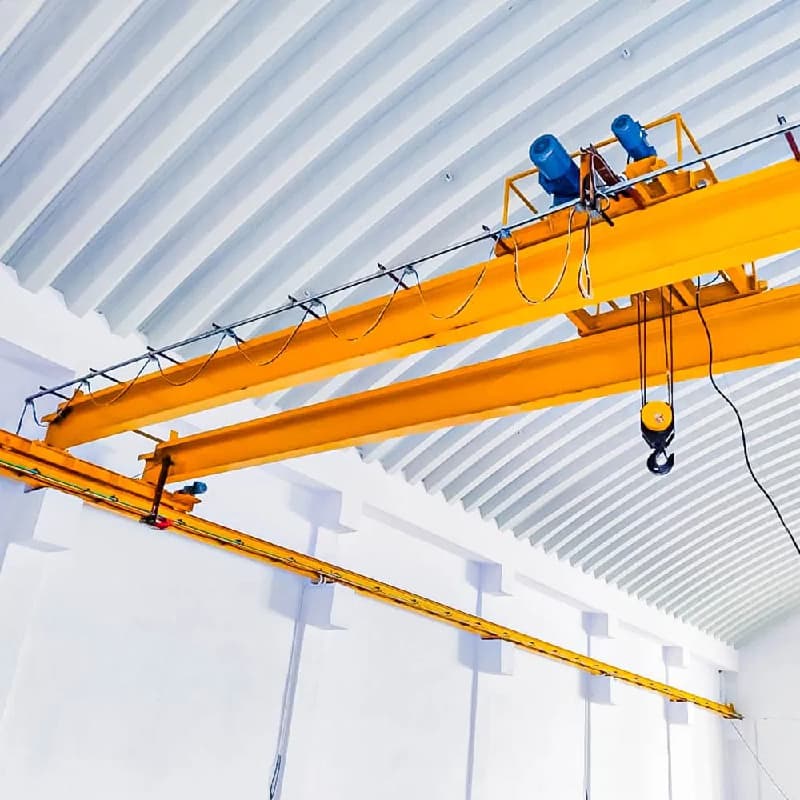
The primary benefits of integrating an overhead crane into your shop include:
- Maximized Floor Space: By operating overhead, these cranes free up valuable floor space for machinery, workstations, and inventory.
- Enhanced Productivity: They dramatically reduce the time and labor required for moving materials compared to manual handling or forklifts.
- Improved Safety: Properly designed cranes minimize the risks associated with manual lifting and ground-based equipment, reducing workplace accidents.
- Load Precision: They allow for accurate positioning of heavy or delicate components, crucial for assembly and manufacturing processes.
Whether it’s a foundry moving molten metal, an automotive plant handling engine blocks, or a warehouse managing heavy pallets, the right shop overhead crane is a transformative investment.
The Gold Standard of Safety and Performance: Understanding the FEM Standard for Overhead Cranes
When investing in an overhead shop bridge crane, the underlying design and manufacturing standards are paramount. This is where the FEM standard for overhead crane comes into play. FEM (Fédération Européenne de la Manutention) is the European Federation of Materials Handling, and its standards are globally recognized as some of the most rigorous and comprehensive in the industry.
The FEM standard provides detailed guidelines for the design, calculation, and construction of crane structures and mechanisms. It goes beyond basic safety to ensure optimal performance, durability, and economy over the crane’s entire lifecycle. Key aspects covered by the FEM standard include:
- Load Classification and Duty Cycle: FEM standards meticulously classify cranes based on their expected usage (number of operating hours, frequency of lifts, average load intensity). This ensures the crane is built with appropriate safety margins and component specifications for its specific duty, preventing under-engineering or wasteful over-engineering.
- Structural Integrity: The standards define precise calculation methods for main girders, end carriages, and other structural components. They account for dynamic forces, fatigue life, and deflection limits. For a double beam overhead crane, this means rigorous validation of the box-girder or truss design to ensure minimal long-term deformation and robust performance under full load.
- Mechanical and Electrical Components: Specifications for hoists, trolleys, motors, brakes, and gearboxes are all outlined to ensure compatibility, reliability, and safety. The standard governs factors like control responsiveness, braking performance, and protection against overloading.
- Safety and Operational Factors: FEM incorporates requirements for safety devices (limit switches, overload protection, emergency stops), control systems, and ergonomic considerations for operators.
By adhering to the FEM standard for overhead crane, Dongqi Crane guarantees that every shop overhead crane we produce is not just a piece of equipment, but a meticulously engineered system built for reliability, longevity, and safety. This commitment to international standards protects your investment and ensures seamless integration into global supply chains and safety audit protocols.
The Robust Choice: Advantages of the Double Beam Design for Shop Cranes
While single-girder cranes have their place for lighter duties, the double beam overhead crane is the preferred choice for demanding workshop applications. As the name suggests, this design features two primary bridge girders that support the trolley and hoist, creating a more stable and powerful lifting platform.
Here’s why a double beam design often represents the optimal solution for an overhead shop bridge crane:
- Higher Load Capacity and Stability: The dual-girder configuration distributes the load more effectively, allowing for significantly higher lifting capacities—often from 5 tons up to several hundred tons. The structure is inherently more resistant to twisting and offers superior hook approach, allowing loads to be lifted closer to the runway girders.
- Ideal for Heavy-Duty and Intensive Use: With a more robust structure and typically more powerful drive systems, double beam cranes are designed for Class III (Heavy Duty) and Class IV (Very Heavy Duty) FEM classifications. They can handle frequent starts and stops, high cycling, and sustained operation with ease.
- Greater Hook Height: The trolley runs on top of the main girders, maximizing the available lift height beneath the crane. This is a critical advantage in workshops with height constraints where every centimeter of vertical space counts.
- Enhanced Precision and Control: The sturdy construction minimizes deflection and sway, enabling more precise load positioning. This is essential for tasks like machine tool servicing, precise assembly, or handling delicate but heavy items.
- Flexibility for Customization: The design readily accommodates various trolley types (standard, motorized, with auxiliary hoists), specialized lifting attachments, and advanced control systems like Variable Frequency Drives (VFD) for smooth acceleration and positioning.
For workshops that handle heavy machinery, large fabricated parts, or require intensive, reliable material handling, the investment in a FEM standard double beam overhead crane translates directly into increased productivity, reduced downtime, and enhanced operational safety.
The Compact Powerhouse: The Small Shop Bridge Crane Solution
Not every workshop is a vast industrial hall. Many small to medium-sized enterprises (SMEs), repair garages, fabrication shops, and R&D facilities require powerful lifting solutions within limited spaces. This is precisely the niche of the small shop bridge crane.
A small shop bridge crane retains all the core functionalities of its larger counterparts but is optimized for constrained environments. Key characteristics include:
- Compact Design: These cranes are engineered with optimized girder profiles and compact end carriages to maximize the working area under the crane without requiring excessive headroom or floor space.
- Adaptable Support Structures: For shops where existing building structures cannot support a crane, Dongqi Crane provides freestanding gantry-style supports or workstation bridge cranes that can be installed with minimal civil work.
- Cost-Effectiveness for SME Applications: By focusing on the essential features needed for lighter to medium duty cycles, a well-specified small shop bridge crane delivers tremendous value, enabling smaller businesses to automate lifting tasks and improve safety without a prohibitive capital outlay.
- FEM Principles Applied: Even our small shop cranes are designed with the core philosophies of the FEM standard—appropriate duty cycle classification, verified structural integrity, and reliable components. This ensures they are not “light-duty” in quality, but rather “right-sized” for their intended application.
The Dongqi Crane Advantage: Factory Direct Supply Meets World-Class Engineering
This brings us to the core of the value proposition: Factory Directly Supply. At Dongqi Crane, we are not just a distributor or a reseller; we are the manufacturer. This integrated approach creates a powerful synergy with our commitment to the FEM standard for overhead crane, delivering unparalleled benefits to our clients.
1. Unbeatable Cost-Efficiency Without Compromise
By eliminating multiple middlemen, importers, and distributors, we pass significant cost savings directly to you. When you see “Factory Directly Supply,” it means you are purchasing your double beam overhead shop crane at a price much closer to its true manufacturing cost. This allows you to invest in a higher-specification, FEM-compliant crane for the budget that might otherwise only afford a lower-grade alternative.
2. Rigorous Quality Control from Raw Material to Final Test
Quality is not inspected into a product; it is built into it. Our in-house manufacturing allows for complete control over every stage of production. We select premium-grade steel, source motors and electrical components from reputable suppliers, and apply advanced welding and fabrication techniques. Every weld, every assembly, and every electrical connection is subject to our stringent quality protocols, which are aligned with and often exceed the FEM standard requirements. This vertical integration is your guarantee of a durable and reliable product.
3. Customization and Rapid Technical Response
A workshop’s needs are unique. With our direct engineering and manufacturing team, customization is not a complicated, outsourced ordeal. Need a specific span, a modified lift height, a specialized hook, or integration with existing automation? Our engineers can work with you to adapt the standard shop overhead crane design to your exact requirements. The feedback loop is short, and solutions are developed quickly and efficiently.
4. Transparent Communication and After-Sales Support
Dealing directly with the factory simplifies communication. You have clear access to technical documentation, installation guides, and spare parts lists. Our after-sales service team possesses deep product knowledge because they work alongside the people who designed and built your crane. This ensures faster troubleshooting, accurate spare parts supply, and more effective maintenance support over the decades-long life of your equipment.
Conclusion: Your Strategic Partner for Overhead Lifting Solutions
Choosing an overhead shop bridge crane is a significant decision that impacts your operational efficiency, safety culture, and bottom line for years to come. In the double beam overhead crane category, the combination of robust engineering per the FEM standard and the economic benefits of a factory-direct supply model represents the optimal path forward.
Whether your requirement is for a high-capacity FEM standard double beam overhead crane for a heavy industrial plant or a versatile and affordable small shop bridge crane for a growing business, Dongqi Crane stands ready as your partner. We deliver more than just equipment; we deliver engineered solutions built on a foundation of quality, transparency, and direct customer value.
Contact Dongqi Crane today. Let our engineering team discuss your specific workshop layout, lifting needs, and operational goals. Discover how our factory-direct, FEM-standard cranes can become the reliable, high-performance backbone of your material handling operations.
