
28-Apr-2026
From Guesswork to Precision: How a Single-Page Worksheet Solves Your Overhead Crane Specification Puzzle
Introduction: The Cost of a Wrong Decision
Every year, procurement teams in manufacturing, logistics, and heavy industry face the same high-stakes question: “What crane do we actually need?” It sounds simple, but the downstream consequences of getting it wrong are anything but.
Choose a crane with insufficient lifting capacity, and you inherit a safety hazard. Specify the wrong duty class, and your equipment—no matter how well built—wears out years before its time. Underestimate the headroom requirement, and your new crane physically cannot fit inside the building you designed it for. These are not hypothetical scenarios. Mis-specifying the duty cycle alone is recognized as a primary cause of premature crane failure and escalating maintenance costs across the industry.
The root cause is rarely negligence. More often, it is information fragmentation. The engineer knows the building dimensions. The operations manager knows the production schedule. The safety officer knows the regulatory requirements. The procurement manager knows the budget. But nobody has a single document where all of this knowledge converges into a coherent specification—until now.
At Dongqi Crane, we have spent over four decades translating complex operational realities into engineered lifting solutions across six continents. That experience has taught us that the gap between a successful crane deployment and a costly mismatch is almost always bridged by one thing: a disciplined, structured inquiry process. This article introduces a practical tool—the Working Condition Analysis Worksheet—designed to give procurement teams, plant engineers, and project managers a single source of truth for crane selection. It is the same methodology our engineering team uses internally to validate specifications before a single drawing is produced.
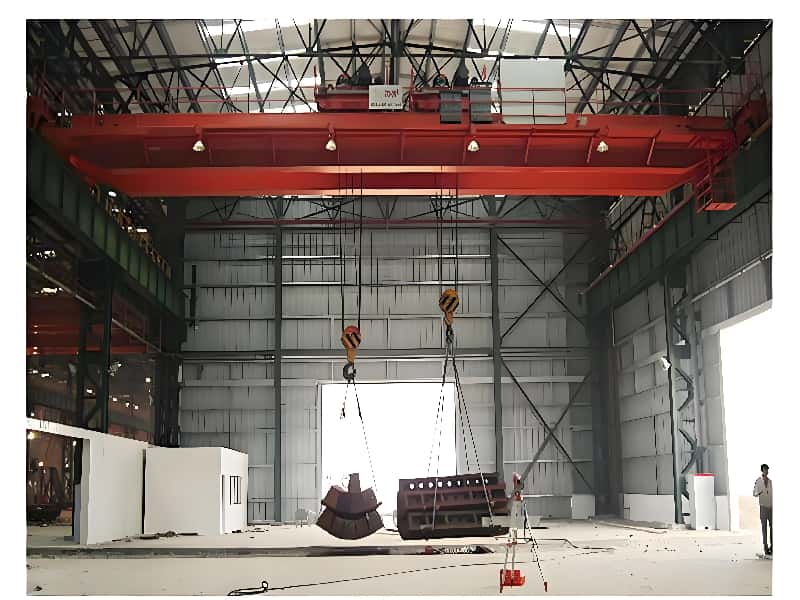
Part 1: The Five Pillars of Crane Selection
Before introducing the worksheet, we must understand the parameters it captures. Industry standards define five primary technical parameters that characterize any crane’s performance and operating capacity: lifting capacity, lifting height, span, working speed, and duty class. Each interacts with the others, and none can be decided in isolation.
1.1 Lifting Capacity: It Is Never Simply the Object Weight
Lifting capacity—rated in tons—is the maximum mass a crane is permitted to handle during normal operation, including the weight of detachable lifting devices such as grabs, electromagnetic chucks, spreader beams, or C-hooks. A common procurement error is to base the specification solely on the weight of the product being lifted, neglecting the weight of below-the-hook attachments.
Consider a steel mill scenario: the ladle used to transport molten metal can itself account for 30% to 50% of the total payload. Specifying a crane based on the product weight alone in such a case would result in a machine that is dangerously under-rated from day one.
Dongqi Crane’s product portfolio addresses this reality with lifting capacities spanning a wide range—from 1-ton single-girder units for light assembly work to 500-ton-plus double-girder systems engineered for steel mills, shipyards, and heavy machinery manufacturing.
Key question for the worksheet: What is the maximum combined weight of the load, plus all lifting attachments (spreader beams, grabs, magnets, slings), plus any potential dynamic or impact factors?
1.2 Lifting Height: Think in Three Dimensions
Lifting height is the vertical distance from the ground or floor level to the highest position of the lifting hook or attachment. If the crane must lower loads below ground level—into pits, for example—the total lifting height is the sum of the above-ground height and the below-ground depth.
Standard overhead crane installations typically limit lifting height to under 20 meters. Exceeding this threshold often requires specialized wire rope winding configurations or enlarged drum dimensions, which in turn affect trolley layout, overall crane dimensions, and cost. Dongqi Crane’s standard single-girder models offer lifting heights configurable from 3 to 50 meters, while our QD double-girder series provides heights from 6 to 30 meters with custom extensions available.
1.3 Span: The Dimension That Defines Structural Design
Span—the horizontal distance between the centerlines of the crane runway rails—is a parameter that directly determines the structural design of the main girder, the crane’s self-weight, and the wheel loads transmitted to the building structure. It is one of the few parameters that cannot be easily changed after installation begins.
For single-girder configurations, Dongqi Crane typically engineers spans from 7.5 to 30 meters, with custom extensions possible upon request. For double-girder configurations, standard spans range from 10.5 to 35.5 meters, and our engineering team has delivered custom designs exceeding 35 meters for specialized projects.
Key question for the worksheet: What is the center-to-center distance of the runway rails, measured at the elevation where the crane will travel?
1.4 Duty Class: The Most Misunderstood Parameter
Duty class—classified under FEM (1Am–8m), ISO (M3–M8), or CMAA (Class A–F) systems—is perhaps the single most critical parameter and also the most frequently overlooked. It is not about how heavy the load is; it is about how frequently the crane works, how much of its operation is at or near full capacity, and how many operating hours are accumulated per day.
Choosing an insufficient duty class leads to premature wear, frequent failures, and potential safety hazards. Selecting an unnecessarily high duty class results in wasted investment—a machine built for continuous steel mill operation performing light warehouse duty.
The duty class spectrum can be understood as follows:
| Duty Class (FEM) | ISO Class | Typical Application | Daily Operating Hours | Load Characteristic |
|---|---|---|---|---|
| A1–A2 | M3 | Maintenance workshops, occasional storage handling | ≤1–2 hours | Light, infrequent |
| A3–A4 | M4–M5 | Machine shops, assembly lines, general production | 2–8 hours | Moderate, varied loads |
| A5–A6 | M6 | Shipyards, steel structure fabrication, warehousing with frequent use | 8–16 hours | Heavy, frequent, high load variation |
| A7–A8 | M7–M8 | Metallurgical plants, foundries, continuous casting | 16–24 hours | Continuous, near full capacity, harsh environments |
Dongqi Crane’s standard single-girder overhead cranes are available in A5, A6, and A7 classifications. Our QD-series double-girder cranes are offered in A5 through A6 as standard, with A7 and A8 configurations available for metallurgical and foundry applications. Each classification determines not only the structural design margin but also component selection—bearings, gearboxes, motors, brakes, and electrical systems must all be rated for the expected fatigue life.
1.5 Working Speeds: Matching Productivity Requirements
Working speeds—including hoisting speed, cross-travel speed, and long-travel speed—must balance productivity with precision. Faster is not always better. In steel mill applications, for example, a ladle crane handling molten metal requires exceptionally smooth, controlled acceleration and deceleration regardless of top speed. In a warehouse handling palletized goods, higher travel speeds may drive productivity gains.
Dongqi Crane’s standard single-girder models offer hoisting speeds of 0.8–8 m/min (single or dual speed), cross-travel speeds of 5–20 m/min, and long-travel speeds of 20–30 m/min. Our heavy-duty QD series, depending on capacity, provides lifting speeds from approximately 7.8 to 15.5 m/min with trolley and crane travel speeds scaling accordingly. All models can be equipped with variable frequency drives (VFDs) for smooth, stepless speed control.

Part 2: Beyond the Basics—Capturing Working Conditions
The five core parameters provide the skeletal framework of a crane specification. But a crane does not operate in a laboratory. It works in a real environment with real constraints—temperature extremes, airborne contaminants, explosive atmospheres, space limitations, power supply characteristics, and regulatory requirements. These working condition variables are what transform a generic crane into a properly engineered solution.
2.1 Environmental Conditions
The operating environment dictates material selection, surface treatment, and component protection levels. A crane working in a coastal shipyard with salt-laden air requires fundamentally different corrosion protection than one in a climate-controlled cleanroom.
Dongqi Crane’s standard products are rated for ambient temperatures from -20°C to +40°C. For special applications—such as steel mills where radiant heat can elevate ambient temperatures above 80°C in localized zones—we engineer customized thermal protection packages including heat-insulation plates, ceramic-fiber-coated wire rope, and water-cooled hook heads. For cold-storage logistics facilities operating at sub-zero temperatures, we specify low-temperature-grade steel and specialized lubricants.
Protection ratings are equally critical. Our standard products carry IP54 protection as a baseline, suitable for general industrial environments with moderate dust and moisture. For metallurgical applications with heavy metallic dust and potential splatter, we upgrade to higher protection classes.
2.2 Building Constraints
A crane that fits perfectly on paper may be impossible to install if building constraints are not captured early. Critical dimensions include:
- Headroom: The vertical distance from the crane rail level to the underside of the roof structure or lowest obstruction. Low-headroom buildings often require specialized compact hoist designs. Dongqi Crane’s single-girder European-standard design achieves a 25–30% height reduction compared to traditional configurations by running the electric hoist on the lower flange of the main girder.
- Runway length: The total length of the crane travel path. This determines whether a festoon cable system, conductor bar, or cable reel is the appropriate power supply solution.
- Column spacing, access points, and overhead obstacles: These affect end-carriage design, buffer specifications, and sometimes necessitate segmented girder delivery for on-site assembly.
2.3 Power Supply and Site Infrastructure
Overseas procurement adds the complexity of voltage and frequency mismatches. Dongqi Crane ships products to over 96 countries, and we routinely configure electrical systems for 220V, 380V, 440V, or 500V at 50Hz or 60Hz. Capturing this information at the inquiry stage avoids costly retrofits or transformer installations later.
2.4 Regulatory and Certification Requirements
Different markets impose different compliance obligations. Dongqi Crane holds CE certification for the European market, GJB9001C for defense-grade quality management, and multiple ISO certifications including ISO9001 (quality), ISO45001 (occupational health and safety), ISO14001 (environmental), and ISO50001 (energy management). We are also licensed under China’s Special Equipment Manufacturing License regime, which is a mandatory requirement for metallurgical cranes under Chinese regulatory oversight.
For projects governed by specific international standards—such as FEM standards for European installations, ISO 4301 for duty classification, or ISO 10972 for crane mechanisms—documentation and compliance verification can be embedded into the procurement specification.
Part 3: The Working Condition Analysis Worksheet
Drawing together the parameters discussed above, the following worksheet is structured as a practical template that procurement teams, plant engineers, and project managers can complete before approaching any crane manufacturer for a quotation. At Dongqi Crane, we actively encourage clients to submit this form alongside their RFQ; it enables our engineering team to prepare a technically accurate, commercially optimized proposal within 24–48 hours, rather than trading multiple rounds of clarification emails.
Working Condition Analysis Worksheet for Overhead Crane Selection
| Section | Parameter | Your Input | Why This Matters |
|---|---|---|---|
| A. Basic Identification | Project/Company Name | Internal tracking reference | |
| Facility Location (City, Country) | Determines applicable regulations, power standards, logistics | ||
| Target Installation Date | Sets procurement and manufacturing timeline | ||
| Industry Sector | □ Steel/Metallurgy □ Manufacturing □ Warehousing □ Power Generation □ Petrochemical □ Mining □ Food Processing □ Textile □ Construction □ Port/Logistics □ Other: _ | Determines special regulatory, environmental, and duty requirements | |
| B. Crane Type Preference | Crane Category | □ Single Girder Overhead □ Double Girder Overhead □ Gantry (Indoor/Outdoor) □ Semi-Gantry □ Jib (Pillar/Wall/Mobile) □ KBK Modular System □ Other: _ | Defines structural configuration and cost framework |
| Girder Configuration | □ Single Girder □ Double Girder □ Undecided (we will recommend) | Double girder required typically for >20t or spans >30m | |
| C. Core Technical Parameters | Maximum Load Weight (tons) | __ tons | The single heaviest object to be lifted, including any attachments |
| Weight of Below-Hook Attachments | _ tons (□ Spreader Beam □ Magnet □ Grab □ C-Hook □ Ladle □ Other: ) | Must be added to load weight for total rated capacity | |
| Lifting Height (above ground) | __ meters | Ground level to highest hook position required | |
| Lifting Depth (below ground) | __ meters | For pits, basements, or below-grade handling | |
| Span / Rail Center Distance | __ meters | Center-to-center measurement of runway rails | |
| Runway Length | __ meters | Total length of crane travel path | |
| D. Operational Profile (Duty Class Determination) | Operating Hours per Day | □ 0–2 hours □ 2–4 hours □ 4–8 hours □ 8–16 hours □ 16–24 hours (continuous) | Primary determinant of duty class |
| Operating Days per Week | __ days | Affects annual utilization calculation | |
| Load Spectrum | □ Light (rarely at full capacity) □ Moderate (varied loads) □ Heavy (frequently near full capacity) □ Very Heavy (consistently at/near full capacity) | Determines load spectrum factor for FEM/ISO classification | |
| Average Lifts per Hour | __ lifts/hour | Impacts component fatigue life calculations | |
| Required Lifting Speed | __ m/min (□ Single Speed □ Dual Speed □ Variable/VFD) | Balances productivity with precision requirements | |
| Required Cross-Travel Speed | __ m/min (□ Single Speed □ Variable/VFD) | ||
| Required Long-Travel Speed | __ m/min (□ Single Speed □ Variable/VFD) | ||
| E. Building & Installation Constraints | Available Headroom (rail top to ceiling) | __ meters | Critical for low-headroom buildings; compact designs may be required |
| Crane Rail Specification | □ Existing (Type: _) □ New (to be supplied) □ Not yet installed | Determines wheel and end-carriage design | |
| Building Type | □ Existing (built _) □ Under construction □ Planned | Affects installation methodology | |
| Access for Installation | □ Overhead crane available □ Mobile crane access □ Restricted access | Determines delivery segmentation and lifting plan | |
| F. Environmental Conditions | Ambient Temperature Range | Min: _ °C / Max: _ °C | Affects steel grade, lubrication, and electrical component selection |
| Relative Humidity / Condensation | □ Normal (40–85%) □ High (>85%, condensation) □ Wet/Splash | Determines IP rating and corrosion protection | |
| Dust / Particle Exposure | □ Clean □ Moderate industrial □ Heavy (metallic/abrasive) | Affects motor enclosure type and electrical cabinet sealing | |
| Corrosive Atmosphere | □ No □ Mild □ Moderate □ Severe (coastal/chemical) | Determines coating specification (e.g., ISO 12944 C3/C4/C5) | |
| Explosive Atmosphere | □ No □ Yes (Zone: , Gas/Dust Group: ) | Triggers explosion-proof design requirements | |
| Special Conditions | □ High temperature radiant heat □ Sub-zero cold storage □ Cleanroom □ Outdoor exposed □ Other: _ | ||
| G. Power Supply | Voltage | __ V | Standard: 380V/3P; also available: 220V, 440V, 500V, others |
| Frequency | □ 50Hz □ 60Hz | ||
| Power Supply Method | □ Festoon cable □ Conductor bar (enclosed) □ Cable reel □ Other | Depends on runway length and environment | |
| H. Control & Automation Requirements | Control Method | □ Pendant (ground control) □ Wireless remote □ Cabin control □ Combination (_) | Cabin recommended for large spans or high-temperature environments |
| Automation Level | □ Manual □ Semi-automated □ Fully automated (PLC/integration with MES) | ||
| Special Control Functions | □ Anti-sway □ Positioning (±mm) □ Synchronized lifting (multiple hooks) □ Load weighing/display □ Black box data recording □ Other: | ||
| I. Compliance & Certification | Required Certifications | □ CE Marking (EU) □ ISO 9001 □ ISO 14001 □ ISO 45001 □ National Special Equipment License □ Customer-specific: _ | |
| Applicable Standards | □ FEM □ ISO 4301 □ CMAA □ GB/T (Chinese) □ Other: _ | ||
| J. Safety & Special Features | Safety Requirements | □ Overload limiter □ Emergency stop □ Dual brakes on main hoist □ Limit switches (upper/lower/cross/long) □ Anti-collision □ Warning lights/sirens □ Wind speed monitor (outdoor) □ Other: _ | |
| K. Additional Notes | Special Instructions | (Describe any unique requirements, previous crane issues, future expansion plans, etc.) | Helps our engineering team provide tailored recommendations |
How to Use This Worksheet: Complete all fields that apply to your project. Fields marked with checkboxes (□) can be ticked. For parameters you are unsure about, mark “TBD” (to be determined) and our engineering team will work with you to define them. Send the completed form with your RFQ to [your Dongqi Crane contact or inquiry channel].
Part 4: From Worksheet to Technical Specification—The Dongqi Engineering Process
A completed worksheet is the starting point, not the endpoint. At Dongqi Crane, the information flows through a structured engineering review process designed to validate every parameter before design work begins.
4.1 The Specification Review Cycle
Day 1–2: Technical Review. Upon receiving a completed worksheet, our application engineering team reviews all parameters for internal consistency. We cross-check lifting capacity against span and duty class to verify that the selected configuration is mechanically and structurally viable. When inconsistencies arise—for example, a requested span that exceeds the structural limits of a single-girder design, or a duty class that appears mismatched to the operating hours described—we flag these immediately and propose alternatives before the quotation is issued.
Day 2–3: Quotation Preparation. With a validated specification, our commercial engineering team prepares a detailed quotation that includes:
- Equipment configuration and bill of materials
- Technical datasheet with confirmed performance parameters
- Compliance declaration addressing all requested certifications and standards
- Delivery timeline based on current production scheduling
- Installation and commissioning scope (if required)
- Warranty terms and after-sales support package
Day 3–4: Client Review and Refinement. We present the quotation alongside a technical clarification document addressing any deviations or recommendations. Clients can request modifications—such as upgrading to VFD control, adding anti-sway functionality, or adjusting the delivery timeline—and our team responds with updated specifications and pricing.
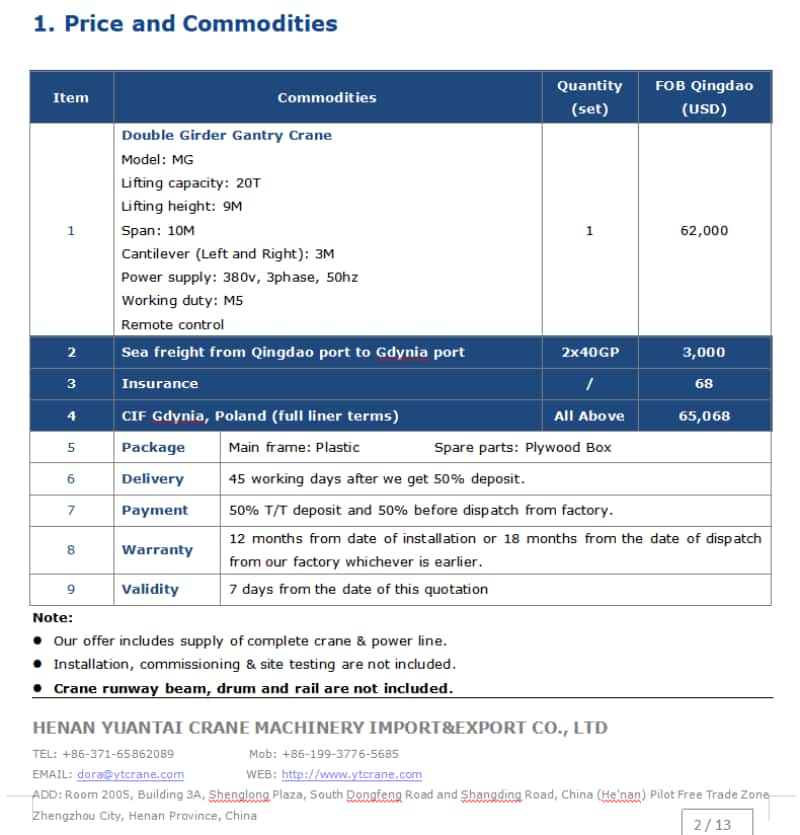
4.2 Case Examples: How the Worksheet Prevents Procurement Errors
Case 1: The Hidden Attachment Weight. A fabrication workshop in Southeast Asia submitted an RFQ for a 10-ton overhead crane to handle steel plate. The completed worksheet revealed that the operation frequently used a magnetic spreader beam weighing 1.8 tons. The combined payload was therefore 11.8 tons—exceeding the capacity of a standard 10-ton crane. We recommended a 15-ton unit with appropriate safety margin, avoiding an expensive post-installation retrofit.
Case 2: The Duty Class Mismatch. A logistics center specified an A4-class crane for a warehouse that would operate 12 hours per day with frequent full-capacity lifts. The worksheet captured 12 operating hours with a “heavy” load spectrum, which corresponds to A5–A6 classification according to FEM standards. By upgrading the specification before ordering, the client avoided premature component wear and extended the crane’s service life by an estimated 8–10 years.
Case 3: The Missing Environmental Factor. A coastal port facility in the Middle East requested a standard outdoor gantry crane. The environmental conditions section of the worksheet indicated “severe” corrosive atmosphere with high humidity and salt exposure. Our engineering team immediately upgraded the corrosion protection specification from the standard C3 coating (suitable for urban/industrial environments) to C5-M (suitable for coastal and offshore environments) in accordance with ISO 12944, and specified stainless steel fasteners for all exposed connections.
Part 5: Integration with Dongqi Crane’s 2026 Product Ecosystem
The 2025 fiscal year demonstrated the breadth of demand across our product portfolio: overhead cranes constituted approximately 26% of total unit volume, gantry cranes and flexible solutions approximately 15%, hoists approximately 42%, and specialized equipment approximately 17%. This distribution reflects what our clients tell us every day: no two lifting challenges are identical, and a one-size-fits-all approach does not work.
Entering 2026, we see three trends shaping crane procurement:
- Demand for intelligence and connectivity. Clients increasingly request that cranes integrate with factory management systems such as MES, with features including condition monitoring, predictive maintenance alerts, and energy consumption tracking built into the standard product offering.
- Preference for European-standard compact designs. Our European-style wire rope hoist line showed the fastest growth trajectory in 2025, driven by demand for energy-efficient, low-headroom, and low-maintenance hoisting solutions suitable for both new installations and modernization projects.
- Growth in modular, rapidly deployable solutions. Portable gantry cranes and KBK modular crane systems captured significant market interest in 2025, reflecting industries’ need for flexible, cost-effective lifting solutions that can be reconfigured as production layouts evolve.
The Working Condition Analysis Worksheet is designed to be a living document that adapts to these evolving requirements. Whether you are procuring a standard 5-ton single-girder crane for a small machine shop or a customized 200-ton double-girder system for a steel mill, the discipline of capturing complete and accurate working condition data remains the single most effective way to ensure that the crane you receive is the crane you need.
Conclusion: An Invitation to Precision
Procurement in the crane industry has historically been dominated by two competing pressures: the need for technical precision and the pressure to obtain fast, competitive quotations. These need not be in conflict. A well-structured inquiry—built on the systematic capture of working conditions and operational requirements—enables manufacturers like Dongqi Crane to provide accurate, optimized proposals in less time and with fewer clarification cycles.
We invite you to use the worksheet presented in this article for your next crane project. Submit it to our engineering team, and experience the difference between a generic quotation and an engineered proposal grounded in your specific operational reality.
Because in material handling, precision is not a luxury. It is the difference between a crane that serves your operation for decades and one that becomes a recurring problem. At Dongqi Crane, we build for the former—and it starts with asking the right questions.
About Dongqi Crane
Henan Dongqi Machinery Co., Ltd. (Dongqi Crane) is a Sino-New Zealand joint venture headquartered in Xinxiang, Henan Province—China’s recognized “Cradle of Cranes.” With a 240,000-square-meter manufacturing facility, over 2,000 sets of precision manufacturing and inspection equipment, a workforce exceeding 3,600 including 500 technical specialists and 70+ senior engineers, and an annual production capacity of more than 10,000 crane units, Dongqi Crane is one of the most comprehensive crane manufacturers in Asia. Our products are exported to over 96 countries and regions and hold certifications including CE, ISO 9001, ISO 45001, ISO 14001, ISO 50001, and GJB9001C. We serve industries spanning steel, power generation, petrochemical, mining, shipbuilding, manufacturing, warehousing, and logistics, with a mission to deliver European-standard lifting solutions backed by localized service and support.
To obtain your copy of the Working Condition Analysis Worksheet in editable format, or to submit a completed worksheet for a project quotation, contact Dongqi Crane’s engineering team at [inquiry channel].
