
27-May-2026
From “Just Functional” to “Truly Productive”: Why European-Style Cranes Are the Key to Cutting Costs and Boosting Efficiency
Introduction: The Hidden Cost of “Good Enough”
Walk through any factory that has been operating for more than a decade, and you are likely to see the same scene: an overhead crane that still lifts, still moves, still gets the job done—technically. The operators know its quirks. They compensate for the sway. They wait for the load to stabilize. They work around its limitations. To the untrained eye, everything looks fine. The crane is “functional.”
But “functional” is not the same as productive. And in 2026, when manufacturing margins are compressed by global competition, rising energy costs, and tightening regulatory requirements, the gap between “functional” and “productive” has never been more expensive.
This gap is precisely what European-style overhead cranes are engineered to close. Unlike traditional cranes designed around robustness at any weight—a philosophy inherited from mid-20th-century Soviet engineering standards—European-style cranes operate on a fundamentally different premise: that every kilogram of unnecessary steel, every watt of wasted electricity, and every minute of unplanned downtime is a cost that compounds relentlessly over the equipment’s 15-to-20-year service life.
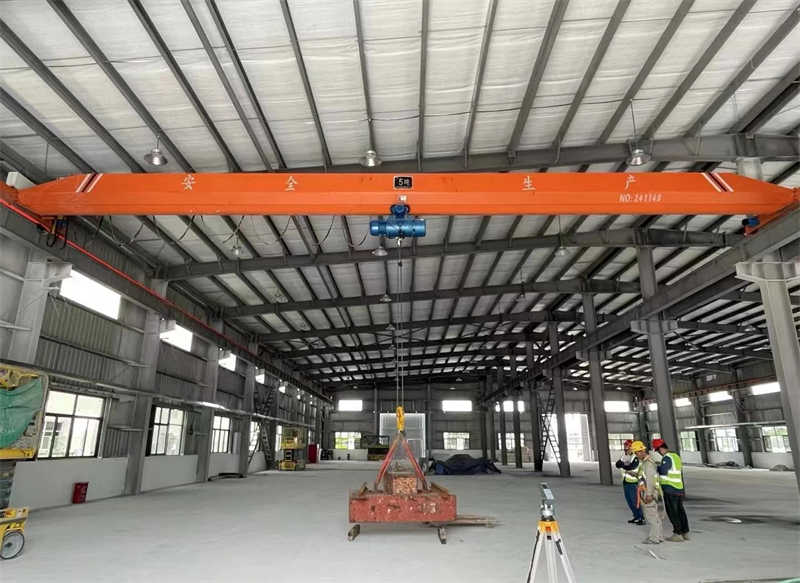
At Dongqi Crane, we have built our manufacturing philosophy around this insight. With over 30 years of experience, a 240,000-square-meter production campus in Changyuan—China’s recognized “Crane Hometown”—and an annual output exceeding 10,000 crane units exported to 96 countries, we have seen firsthand how the transition from traditional to European-style lifting equipment transforms factory economics. Our certifications, including CE, ISO 9001, ISO 14001, ISO 45001, ISO 50001, SGS, and GJB9001C, reflect a commitment to international standards. Our technology partnerships with ABM, SEW, ABB, NORD, Siemens, and Schneider Electric ensure that every crane we manufacture integrates world-class components with Chinese manufacturing efficiency.
This article examines why European-style cranes deliver superior long-term value—not through abstract claims, but through specific, measurable advantages in cost reduction and efficiency improvement. It is written for procurement managers, plant directors, and operations leaders who understand that the purchase price is only the beginning of the story.
Part 1: Redefining “Cost” — Why Purchase Price Is the Wrong Metric
1.1 The Iceberg Problem
The most common mistake in crane procurement is treating the purchase price as the primary decision criterion. The reality is that the initial equipment cost typically represents only 20-30% of what a crane will actually cost over its lifetime. The remaining 70-80% lies beneath the surface: energy consumption, maintenance labor, spare parts, unplanned downtime, and eventual decommissioning.
Industry research analyzing purchasing data from over 200 industrial facilities confirms that while European cranes carry a 15-25% higher initial cost than traditional designs, their total cost of ownership (TCO) over ten years is 30-40% lower. Over a full 20-year lifecycle, the difference can exceed $200,000 per crane—an amount that dwarfs the initial price premium.
This is not an argument for spending more money. It is an argument for measuring cost correctly. When procurement decisions are made on TCO rather than purchase price, European-style cranes are not more expensive—they are significantly cheaper.
1.2 What Drives the TCO Advantage?
The European-style crane’s cost advantage is not a single feature but a system-level outcome of its design philosophy. It emerges from the interaction of four factors:
First, lightweight structural design reduces dead weight by 15-30% compared to traditional cranes of equivalent capacity, directly lowering wheel loads on runway beams and reducing building structural requirements. According to the 2023 China High-End Crane Market Research Report, European-designed bridge cranes achieve a main girder self-weight coefficient (self-weight / rated capacity) below 0.45, compared to 0.6-0.8 for traditional products. This alone can save 10-17% on civil engineering costs in new construction.
Second, energy-efficient drive systems—primarily variable-frequency drives (VFDs) and integrated “three-in-one” motors—reduce electricity consumption by 25-40% compared to traditional constant-speed motors. For a factory operating multiple cranes across multiple shifts, this becomes a substantial annual saving that compounds over the equipment’s life.
Third, modular, low-maintenance design extends maintenance intervals, simplifies repairs, and reduces spare parts inventory. European-style cranes typically use globally standardized components from manufacturers like SEW, ABB, and Siemens, eliminating the proprietary parts trap that forces buyers into single-source dependency for critical spares.
Fourth, superior reliability and longer service life—typically 15-20 years with proper maintenance—mean that the initial investment is amortized over a longer productive period, further reducing annualized cost.
Together, these factors create an economic profile where a slightly higher initial investment unlocks dramatically lower ongoing costs. The math is straightforward, yet many procurement organizations continue to optimize for the wrong variable.
Part 2: The Cost-Reduction Mechanism — How European Design Saves Money at Every Stage
2.1 Construction and Infrastructure Savings: The Lightweight Advantage
The cost-saving impact of European-style cranes begins before the crane is even installed—at the building design stage. Traditional cranes, with their heavy structural components and high wheel loads, require substantial runway beams, reinforced columns, and generous vertical clearance. These requirements translate directly into higher construction costs, more steel consumption, and larger foundations.
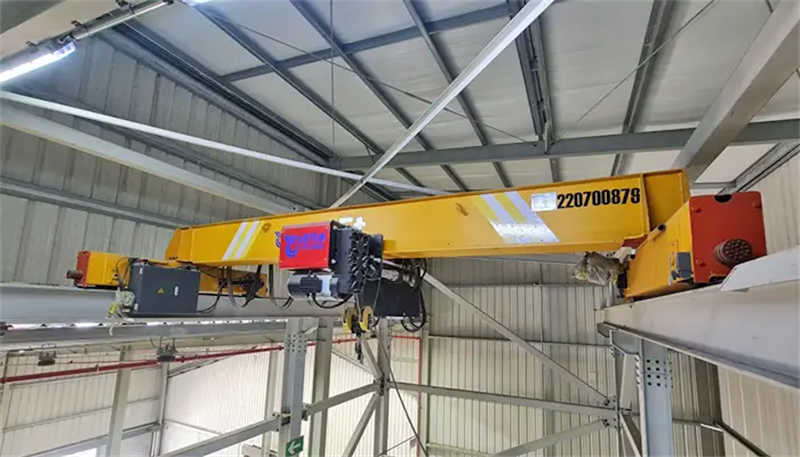
European-style cranes reverse this equation. Through the use of high-strength low-alloy steels (such as Q345B, equivalent to S355 in European standards), optimized box-girder geometries refined through finite element analysis, and compact “three-in-one” drive units that integrate the motor, reducer, and brake into a single assembly, these cranes achieve the same lifting capacity with significantly less structural mass.
The effect on building costs is substantial. Lighter crane weight means lower wheel pressure on runway beams, allowing for lighter structural steel specifications in the building frame. In some cases, steel consumption in the supporting structure can be reduced by more than 15%. The low wheel pressure also reduces concrete foundation requirements, as the track foundation does not need to support the same loads.
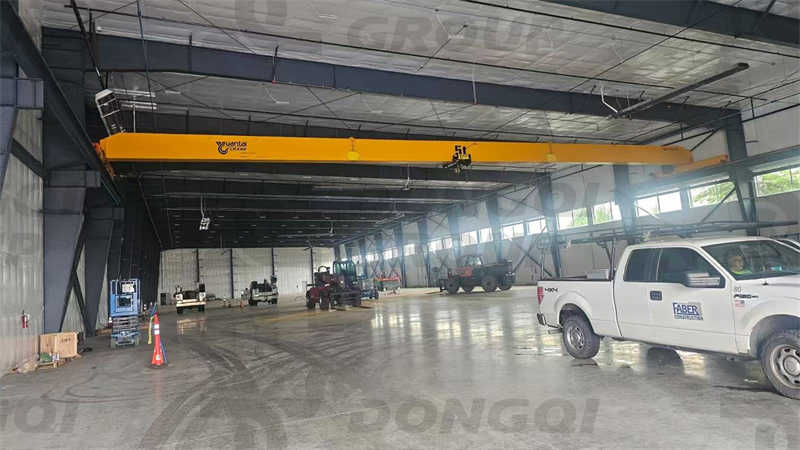
Perhaps the most dramatic saving comes from the low-headroom design characteristic of European-style cranes. By minimizing the distance between the hook’s highest position and the crane’s own structure, these cranes reduce the required building height for a given lifting height. For new construction, this can mean reducing the overall factory height by 1-2 meters, generating savings not only in structural steel but also in cladding, insulation, heating/cooling, and lighting over the building’s life. European-style low-headroom designs can operate effectively in buildings with 20-24 feet of clear height, while traditional cranes may require 28-32 feet or more for the same lifting capability.
For existing factory renovations, the lightweight design offers a different kind of saving: the ability to install higher-capacity cranes on existing runways without expensive structural reinforcement. In many cases, the lower wheel loads of a European-style crane fall within the original design margins of the building, enabling a straightforward equipment swap rather than a costly structural upgrade.
2.2 Energy Efficiency: Where the Compounding Savings Happen
If infrastructure savings represent a one-time benefit at installation, energy savings represent a continuous benefit that compounds year after year. For a crane operating two shifts per day over 15-20 years, electricity cost is one of the largest components of total lifecycle cost.
Traditional cranes typically use constant-speed motors controlled by contactors. When the operator presses a button, the motor runs at full speed. Stopping is achieved through mechanical braking, which converts kinetic energy into heat—a complete waste of a valuable resource. There is no intermediate speed, no energy recovery, and no adaptation to actual load conditions.
European-style cranes equipped with variable-frequency drives (VFDs) operate on entirely different principles. VFDs enable stepless speed control from near-zero to full rated speed, meaning the motor only draws the power needed for the actual operating condition. When handling lighter loads—which account for a surprisingly large portion of typical duty cycles—the system automatically reduces power draw. Across a full working day, the cumulative energy saving is substantial, typically 25-40% compared to traditional constant-speed systems.
Furthermore, advanced European-style systems can incorporate regenerative drive technology that captures the potential energy released during load lowering and feeds it back into the facility’s electrical grid. In high-throughput environments where cranes perform hundreds of lift-lower cycles per shift, regenerative braking alone can account for 30-45% of total energy savings.
The financial impact is meaningful. For a single 10-ton crane, annual electricity savings of 25-35% can amount to approximately 12,000 yuan per year. Across a facility with five or ten cranes, this becomes a six-figure annual saving that drops directly to the bottom line. Moreover, energy-efficient equipment increasingly qualifies for government incentives under China’s 2026 large-scale equipment renewal policy, which explicitly supports energy-saving and carbon-reduction equipment upgrades with tax benefits and financial subsidies.
2.3 Maintenance and Downtime Reduction: The Hidden Savings Multiplier
Of all the costs associated with overhead crane ownership, downtime is the most difficult to quantify—and often the most damaging. When a crane fails during a production shift, the cost is not just the repair. It is the idle workers, the stopped production line, the delayed shipments, and the potential contractual penalties for late delivery. For continuous-process industries like steelmaking or automotive assembly, a single hour of crane downtime can cost tens of thousands of dollars in lost production.
European-style cranes address downtime risk through both preventive and predictive measures. The modular design philosophy means that major components—drive units, electrical controls, braking systems—are standardized, self-contained modules that can be rapidly diagnosed and replaced as complete units rather than repaired piece by piece. This dramatically shortens repair time when issues do occur.
More importantly, European-style cranes are designed for longer maintenance intervals. High-quality components, precision manufacturing, and sealed, lubrication-free designs reduce the frequency of routine maintenance and the probability of unexpected failures. Fully enclosed gearboxes, sealed bearings, and protected electrical enclosures keep contaminants out and reliability in. The maintenance cycle for European-style cranes can extend to six months or more, compared to monthly or quarterly schedules for many traditional designs.
For facilities that upgrade further to smart crane platforms with IoT-enabled predictive maintenance, the benefits multiply. Continuous monitoring of motor temperature, gearbox vibration, brake wear, and operating cycles enables maintenance teams to identify potential failures before they cause downtime—and to schedule interventions during planned production pauses rather than reacting to emergencies.
2.4 Space Utilization: Turning Wasted Volume Into Productive Capacity
Factory space is a fixed asset with a carrying cost. Every square meter of floor area and every meter of vertical clearance represents capital investment. Traditional cranes, with their bulky structures and large hook approach dimensions, leave significant portions of the building envelope unused—dead zones near walls and columns where the hook cannot reach, and vertical headroom consumed by the crane’s own structure.
European-style cranes are engineered to maximize usable space. Their compact end-carriage and trolley designs achieve extremely small hook approach dimensions—in some configurations, the hook can reach within 300mm of the building wall. This virtually eliminates the dead zones that traditional cranes leave along the sides of the building, expanding the effective working area without expanding the building footprint.
In the vertical dimension, the low-headroom design frees up clearance that can be used for higher lifting, taller storage racking, or additional mezzanine levels. In existing buildings, replacing a traditional crane with a European-style equivalent often increases available lifting height by 400-600mm or more—a meaningful gain in facilities where every millimeter of height matters. In new construction, the same low-headroom design enables a lower overall building height for the same lifting capability, generating the construction cost savings described earlier.
For factories that are growing and space-constrained, this combination of factors can defer or eliminate the need for costly building expansions. The capacity gain comes from using existing space more efficiently rather than creating new space.
Part 3: The Efficiency Mechanism — Beyond Cost Savings to Productivity Gains
3.1 Precision Handling: Speed Without Sacrifice
Cost reduction alone would justify the transition to European-style cranes. But the efficiency gains are equally compelling—and in many operations, even more financially significant.
Traditional cranes with two-speed or single-speed motors force operators into a constant trade-off between speed and precision. The high speed moves the load quickly but makes accurate positioning nearly impossible. The low speed enables positioning but at a pace that drags down overall cycle time. The result is a handling process that is either fast or accurate, but rarely both.
European-style cranes with full variable-frequency drives eliminate this trade-off. Stepless speed control from 0 to 100% of rated speed means the operator—or the automated control system—can move rapidly through the long, non-productive travel distances and then decelerate smoothly to creep speed for final positioning. Electronic anti-sway systems actively counteract the pendulum effect of the load, keeping it stable during acceleration and deceleration and eliminating the waiting time that operators of traditional cranes must spend allowing the load to settle.
The practical result is a lift cycle that is both faster and more precise. Industry data from over 200 actual installations shows that properly configured overhead crane systems can improve production efficiency by 40-60% compared to alternative material handling methods, with a typical investment payback period of 2.5 to 4.5 years. Even compared to an existing traditional crane, the cycle-time improvement from European-style precision handling is typically 20-30%.
This matters most in operations where the crane is on the critical path of production—loading and unloading machine tools, positioning components for assembly, or feeding materials to continuous processes. In these applications, faster crane cycles translate directly into higher throughput without adding equipment, shifts, or floor space.
3.2 Automation Readiness: Building the Foundation for Industry 4.0
Manufacturing is undergoing a fundamental shift toward automation and digital integration. China’s Ministry of Industry and Information Technology has set a target that by 2030, every above-scale machinery enterprise will complete at least one full cycle of digital transformation, with 60% reaching smart manufacturing maturity Level 2 or above. The “AI + Manufacturing” action plan explicitly mandates AI application across R&D, production, and equipment predictive maintenance.
In this environment, the overhead crane can no longer be an isolated piece of mechanical equipment operated by a skilled individual. It must become a node in the digital factory ecosystem—capable of receiving instructions from Manufacturing Execution Systems, reporting its status to centralized monitoring platforms, and eventually operating with varying degrees of autonomy.
European-style cranes are engineered for this transition. Their PLC-based control architecture, standardized communication interfaces, and modular electrical design provide a natural foundation for automation integration. Traditional cranes with relay-based or contactor-based controls require extensive modification—often approaching the cost of replacement—to achieve the same level of connectivity.
Dongqi Crane’s smart crane platforms support IoT connectivity through integrated sensors that monitor load, motor temperature, vibration, brake wear, and energy consumption. This data is transmitted to central monitoring systems and can be integrated with customer MES or ERP platforms. Predictive maintenance algorithms analyze equipment condition trends to identify potential failures before they cause downtime. For a factory pursuing smart manufacturing certification or responding to customer demands for digital traceability, this capability is increasingly not optional—it is a requirement.
3.3 Safety and Compliance: Protecting People, Products, and Reputation
Efficiency without safety is not efficiency—it is risk. Traditional cranes, particularly those manufactured before modern safety standards were codified, often lack overload protection, anti-collision systems, emergency braking redundancy, and other active safety features that are now considered essential.
European-style cranes incorporate multiple layers of active protection. Overload limiters prevent lifts beyond rated capacity. Anti-collision systems prevent two cranes on the same runway from contacting each other. Zone protection prevents the crane from entering restricted areas. Emergency braking systems with redundant safety-rated PLCs ensure that a single component failure cannot result in a dropped load.
Beyond regulatory compliance, these safety features have direct financial implications. Facilities with modern, safety-certified lifting equipment typically experience 35-50% fewer incidents, translating into lower insurance premiums, fewer workers’ compensation claims, and reduced liability exposure. International buyers increasingly audit supplier safety records as part of their ESG due diligence. For export-oriented manufacturers, the safety certification of production equipment can be a factor in winning or losing contracts.
European-style cranes also meet international standards including FEM, DIN, CE, and ATEX certifications, which are increasingly required for equipment installed in facilities exporting to European, North American, and other regulated markets. This compliance is not merely a marketing advantage—it is a practical necessity for manufacturers whose customers demand internationally certified production equipment throughout the supply chain.
Part 4: The Dongqi Crane Advantage — Engineering European Standards With Chinese Manufacturing Efficiency
The case for European-style cranes is clear. The more practical question for procurement leaders is: which manufacturer should you trust with this investment?
Dongqi Crane offers a distinct value proposition: European-standard design and components, manufactured at scale in our 240,000-square-meter facility, with the cost efficiency that comes from three decades of focused crane production.
4.1 Design Philosophy Aligned With European Standards
Dongqi Crane’s European-style products are designed to FEM and DIN standards, the benchmarks for crane engineering in global markets. Our design approach emphasizes structural optimization through finite element analysis, material selection using high-strength steels (including Q345B/S355 grades), and modular architecture that simplifies maintenance and future upgrades.
The result is a product line that delivers the lightweight, compact, energy-efficient characteristics of European design while remaining cost-competitive with traditional alternatives.
4.2 World-Class Components, Integrated Systems
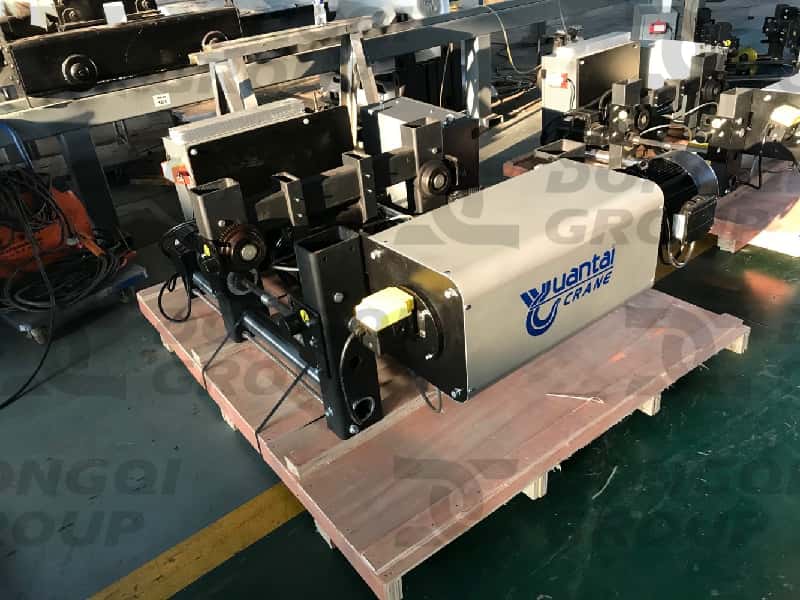
A crane is only as reliable as its components. Dongqi Crane maintains technology partnerships with SEW, ABB, NORD, Siemens, and Schneider Electric—the same manufacturers that supply Europe’s leading crane builders. Our VFD-equipped cranes use ABB or Siemens drives. Our hoists incorporate SEW or NORD gearmotors. Our electrical systems are built around Schneider or Siemens components.
This commitment to premium components ensures that Dongqi cranes deliver the reliability, energy efficiency, and long service life that define the European-style category. It also means that spare parts and technical support are available globally through established distribution networks—eliminating the single-source dependency that creates risk with proprietary designs.
4.3 Manufacturing Scale and Quality Assurance
Our 240,000-square-meter production campus houses over 500 advanced production and testing devices, including 30 CNC machining centers, an Italian COORD3 three-coordinate measuring center, and laser-plasma CNC cutting centers. This investment in precision manufacturing ensures consistency across every crane we produce.
Quality is verified through a multi-stage process: incoming material inspection with chemical composition and mechanical property testing, in-process weld inspection using ultrasonic and radiographic methods, and final load testing at 125% of rated capacity before shipment. Our ISO 9001, CE, and SGS certifications provide independent verification of our quality management system.
4.4 Proven Performance Across Industries and Geographies
Dongqi Crane’s customer base includes some of the world’s most demanding industrial organizations: Shanghai Gas Group, China Railway Corporation, CRRC Group, China Aerospace Group, and China National Petroleum Corporation. Our cranes operate in steel mills, automotive plants, logistics centers, power generation facilities, and manufacturing operations across 96 countries.
In one representative project, a large logistics center in Thailand handling over 500 tons of daily cargo throughput needed to upgrade its material handling capability within existing space constraints. Dongqi deployed MGO-type 10-ton single-girder gantry cranes with European-style compact design and variable-frequency drives. The result: cargo handling efficiency improved by 40%, equipment energy consumption decreased by 15%, and the payback period was just 18 months.
4.5 Alignment With Government Equipment Renewal Policies
China’s 2026 large-scale equipment renewal policy—jointly issued by the National Development and Reform Commission and the Ministry of Finance—provides financial support for industrial equipment upgrades, particularly those that improve energy efficiency, safety, or digital capability. The policy explicitly supports equipment renewal in industrial, energy, logistics, and manufacturing sectors, with tax incentives for energy-saving and intelligent equipment.
For Chinese manufacturers considering crane modernization, this policy can substantially reduce the net investment required. Dongqi Crane’s European-style products, with their documented energy savings of 25-40% and IoT-ready control architecture, align directly with the policy’s objectives. Our team can assist customers in understanding eligibility requirements and preparing documentation for policy-supported upgrade projects.
Part 5: Making the Transition — A Practical Framework for Decision-Makers
5.1 When to Replace vs. When to Modernize
Not every facility needs a full crane replacement. For operations with structurally sound but technologically outdated cranes, a modernization program targeting specific systems—electrical controls, drives, safety devices—can deliver many of the benefits of European-style performance at a fraction of the cost of new equipment.
The decision framework should consider:
- Structural condition: If the main girder and end carriages are in good condition with no fatigue cracking or significant corrosion, modernization may be viable. If structural integrity is compromised, replacement is the safer and more economical choice.
- Control system age: Relay-based or early-generation contactor controls are increasingly difficult to maintain and cannot support automation integration. Retrofitting with PLC controls and VFDs is often the highest-return upgrade.
- Safety compliance: Cranes lacking overload protection, anti-collision systems, or modern braking standards create regulatory and liability exposure that justifies prioritized upgrade.
- Duty cycle requirements: If production volumes have increased since the crane was originally specified, the existing equipment may be operating beyond its design duty class—accelerating wear and increasing failure risk.
Dongqi Crane’s engineering team provides assessment services to help customers evaluate their existing equipment and determine the optimal upgrade path.
5.2 Building the Business Case
For procurement leaders who need to justify the investment to financial decision-makers, the TCO framework provides a rigorous analytical foundation. The key is to present the complete cost picture:
| Cost Category | Traditional Crane | European-Style Crane | 10-Year Difference |
|---|---|---|---|
| Purchase & Installation | Lower upfront | 15-25% higher | -$12,500 to +$15,000 |
| Energy (10 years) | Baseline | 25-40% lower | -$30,000 to -$48,000 |
| Maintenance (10 years) | Baseline | 40%+ lower | -$24,000 to -$48,000 |
| Downtime (10 years) | Higher risk | Significantly lower | Risk reduction (variable) |
| Building/Infrastructure | Higher requirements | Lower requirements | -$10,000 to -$25,000 |
| Net 10-Year Position | European design saves $50,000-$120,000+ |
The analysis consistently shows that European-style cranes deliver substantially lower total cost despite their higher initial price—and the gap widens over longer time horizons.
Conclusion: From “Functional” to “Productive” — The Choice That Compounds
The distinction between a crane that is merely “functional” and one that is genuinely “productive” is not a matter of opinion. It is measurable in kilowatt-hours consumed, in minutes of cycle time, in hours of unplanned downtime, in meters of unused building height, and in maintenance invoices paid over the equipment’s life.
A traditional crane that still lifts and moves loads may appear to be adequate. But “adequate” in 2026 carries a hidden price that compounds every day the crane operates. Higher electricity costs. More frequent repairs. Slower throughput. Lost vertical space. And the ever-present risk that a failure during peak production will cascade into missed shipments, customer penalties, and reputational damage.
European-style cranes address these hidden costs at the source—through lightweight design that reduces structural demands, variable-frequency drives that cut energy consumption, modular architecture that simplifies maintenance, and precision control that accelerates every lift cycle. The result is not just a better crane; it is a better factory, with lower operating costs, higher throughput, and a digital foundation ready for the automation demands of the coming decade.
Dongqi Crane is ready to partner with you in making this transition. Whether you are building a new facility and want to optimize your crane investment from the start, or operating an existing factory where outdated lifting equipment is silently eroding your competitiveness, our engineering team brings the expertise, manufacturing scale, and global service infrastructure to deliver results.
Visit sg.craneyt.com to discuss your specific requirements with our team. Let’s transform your material handling from “just functional” to “truly productive.”
About Dongqi Crane
Henan Dongqi Machinery Co., Ltd. is a leading manufacturer of European-standard overhead cranes, gantry cranes, electric hoists, and intelligent lifting solutions. With over 30 years of experience, a 240,000-square-meter manufacturing facility, annual production exceeding 10,000 units, and exports to 96 countries, Dongqi Crane delivers quality, reliability, and innovation to manufacturers worldwide. Our certifications include CE, ISO 9001, ISO 14001, ISO 45001, ISO 50001, SGS, and GJB9001C. Technology partners include ABM, SEW, ABB, NORD, Siemens, and Schneider Electric. Contact us at pk.craneyt.com.
