
22-Apr-2026
How to Read a Crane Quotation: 10 Critical Configuration Details You Must Verify
A Buyer’s Guide from DONGQI CRANE for Procurement Professionals and Plant Managers
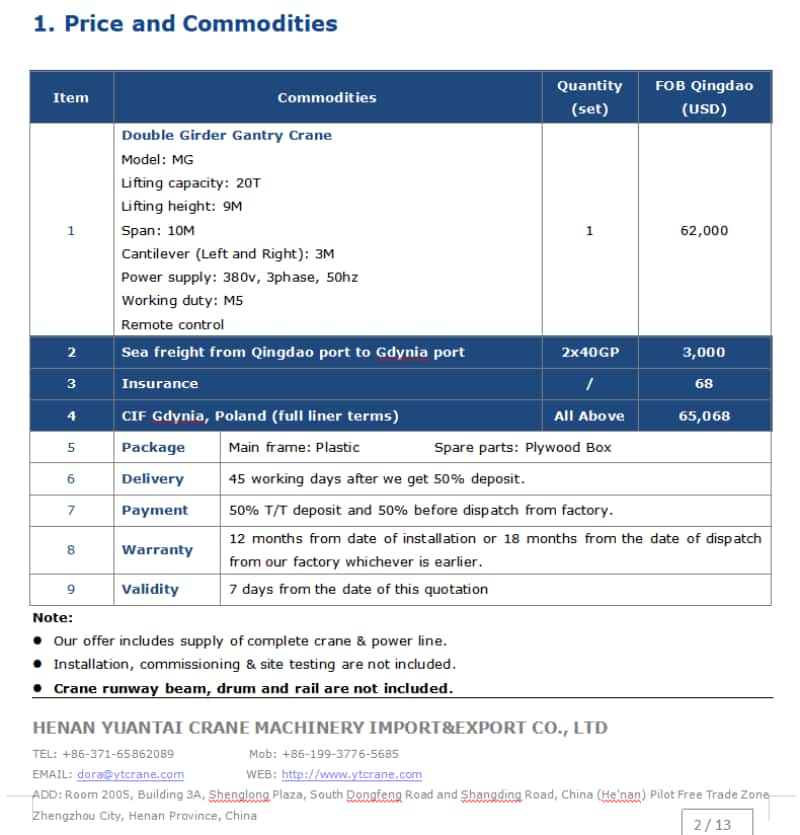
You have received three crane quotations for what appears to be the same 10-ton overhead crane. The prices vary by 40%. The technical descriptions are filled with acronyms and model numbers you do not recognize. The payment terms, delivery schedules, and warranty clauses all read differently.
How do you determine which quote represents genuine value—and which one hides costly omissions that will surface only after installation begins?
At DONGQI CRANE, a Sino-New Zealand joint venture with over 40 years of manufacturing experience and products operating in 96 countries, we have reviewed thousands of competitor quotations brought to us by confused buyers. The pattern is consistent: suppliers omit critical configuration details, substitute lower-grade components, or bury exclusions in fine print—all while presenting a deceptively low headline price.
This guide provides a systematic framework for evaluating any crane quotation. By verifying the ten configuration details outlined below, you will distinguish between comprehensive proposals and incomplete ones, protect your procurement budget from hidden costs, and ensure the crane delivered matches the crane you expected.
Why Reading a Crane Quotation Requires Technical Literacy
A crane is not a commodity. Unlike a standard electric motor or a pump that can be compared by model number alone, a crane is an engineered system comprising structural steel, hoisting mechanisms, motors, gearboxes, electrical controls, and safety devices. The performance, reliability, and total cost of ownership depend on how these components are specified—and how clearly those specifications are documented in the quotation.
A vague quotation is a red flag. If a supplier cannot articulate exactly what they are providing, they may not have full control over their supply chain—or they may be deliberately leaving room for cost-cutting substitutions after the order is placed.
The DONGQI CRANE standard: Every quotation we issue includes a detailed technical specification document that becomes part of the commercial contract. There is no ambiguity about what is being supplied, because everything is documented in writing.
The 10 Critical Configuration Details to Verify
1. Work Duty Classification (FEM / ISO / CMAA)
This is the single most important specification in any crane quotation—and the one most frequently omitted or obscured.
What to look for: The quotation must explicitly state the work duty classification using a recognized standard: FEM (1Am, 1Bm, 2m, 3m, 4m), ISO (M3, M4, M5, M6, M7, M8), or CMAA (Class A, B, C, D, E, F). A statement like “heavy duty” or “industrial grade” without a specific classification code is meaningless.
Why it matters: Work duty classification determines the crane’s structural fatigue life, motor sizing, gearbox capacity, and brake rating. An M3 (light duty) crane operating in an M6 (heavy duty) application will experience premature gearbox failure, structural cracking, and voided warranties—often within the first year. Conversely, specifying an M7 crane for an M4 application wastes capital.
The cost impact: Upgrading from M3 to M6 can increase equipment cost by 30–50%—which is why some suppliers “forget” to specify the duty class, allowing them to quote an attractively low price based on the lightest possible configuration.
DONGQI CRANE practice: Every quotation clearly states the FEM/ISO classification, and our engineering team documents the duty cycle analysis that supports the specification. We quote based on your actual operating conditions—not the lowest possible classification.
Your verification checklist:
- [ ] Is a specific FEM/ISO/CMAA classification stated?
- [ ] Does the classification match your actual operating hours and load spectrum?
- [ ] If not stated, request written confirmation before comparing quotes.
2. Hoist Model and Brand Specification
The hoist is the heart of the crane. It generates the lifting force, controls the speed, and accounts for the majority of maintenance events over the crane’s lifespan. Yet many quotations list only “electric wire rope hoist” without specifying manufacturer, model series, or component brands.
What to look for: The quotation should identify the hoist by manufacturer and model series (e.g., “DONGQI CD1 Series,” “DONGQI European-Style ND Series,” or a specific third-party brand such as “STAHL,” “KITO,” or “DEMAG” if sourced externally). For integrated hoists, the quotation should specify the brands of critical components: motor, gearbox, brake, and wire rope.
Why it matters: Hoist quality varies enormously. A premium European-style hoist with SEW motor and sealed gearbox may cost 50–80% more than a basic CD type hoist—but delivers 30–40% energy savings, 50% lower failure rates, and significantly longer service life. Without specific model identification, you cannot verify what you are paying for.
Common omission tactics:
- “Electric hoist included” (no brand or model)
- “Famous brand motor” (which brand?)
- “European design” (designed in Europe, but manufactured where and with what components?)
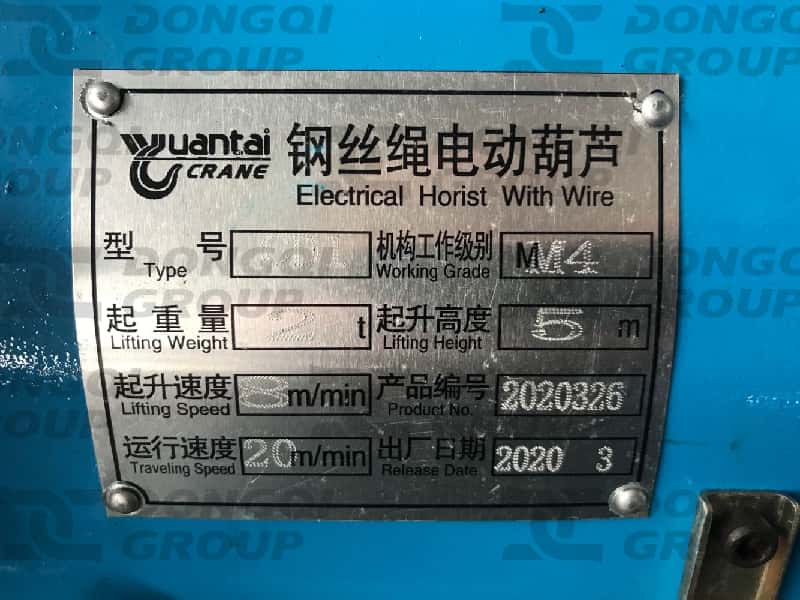
DONGQI CRANE practice: We manufacture our own hoists—CD type, MD type, and European-style—and clearly specify the model series in every quotation. For European-style hoists, we document the component brands: SEW or NORD motors, Schneider or Siemens electrical controls, and premium bearings and seals.
Your verification checklist:
- [ ] Is the hoist manufacturer and model series specified?
- [ ] Are critical component brands (motor, gearbox, brake) identified?
- [ ] If third-party hoist, is it genuine OEM or a licensed copy?
3. Structural Steel Material Grade and Deflection Standard
The bridge girders are the backbone of the crane. Their material grade and design deflection criteria determine whether the crane will operate smoothly for decades or develop alignment problems within years.
What to look for: The quotation should specify the steel grade (e.g., Q235B, Q355B, or equivalent ASTM/EN grades) and the design deflection standard. Industry norms are L/800 for overhead cranes and L/1000 for European-standard designs (where L is the span length). A stiffer beam (L/1000 or better) reduces wheel wear, improves trolley tracking, and extends runway life.
Why it matters: Steel grade directly affects structural fatigue life. Q235B is adequate for light to medium duty applications. Q355B (higher yield strength) is required for heavy-duty cycles or longer spans. A supplier using lower-grade steel to reduce cost will not advertise this—but it will appear as premature deflection and alignment issues.
Common omission tactics:
- No steel grade specified
- “High-strength steel” without grade identification
- Deflection standard not stated
DONGQI CRANE practice: We specify steel grades in every quotation and provide material test certificates upon request. Our European-standard cranes are designed to L/1000 deflection criteria using FEA-optimized beam sections that reduce weight while maintaining rigidity.
Your verification checklist:
- [ ] Is steel grade explicitly stated?
- [ ] Is deflection standard (L/800, L/1000) specified?
- [ ] Will material test certificates be provided?
4. Electrical Control System and Component Brands
The electrical control system determines how reliably the crane starts, stops, and responds to operator commands. Component quality here directly impacts uptime and maintenance costs.
What to look for: The quotation should identify the control method (pendant, radio remote, or cabin), the VFD (variable frequency drive) configuration (none, hoist only, or full motion control), and the brands of major electrical components: contactors, relays, VFDs, and main power disconnect.
Why it matters: The difference between no-name contactors and Schneider or Siemens components is measured in years of service life and thousands of operating cycles. VFD control adds 15–25% to equipment cost but reduces mechanical wear by 40–60% through soft-start and soft-stop operation. Without brand specifications, you may receive the lowest-cost components available in the market at the time of manufacture.
Common omission tactics:
- “VFD control” without specifying which motions
- “Quality electrical components” without brand names
- No mention of enclosure protection rating (IP54, IP55, IP65)
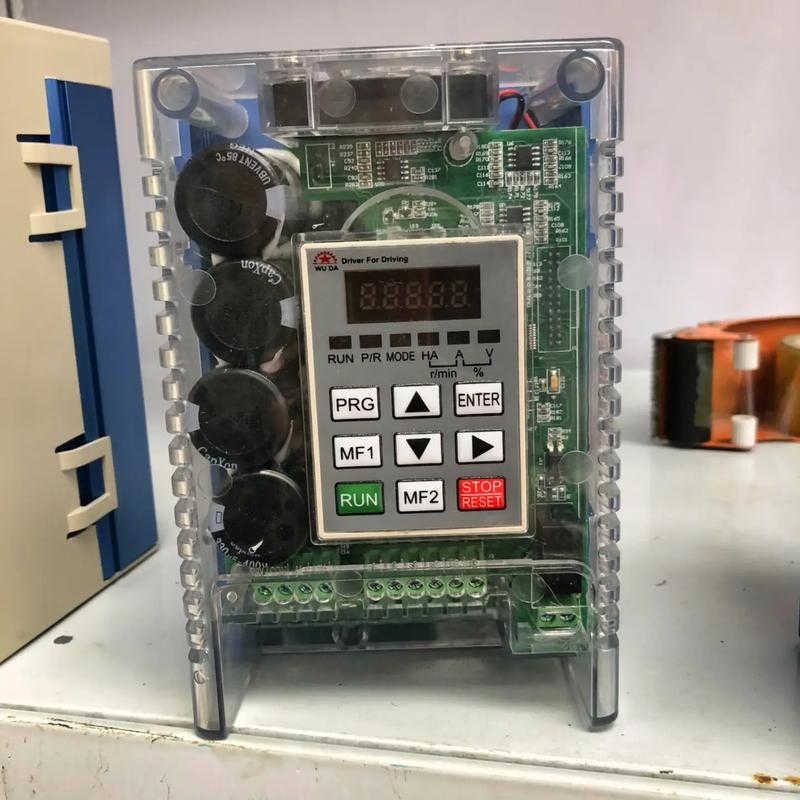
DONGQI CRANE practice: We standardize on Schneider and Siemens electrical components. Every quotation specifies VFD configuration by motion (hoist, cross travel, long travel) and identifies control panel enclosure rating. For harsh environments, we specify IP65 sealed enclosures.
Your verification checklist:
- [ ] Are contactor/relay brands specified?
- [ ] Is VFD configuration clearly defined (which motions)?
- [ ] Is enclosure protection rating (IP code) stated?
5. Below-the-Hook Equipment and Rigging
The crane quotation typically covers the crane itself—the bridge, trolley, and hoist. What happens below the hook is often excluded or left ambiguous, creating a significant gap between expected and delivered functionality.
What to look for: Does the quotation include a hook? What type? Does it include a lifting beam, spreader bar, magnet, vacuum lifter, or grab bucket if your application requires specialized handling? Is rigging (slings, shackles) included or excluded?
Why it matters: A standard hook may be inadequate for your specific loads. Long, flexible, or unbalanced loads require lifting beams or spreader bars that can add $5,000–$25,000 to the project cost. If these items are not explicitly included, you will face unexpected procurement after the crane arrives.
Common omission tactics:
- Quotation states “crane only” in fine print
- Hook type not specified (single, double, ramshorn, swivel)
- Below-the-hook equipment listed as “optional” without pricing
DONGQI CRANE practice: We clearly delineate what is included and what is excluded. If your application requires specialized below-the-hook equipment, we either include it with full specifications or provide a separate line item with transparent pricing.
Your verification checklist:
- [ ] Is hook type and capacity specified?
- [ ] Are lifting beams or spreader bars included if required?
- [ ] Is rigging (slings, shackles) in scope?
6. Runway, Installation, and Commissioning Scope
This is where many buyers experience the largest gap between quoted price and final project cost. The crane quotation often covers only the equipment delivered to site—not the civil works, runway installation, or commissioning required to make it operational.
What to look for: The quotation must clearly state what is included regarding:
- Runway beams and support steel (included or by others?)
- Installation labor (supplier-provided or buyer-responsible?)
- Commissioning and load testing (included or separate?)
- Operator training (included or additional cost?)
Why it matters: Installation and runway costs typically equal 25–50% of the crane equipment price. If these are not included in the quotation, your true project cost will be significantly higher than the quoted figure. A quotation that appears 20% lower than competitors may simply be excluding these essential items.
Common omission tactics:
- “Installation by others” buried in terms and conditions
- Runway not mentioned at all
- Load test certificate excluded
DONGQI CRANE practice: We provide complete transparency on installation scope. DONGQI CRANE does not maintain local installation crews; instead, we dispatch our own factory engineers from China to your site anywhere in the world. Our engineers supervise the installation performed by your local contractor, oversee commissioning, conduct load testing, and provide operator training. This scope and associated costs are clearly documented in our proposals.
Your verification checklist:
- [ ] Is runway steel in scope or by others?
- [ ] Is installation supervision included?
- [ ] Are load testing and certification included?
- [ ] Is operator training included?
7. Warranty Terms and Coverage Period
Warranty terms vary dramatically across suppliers—and the differences are often buried in fine print that buyers discover only when making a claim.
What to look for: The quotation should specify:
- Warranty duration (12 months, 18 months, 24 months from commissioning or shipment?)
- What is covered (parts only, or parts and labor?)
- What is excluded (wear parts? improper operation? overload events?)
- Warranty claim process and response time
Why it matters: A “24-month warranty” that covers parts only and excludes wear components provides significantly less protection than an “18-month comprehensive warranty” covering both parts and on-site labor. Some warranties begin from shipment date, not commissioning date—meaning several months of coverage may expire before the crane is even operational.
Common omission tactics:
- Warranty start date not specified (shipment vs. commissioning)
- Labor excluded (parts only)
- Wear parts (wire rope, brake pads, contactors) excluded
DONGQI CRANE practice: Our standard warranty covers parts for 18 months from commissioning or 24 months from shipment, whichever occurs first. Wear parts are covered against manufacturing defects. Warranty terms are clearly documented in the quotation and purchase agreement.
Your verification checklist:
- [ ] Is warranty duration clearly stated?
- [ ] Does warranty start from shipment or commissioning?
- [ ] Are parts and labor both covered?
- [ ] Are exclusions clearly listed?
8. Freight, Duties, and Incoterms
For international buyers, freight and import duties can add 10–30% to the equipment cost. Ambiguous Incoterms create disputes about who bears risk during transit and who is responsible for customs clearance.
What to look for: The quotation must specify the Incoterm (e.g., FOB Shanghai, CIF Jakarta, DDP Bangkok) and clearly state whether freight, insurance, and import duties are included or excluded.
Why it matters: A CIF (Cost, Insurance, Freight) quotation includes shipping and insurance to the destination port—but not import duties, port handling charges, or inland transportation to your facility. A DDP (Delivered Duty Paid) quotation includes everything to your door. Comparing a CIF quote to a DDP quote without adjustment creates a false price comparison.
Common omission tactics:
- Incoterm not specified
- “Freight to be advised” without commitment
- Duties and local charges not mentioned
DONGQI CRANE practice: We quote with clearly specified Incoterms and provide transparent freight estimates based on your destination. Our export documentation team helps clients navigate preferential tariff agreements (RCEP, ACFTA) that may reduce or eliminate import duties.
Your verification checklist:
- [ ] Is Incoterm explicitly stated?
- [ ] Are freight and insurance included or separate?
- [ ] Are import duties and local charges estimated?
9. Documentation and Certification Package
The documentation accompanying a crane is not just paperwork—it is essential for customs clearance, regulatory compliance, insurance coverage, and future maintenance.
What to look for: The quotation should list the documentation that will be provided:
- Material test certificates (mill certificates for structural steel)
- Welding procedure specifications (WPS) and welder qualifications
- Load test certificate
- Geometric survey report (alignment and camber measurements)
- Operation and maintenance manuals
- Electrical schematics
- Spare parts catalog
- Certificate of Conformity (CE, ISO, or country-specific)
Why it matters: Many countries require specific documentation for crane import and operation. Indonesia requires SNI certification documentation. Thailand requires TISI compliance. Vietnam requires CR certification. Malaysia requires DOSH approval. Missing documentation can delay customs clearance by weeks or prevent legal operation entirely.
Common omission tactics:
- Documentation package not specified
- “Standard documentation” without detail
- Country-specific certification excluded
DONGQI CRANE practice: We hold ISO 9001, ISO 14001, ISO 45001, and CE certifications. Every shipment includes a comprehensive documentation package tailored to the destination country’s requirements. Our technical documentation team ensures material traceability, weld procedure documentation, and compliance certificates are complete before shipment.
Your verification checklist:
- [ ] Is a documentation list provided?
- [ ] Are material test certificates included?
- [ ] Are country-specific certifications addressed?
- [ ] Are manuals provided in your language?
10. Spare Parts Availability and After-Sales Support Model
A crane operates for 15–25 years. During that lifespan, it will require replacement parts. Understanding how those parts will be obtained—and what technical support will be available—is essential before purchase.
What to look for: The quotation should describe the after-sales support model:
- How are spare parts ordered and delivered?
- What are typical lead times for critical components?
- Is remote technical support available?
- Is on-site engineer support available if needed?
Why it matters: Many buyers assume the supplier has local spare parts inventory. When a critical component fails, they discover parts must be ordered from overseas with weeks of lead time—and no local technical support is available for installation.
DONGQI CRANE practice: We are completely transparent about our support model. DONGQI CRANE does not maintain local spare parts warehouses or local agencies. Instead, we provide:
- Rapid spare parts fulfillment: Parts ship directly from our 240,000m² factory via international express courier (DHL, FedEx, UPS), typically arriving at major global destinations within 3–7 business days.
- Direct engineer dispatch: When on-site expertise is required, we dispatch DONGQI CRANE factory engineers directly from China to your facility.
- Remote technical support: Video-assisted troubleshooting via WeChat, WhatsApp, or Zoom.
- Recommended spares list: At time of purchase, we provide a critical spares recommendation so you can stock high-wear items locally.
This direct-from-factory model eliminates intermediary markups and ensures you receive genuine DONGQI CRANE parts and factory-trained expertise.
Your verification checklist:
- [ ] Is the spare parts ordering process clearly explained?
- [ ] Are typical parts lead times provided?
- [ ] Is remote technical support available?
- [ ] Is on-site engineer dispatch available?
Quotation Comparison Checklist
Use this checklist to normalize and compare multiple crane quotations. Award one point for each item clearly specified.
| Verification Item | Supplier A | Supplier B | Supplier C |
|---|---|---|---|
| 1. Work duty classification (FEM/ISO/CMAA) stated | ☐ | ☐ | ☐ |
| 2. Hoist manufacturer and model specified | ☐ | ☐ | ☐ |
| 3. Steel grade and deflection standard stated | ☐ | ☐ | ☐ |
| 4. Electrical component brands specified | ☐ | ☐ | ☐ |
| 5. Below-the-hook equipment scope clear | ☐ | ☐ | ☐ |
| 6. Installation and commissioning scope defined | ☐ | ☐ | ☐ |
| 7. Warranty terms fully documented | ☐ | ☐ | ☐ |
| 8. Incoterms and freight responsibility clear | ☐ | ☐ | ☐ |
| 9. Documentation and certification package listed | ☐ | ☐ | ☐ |
| 10. After-sales support model explained | ☐ | ☐ | ☐ |
| TOTAL (out of 10) |
A quotation scoring below 8 should prompt additional questions before proceeding. A quotation scoring below 6 represents significant procurement risk.
Red Flags That Signal Hidden Problems
Beyond the ten verification items, certain patterns in quotations warrant immediate caution:
“Price valid for 7 days only.” Crane manufacturing costs do not fluctuate that rapidly. This is a high-pressure sales tactic, not a reflection of market conditions.
“Same as European quality” without specifications. If a supplier cannot articulate how their product achieves European quality standards—specific design codes, component brands, or certifications—the claim is meaningless.
No physical address for manufacturing facility. Trading companies without their own factories cannot control quality, delivery, or after-sales support. Verify that the supplier operates their own manufacturing facility.
Unwillingness to provide customer references. Established manufacturers serving international markets have satisfied customers willing to share their experience. Refusal to provide references is a major warning sign.
Vague answers to technical questions. If a supplier cannot answer specific questions about work duty classification, deflection standards, or component brands, they lack the engineering depth to support your project.
The DONGQI CRANE Commitment to Quotation Transparency
At DONGQI CRANE, we believe that an informed buyer makes better decisions. Our quotations are designed to provide complete transparency across all ten verification items:
| Verification Item | DONGQI CRANE Standard |
|---|---|
| Work Duty Classification | FEM/ISO classification stated; duty cycle analysis documented |
| Hoist Specification | DONGQI CD, MD, or European series specified; component brands identified |
| Steel and Deflection | Steel grade stated; L/1000 deflection for European series |
| Electrical Components | Schneider/Siemens standard; VFD configuration by motion |
| Below-Hook Equipment | Clearly included or separately itemized |
| Installation Scope | Engineer supervision included; runway responsibility defined |
| Warranty | 18/24 months documented; coverage terms explicit |
| Freight and Incoterms | Incoterm stated; freight estimate provided |
| Documentation | Complete package including material certs, load test, manuals |
| After-Sales Support | Direct-from-factory parts; engineer dispatch; remote support |
We welcome comparison. We encourage every buyer to ask hard questions, verify our claims, and speak with our existing customers. A crane is a multi-decade investment. The time spent evaluating quotations properly is an investment in avoiding costly surprises.
Conclusion: Read the Fine Print Before You Sign
A crane quotation is more than a price. It is a promise about what will be delivered, how it will perform, and how it will be supported over its 15–25 year service life. The ten verification items in this guide represent the difference between a quotation you can trust and one that conceals costly omissions.
Before you compare prices, verify that you are comparing equivalent specifications. Before you sign a purchase agreement, confirm that every critical configuration detail is documented in writing. Before you make a final decision, ensure you understand exactly how spare parts and technical support will be delivered when—not if—they are needed.
At DONGQI CRANE, we provide complete transparency because we want our customers to succeed. A satisfied customer operating a reliable crane is the foundation of our 40-year reputation and our continued growth across 96 countries.
Ready to receive a fully transparent crane quotation for your project?
[Contact DONGQI CRANE’s international sales team today for a detailed technical and commercial proposal tailored to your specific requirements.]
DONGQI CRANE: Your Direct-from-Factory Partner for Overhead Cranes, Gantry Cranes, and Custom Lifting Solutions Since 1985.
Transparent Quotations • Factory-Direct Pricing • Engineering-Driven Proposals
ISO 9001 • ISO 14001 • ISO 45001 • CE Certified
240,000m² Manufacturing Facility • 10,000+ Annual Capacity • Exports to 96+ Countries
Direct Engineer Dispatch Worldwide • Express Spare Parts Delivery • Remote Technical Support
