
23-Sep-2025
KBK vs. Single-Girder Bridge Cranes: How to Make the Right Choice for Your Assembly Line
Confused between KBK and single-girder bridge cranes? Dongqi Crane’s expert guide compares structure, capacity, and application to help you select the perfect lifting solution for your assembly line. Get a free consultation today!
Introduction: The Heartbeat of an Efficient Assembly Line
In the dynamic environment of a modern assembly line, the seamless movement of materials is not just a convenience—it’s a critical driver of productivity, safety, and product quality. Whether you’re handling delicate electronic components or heavy machine parts, the choice of your overhead lifting equipment can make or break your operational efficiency. A common dilemma faced by plant managers and engineers is choosing between the flexible, modular KBK system and the robust, powerhouse single-girder bridge crane.
This comprehensive guide from Dongqi Crane will demystify these two popular options. We will delve into their core differences, applications, and advantages, empowering you with the knowledge to make an informed investment that perfectly aligns with your production needs.
Part 1: Understanding the Core Concepts
What is a KBK Crane? The Epitome of Flexibility
KBK, short for the German Kombiniert Kran Bahn (Combined Crane System), is a standardized, modular lightweight lifting system. Think of it as a set of high-quality building blocks for your material handling needs.
- Structure: It consists of prefabricated components—including oval-shaped tracks, trolleys, suspension kits, and turns—that can be easily assembled and reconfigured.
- Key Characteristics:
- Lightweight: Made from high-strength aluminum or steel, it adds minimal load to your building’s structure.
- High Flexibility: KBK tracks can be configured in straight lines, curves, and switches to create complex two-dimensional or three-dimensional layouts that cover multiple workstations.
- Precision Handling: Offers exceptionally smooth and precise load positioning, ideal for tasks requiring accuracy.
- Lower Capacity: Typically designed for lighter loads, commonly ranging from 125 kg to 2,000 kg.
- Ideal Applications: Perfect for precision assembly lines, electronics manufacturing, packaging areas, laboratories, and any environment where workstations are dense and processes require frequent, exact movements.
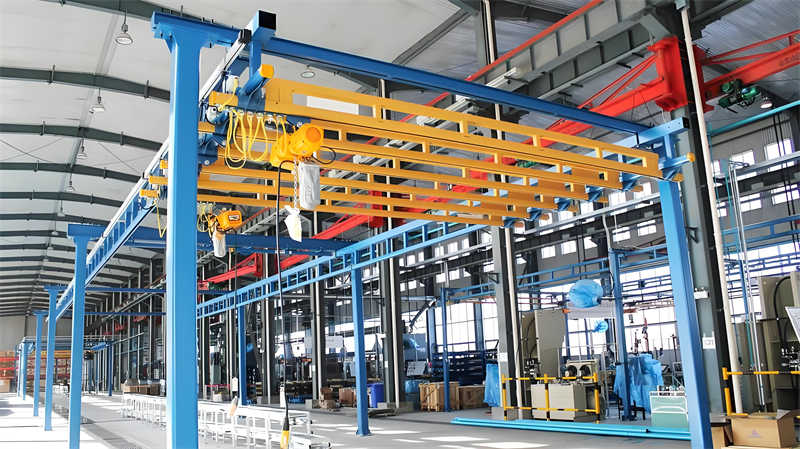
What is a Single-Girder Bridge Crane? The Workhorse of the Workshop
A single-girder bridge crane is a more traditional and robust overhead crane system designed for heavy-duty applications across larger, open spaces.
- Structure: It features a single main beam (the bridge) that runs on elevated rails attached to the building’s support columns or runway tracks. A hoist and trolley unit moves along the bottom flange of the main beam.
- Key Characteristics:
- Robust Construction: Built with durable steel girders, it is designed for strength and longevity.
- Wide Coverage: Efficiently serves a large, rectangular bay area, making it the master of a designated workspace.
- High Capacity: Engineered to handle significantly heavier loads, typically from 1 ton to 20+ tons.
- Requires Robust Support: Requires a strong overhead support structure, such as reinforced concrete columns or specially constructed runway beams.
- Ideal Applications: Ideal for machine shops, steel warehouses, loading bays, fabrication facilities, and any setting where the primary need is to move heavy loads efficiently over a broad area.
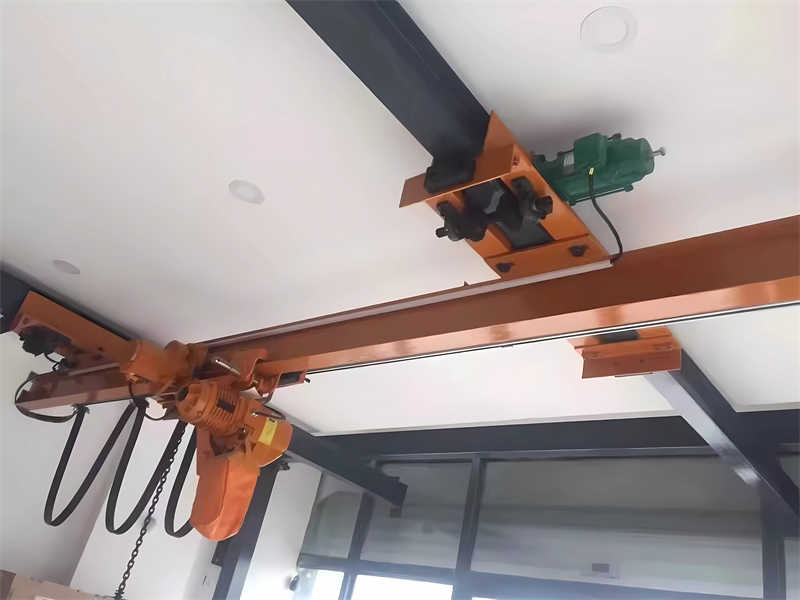
Part 2: Head-to-Head Comparison: KBK vs. Single-Girder Bridge Crane
The following table provides a clear, at-a-glance comparison to highlight the key differences.
| Feature | KBK Crane | Single-Girder Bridge Crane | Your Key Consideration |
|---|---|---|---|
| Structure & Capacity | Modular, lightweight design. Lower capacity (≤ 2T). | Solid, heavy-duty girder design. Higher capacity (1T – 20T+). | What is the maximum weight you need to lift? |
| Coverage & Flexibility | Highly flexible. Easily configured with curves and switches for complex layouts. | Covers a large, rectangular area. Fixed path, less flexible. | Is your layout fixed or subject to change? Is the workspace complex? |
| Building Requirements | Low requirements. Can be suspended from existing roof structures with minimal reinforcement. | High requirements. Needs strong runway beams or building columns designed for the load. | What is your building’s load-bearing capacity? Is it a new or existing facility? |
| Precision & Speed | Superior precision. Ideal for delicate, repetitive positioning tasks. | Faster travel speeds. Better for rapid transport across long distances. | Is pinpoint accuracy or transport speed more critical? |
| Cost Considerations | Lower initial equipment cost; easy installation. Total cost can rise with complex layouts. | Higher initial investment (crane and infrastructure); superior ROI for heavy loads over large areas. | What is your budget, and what is the long-term Return on Investment (ROI) you expect? |
Part 3: The Dongqi Crane Selection Guide: Making the Right Choice
Choosing the right crane is not about finding the “best” one, but the most suitable one for your specific operation. Follow this simple guide.
Step 1: Define Your Core Requirements
Ask yourself these critical questions:
- Load Capacity: What is the maximum weight of the heaviest item you will lift?
- Work Area: What is the size and shape of the area that needs to be covered?
- Operational Needs: How frequently are lifts performed? Is millimeter-level precision required?
- Site Conditions: What are the specifications of your building (ceiling height, column strength, etc.)?
Step 2: Follow the Decision Path
- Choose a KBK System if:
- Your load requirements are 2 tons or less.
- Your production line has multiple, closely-spaced workstations.
- You need exceptional precision for assembly tasks.
- Your factory layout changes frequently or you need a system that can grow with your production line.
- Your building has limited load-bearing capacity.
- Choose a Single-Girder Bridge Crane if:
- Your load requirements exceed 2 tons.
- You need to serve a large, open area like a warehouse or fabrication bay.
- The primary task is efficient transportation of heavy loads rather than intricate positioning.
- Your facility has the necessary robust support structure in place.
Step 3: Consider an Integrated Solution
For complex operations, a hybrid approach often yields the best results. For example, a single-girder bridge crane can be used for the primary movement of heavy sub-assemblies across the workshop, while KBK systems are installed at individual stations for precise positioning and assembly. Dongqi Crane specializes in designing such custom, integrated material handling solutions that maximize efficiency across your entire workflow.
Part 4: Why Partner with Dongqi Crane?
At Dongqi Crane, we don’t just sell cranes; we provide reliable, efficient, and safe lifting solutions backed by unparalleled expertise.
- Comprehensive Product Portfolio: We offer both high-quality KBK systems and a wide range of single-girder and double-girder bridge cranes, ensuring you get unbiased advice.
- Expert Engineering Support: Our team of engineers provides free, on-site assessments to recommend the optimal solution based on your technical and budgetary requirements.
- Uncompromising Quality and Safety: All our cranes are manufactured to international standards (ISO, FEM, DIN) and come with full certification, guaranteeing safety and durability.
- Lifelong Customer Service: From installation and commissioning to preventative maintenance and spare parts, we support you throughout the entire lifecycle of your equipment.
Conclusion: Empower Your Production Line with the Right Lift
The decision between a KBK and a single-girder bridge crane is a strategic one that impacts your daily operations, safety, and bottom line. By carefully evaluating your needs against the strengths of each system, you can invest in a solution that will enhance your productivity for years to come.
Still unsure which crane is the perfect fit for your assembly line?
Let the experts at Dongqi Crane guide you. We are committed to helping you optimize your material handling processes.
Contact us today for a free, no-obligation consultation and on-site assessment!
📞 [+86 18638815424]
📧 [sales010@cranesdq.com]
🌐 [https://sg.craneyt.com/]
Download our free product catalogs or explore our case studies to see our cranes in action!
