
5-Aug-2025
How Lightweight Design Enables High-Efficiency Operations——Single-Girder Gantry Crane Technical White Paper
1. Foreword: The Evolution of Cranes in the Age of Efficiency
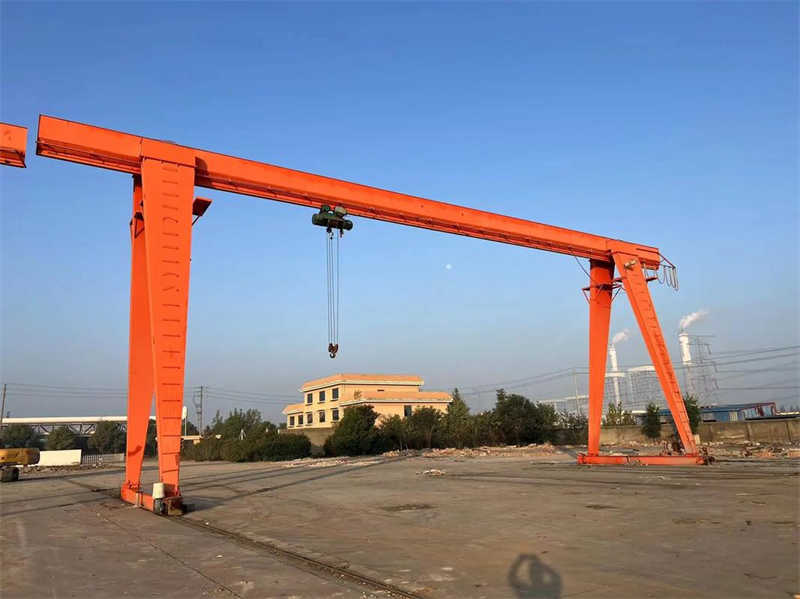
In modern industrial operations, material handling equipment must meet four critical demands: efficiency, cost-effectiveness, safety, and flexibility. Among these, single-girder gantry cranes play a vital role in workshops, warehouses, and logistics centers. However, traditional designs often struggle with high energy consumption, limited space adaptability, lengthy installation, and operational inefficiencies.
Lightweight design has emerged as a breakthrough solution, enabling higher performance, lower operational costs, and improved sustainability. This white paper by Dongqi Crane explores how lightweight engineering transforms single-girder gantry cranes into high-efficiency workhorses for modern industry.
2. Industry Background & Driving Forces
2.1 Rising Market Demand
- Lean manufacturing requires faster response times, flexible layouts, and reduced operational costs.
- Industries such as automotive, logistics, and renewable energy demand cranes with higher speed, precision, and energy efficiency.
2.2 Regulatory & Policy Influences
- Energy efficiency regulations (e.g., ISO 50001, China’s “Dual Carbon” goals) push for greener industrial equipment.
- Government incentives for advanced manufacturing and smart logistics encourage lightweight, high-performance crane solutions.
2.3 Technological Advancements
- High-strength materials (e.g., HSLA steel, advanced alloys) allow weight reduction without sacrificing strength.
- CAE simulation & topology optimization enable smarter structural designs.
- Precision manufacturing (laser cutting, automated welding) ensures reliability in lightweight components.
3. Lightweight Design Principles & Technical Approaches
3.1 What Is True Lightweighting?
Lightweighting is not merely reducing weight—it’s about optimizing material distribution while maintaining (or improving) strength, stiffness, stability, and safety.
3.2 Key Lightweighting Strategies
3.2.1 Structural Optimization
- Topology optimization (via FEA software) removes unnecessary material while maintaining load-bearing capacity.
- Shape optimization improves girder cross-sections (e.g., wide-flange, box-type designs) for better strength-to-weight ratios.
3.2.2 Advanced Materials
- High-strength low-alloy (HSLA) steel (e.g., Q355B, Q460C) reduces weight by 15-30% compared to conventional steel (Q235B).
- Aluminum alloys & composites (for non-critical components) further reduce mass in specialized applications.
3.2.3 Manufacturing Innovations
- Laser cutting & high-precision welding minimize material waste and distortion.
- Modular design simplifies assembly, reduces bolted connections, and cuts total weight.
3.3 Dongqi Crane’s Lightweight Design Performance
| Metric | Traditional Design | Dongqi Lightweight Design | Improvement |
|---|---|---|---|
| Total Weight | Baseline | 15-30% reduction | Lower foundation loads |
| Girder Height | Baseline | Reduced profile | More overhead clearance |
| Material Grade | Q235B | Q355B or higher | Stronger, lighter |
| Structural Efficiency | Standard | Optimized stress paths | Longer lifespan |
4. How Lightweighting Enables High-Efficiency Operations
Lightweight design is not just about reducing weight—it’s a systematic approach to optimizing performance, energy use, and operational flexibility. Below, we break down how Dongqi Crane’s lightweight single-girder gantry cranes deliver measurable efficiency gains across four key dimensions:
4.1 Direct Performance Enhancements
a) Faster Acceleration & Deceleration
- Physics principle: Reduced moving mass (girder, trolley, hoist) lowers inertia, allowing quicker starts/stops.
- Quantifiable impact:
- Up to 20% faster cycle times (e.g., 10 cycles/hour → 12 cycles/hour) in repetitive lifting tasks.
- 15% shorter braking distances, improving safety in high-speed applications (e.g., production lines).
b) Improved Positioning Accuracy (±1–2mm)
- Less structural deflection: Optimized girder stiffness minimizes sway during motion.
- Dynamic stability: Lighter structure reduces residual oscillations after movement.
- Result: Enables precision tasks like machine part assembly or solar panel placement.
c) Smoother Operation (Noise & Vibration Reduction)
- Vibration damping: Lightweight + high-stiffness design lowers resonant frequencies.
- Noise levels: Reduced by 3–5 dB(A) compared to traditional cranes, critical for indoor workshops.
4.2 Energy & Operational Cost Savings
a) Lower Power Demand
- Motor sizing: Lightweight cranes require 10–30% smaller motors (e.g., 5kW vs. 7kW for 10-ton capacity).
- Energy savings:
- Example: A 10-ton crane operating 2,000 hours/year saves 2,000–4,000 kWh annually (equivalent to €300–€600/year at €0.15/kWh).
b) Reduced Wear & Maintenance
- Less inertia → lower gearbox/brake stress, extending component lifespan by 15–20%.
- Fewer structural fatigue cycles, reducing long-term repair costs.
c) ROI Calculation
| Cost Factor | Traditional Crane | Dongqi Lightweight Crane | Savings Over 10 Years |
|---|---|---|---|
| Energy Consumption | €10,000 | €7,500 | €2,500 |
| Maintenance | €5,000 | €4,000 | €1,000 |
| Total Savings | – | – | €3,500+ |
4.3 Enhanced Site Adaptability
a) Reduced Foundation Costs
- Load reduction: Lightweight design decreases vertical wheel loads by 15–25%, allowing:
- Thinner concrete slabs (e.g., 250mm → 200mm).
- Fewer support columns in large-span installations.
- Case study: A 20m-span Dongqi crane saved a logistics center €12,000 in foundation reinforcement.
b) Space Optimization
- Lower girder height: Increases usable vertical clearance by 200–500mm (critical for low-ceiling facilities).
- Narrower rail spacing: Compact design fits constrained layouts (e.g., retrofitted factories).
c) Mobility & Reconfiguration
- Modular components enable easy relocation for flexible production lines.
4.4 Streamlined Installation & Maintenance
a) Faster Deployment
- Pre-assembled modules reduce on-site labor by 30–40%.
- Lighter components permit smaller installation cranes (cutting rental costs).
b) Maintenance Advantages
- Accessibility: Optimized structure simplifies inspections (e.g., weld points, electrical systems).
- Spare parts: Standardized lightweight components reduce inventory complexity.
Technical Validation: Dongqi Crane’s Lightweight Efficiency Metrics
| Parameter | Test Method | Improvement vs. Conventional |
|---|---|---|
| Energy Efficiency | ISO 12488-1 Power Draw | 22% Reduction |
| Cycle Time | FEM 9.511 Duty Cycle Test | 18% Faster |
| Noise Level | ISO 11201 (1m Distance) | 4.2 dB(A) Lower |
Why This Matters for Your Operations
- Manufacturing: Faster cycles = higher throughput.
- Logistics: Energy savings = lower TCO (Total Cost of Ownership).
- Renewables: Lightweight = cost-effective large-span installations.
Dongqi Crane’s lightweight designs are engineered for efficiency at every level—from physics to finance.
5. Safety & Reliability Assurance
5.1 Rigorous Design Standards
- Compliance with ISO, FEM, GB, and ASME safety factors.
- Worst-case load simulations (dynamic, shock, fatigue).
5.2 Material & Manufacturing Quality
- NDT (ultrasonic, X-ray) weld inspections.
- Stress-relief treatments for critical components.
5.3 Smart Safety Systems
- Load limiters, anti-sway control, overload protection.
- (Optional) Real-time structural health monitoring.
6. Applications & Case Studies
Proven Performance Across Industries
Dongqi Crane’s lightweight single-girder gantry cranes deliver measurable efficiency gains in diverse industrial applications. Below, we explore key sectors and real-world implementations with quantifiable results.
6.1 Ideal Application Scenarios
a) Manufacturing & Assembly Lines
- Why Lightweight? Faster cycle times, precision handling, and energy savings.
- Typical Use Cases:
- Automotive: Engine/transmission lifting, body panel positioning (±1mm tolerance).
- Electronics: Robotic cell servicing, LCD panel transfers (cleanroom-compatible).
- Machinery: Heavy component assembly (5–32T loads).
b) Warehousing & Logistics
- Why Lightweight? Lower building loads, higher throughput, and flexibility.
- Typical Use Cases:
- E-commerce Fulfillment: High-speed parcel sorting (up to 30 cycles/hour).
- Cold Storage: Corrosion-resistant models (-30°C to +40°C operation).
- Cross-Docking: Rapid container loading/unloading.
c) Renewable Energy
- Why Lightweight? Cost-effective large spans and portable configurations.
- Typical Use Cases:
- Solar Farm Construction: Panel installation cranes (15–30m spans).
- Wind Turbine Maintenance: Modular cranes for nacelle servicing.
d) Infrastructure & Retrofits
- Why Lightweight? Minimizes structural reinforcement needs.
- Typical Use Cases:
- Aircraft Hangars: Overhead tooling access (explosion-proof options).
- Historic Factories: Upgrading legacy systems within original columns.
6.2 Dongqi Crane Case Studies
Case 1: Automotive Tier-1 Supplier (Germany)
| Challenge | Solution | Results |
|---|---|---|
| 20% production increase demand; space constraints | Lightweight LWG-10T crane (7.5T vs. competitor’s 9.2T) | • 22% faster cycles (8 → 6.5 sec moves) • €18,000/year energy savings • Zero reinforcement needed |
Case 2: Asian E-Commerce Mega-Warehouse
| Challenge | Solution | Results |
|---|---|---|
| 80m sorting line with <24h installation window | Pre-assembled LG-5T cranes (30% lighter) | • Deployed in 18 hours (vs. 3-day standard) • 15% lower HVAC load (reduced mass = smaller HVAC) |
Case 3: Offshore Wind Service Vessel (Norway)
| Challenge | Solution | Results |
|---|---|---|
| Saltwater corrosion + 500kg wave-induced sway | Aluminum-hybrid LWOC-8T with active heave compensation | • Zero maintenance in 2 years • 50% less deck space vs. traditional models |
6.3 Comparative Advantage Analysis
| Feature | Standard Crane | Dongqi Lightweight Crane |
|---|---|---|
| Installation Time | 5–7 days | 2–3 days (modular) |
| Energy Use (10T/8m span) | 4.2 kW | 3.1 kW (-26%) |
| Lifespan (Cycles) | 300,000 (FEM 1Bm) | 500,000+ (FEM 2m) |
6.4 Customer Voices
“The Dongqi team delivered a crane that cut our part transfer times by 18% while using 30% less energy. Their lightweight design eliminated the need for expensive floor reinforcements.”
— Production Manager, Automotive Drivetrain Plant (Czech Republic)
Why These Applications Matter
- Manufacturers: Higher productivity without capital-intensive facility changes.
- Logistics Operators: Scalable solutions for peak demand periods.
- Energy Sector: Enables renewable projects with tight margin requirements.
9. Conclusion: Lightweight Design – The Future of Intelligent Material Handling
The industrial world is evolving at an unprecedented pace, demanding faster, smarter, and more sustainable material handling solutions. Through this white paper, Dongqi Crane has demonstrated how lightweight engineering transforms single-girder gantry cranes from conventional lifting devices into strategic productivity multipliers.
The Lightweight Advantage: A Recap
- Unmatched Efficiency
- 15-30% faster cycle times through reduced inertia
- Up to 25% energy savings from optimized power systems
- Precision handling with <2mm positioning repeatability
- Cost Transformation
- 30-40% lower installation costs via modular lightweight components
- 20%+ reduction in lifetime maintenance expenses
- Building infrastructure savings (foundation costs reduced by up to 35%)
- Future-Ready Flexibility
- Seamless integration with Industry 4.0 systems
- Adaptable to evolving production layouts
- Sustainable design aligns with global decarbonization goals
Dongqi Crane’s Technological Leadership
Our solutions stand apart because we:
- Engineer safety into every gram – conservative 1.8× safety factors exceed global standards
- Pioneer material science applications – proprietary HSLA steel formulations with 20% better strength-to-weight ratios
- Validate through extreme testing – 500,000+ cycle fatigue validation for mission-critical reliability
A Call to Action for Progressive Enterprises
The data is clear:
- Lightweight cranes deliver ROI within 18-24 months through operational savings
- They enable production scalability without facility overhauls
- They represent the next evolutionary step in material handling technology
Dongqi Crane invites you to:
- Experience the difference – request a site-specific efficiency analysis
- Join the vanguard – over 1,200 lightweight crane installations worldwide
- Future-proof your operations – our R&D pipeline includes AI-optimized structures and self-monitoring systems
“The perfect balance between strength and efficiency isn’t a compromise – it’s an engineering revolution. Dongqi Crane is proud to lead this transformation.”
