
30-Jan-2026
The Complete Guide to Manual Hoists: An In-Depth Analysis of Hand Chain Hoists vs. Lever Hoists
Introduction: The Critical Role of Manual Hoists in Modern Industry
In the complex ecosystem of industrial operations, material handling remains a cornerstone of productivity, safety, and efficiency. From manufacturing plants and construction sites to warehouses and utility maintenance, the ability to move heavy, cumbersome, or delicate loads with precision is non-negotiable. While powered systems like electric overhead cranes dominate high-volume applications, manual hoists hold an indispensable and irreplaceable position. They offer unmatched reliability, portability, and cost-effectiveness for a vast range of tasks, especially in environments where power is unavailable, conditions are harsh, or operations are intermittent.
The decision to integrate a manual hoist into your workflow is only the first step. The subsequent, more critical choice is selecting the right type of manual hoist. The two primary contenders—the Hand Chain Hoist and the Lever Hoist—though seemingly similar in their core function of lifting, are engineered for distinctly different operational philosophies and physical environments. Selecting the incorrect type can lead to inefficiency, increased operator fatigue, potential safety risks, and unnecessary equipment wear.
This comprehensive guide, presented by Dongqi Crane, delves far beyond surface-level comparisons. We will dissect the mechanical principles, explore granular application details, examine the stringent standards governing their manufacture and use, and provide a structured framework for selection. Our goal is to equip you with the knowledge to make an informed, confident decision that optimizes your lifting operations for safety, performance, and value.
Chapter 1: The Hand Chain Hoist – The Vertical Lifting Specialist
1.1 Design and Operating Principle
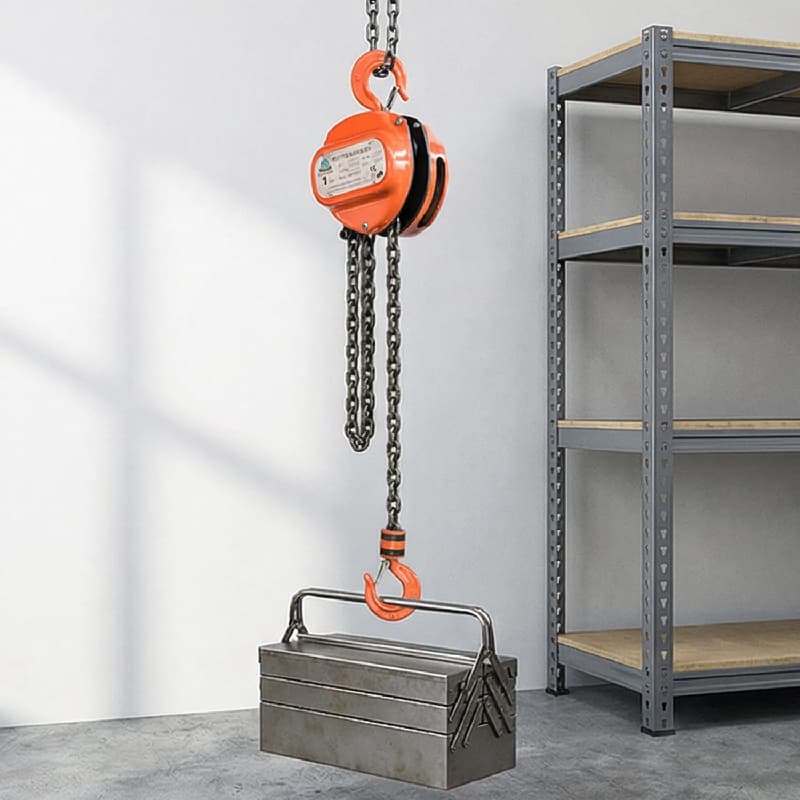
A hand chain hoist is a marvel of mechanical simplicity and efficiency. Its core components include:
- Load Chain: A high-tensile, heat-treated alloy steel chain (typically Grade 80 or 100) that directly engages the load hook.
- Hand Chain: A smaller, endless loop chain operated by the user. Pulling this chain drives the entire mechanism.
- Gear Train: A system of precision-machined gears (spur and/or planetary) enclosed in a robust housing. This train converts the moderate force from the hand chain into immense lifting power, achieving a high mechanical advantage. Common gear ratios range from 5:1 for lighter models to over 100:1 for heavy-capacity units.
- Lifting and Lowering Mechanisms: Controlled via a directional selector (a simple switch or wheel) that engages the appropriate gear set or clutch for safe, controlled motion.
- Braking System: The most critical safety feature. Most modern hand chain hoists employ an automatic load brake, a mechanical device that immediately and automatically engages to hold the load if the operator releases the hand chain. This is often a disc-type brake system that is fail-safe in design.
- Hooks: Top hook for suspension (often swivel-type) and bottom load hook, both equipped with safety latches.
Operation: The operator suspends the hoist from a fixed, overhead point—such as a trolley on an I-beam, a gantry crane hook, or a dedicated mounting point. Pulling down on one side of the endless hand chain rotates the gears, which in turn winds the load chain, lifting the load. The direction is controlled by the selector.
1.2 In-Depth Benefits and Advantages
- Superior Efficiency for Pure Vertical Lifting: When the task is strictly repetitive up-and-down motion in a fixed location, no manual tool is faster or requires less operator effort per cycle. The ergonomic, rhythmic pulling of the hand chain allows for sustained work.
- Exceptional Precision and Control: The direct gear-to-chain connection and fine hand chain links allow for micro-adjustments, enabling millimeter-perfect positioning of machinery, molds, or assemblies. This is crucial in alignment-sensitive tasks.
- High Duty Cycle and Durability: Built for sustained use in industrial settings, their sealed gearboxes protect against contaminants. With minimal moving parts exposed and high-quality construction, they offer an exceptionally long service life with only basic maintenance.
- Operator Safety and Ergonomics: The automatic load brake provides fundamental safety. The operation allows the user to stand clear of the load path, and the hand chain pull can be positioned for optimal posture. Many models feature low-friction coated hand chains for easier pulling.
- Cost-Effectiveness: Lower initial investment compared to powered hoists and minimal ongoing costs (no electricity, less frequent repairs) make them ideal for standard lifting tasks.
1.3 Typical Applications and Use Cases
- Stationary Workshop Lifts: Permanently mounted on jib cranes in machine shops, welding bays, or assembly stations.
- Integration with Gantry and Bridge Systems: Used as the lifting mechanism on portable gantry cranes or lightweight modular crane systems.
- Maintenance Bays: For lifting engines, transmissions, or heavy components in automotive and aerospace maintenance.
- Production Lines: For loading/unloading fixtures or transferring work-in-progress between stations where power is not desired.
- Warehousing: For occasional heavy lifting tasks where installing a full electric crane system is not justified.
Chapter 2: The Lever Hoist – The Versatile Portable Powerhouse
2.1 Design and Operating Principle
The lever hoist, or ratchet hoist, is the definition of compact, adaptable power. Its design prioritizes functionality in constrained spaces.
- Load Chain: Similar high-grade alloy steel chain as in hand chain hoists.
- Lever Handle (Ratchet Handle): The operating mechanism. A reciprocating (back-and-forth) motion on this handle drives the hoist.
- Ratchet and Pawl System: The heart of the lever hoist. The lever action turns a ratchet wheel. A spring-loaded pawl engages the teeth of this wheel, preventing reverse motion and allowing incremental advancement with each stroke.
- Directional Control Lever: A robust selector that changes the engagement of the pawls to switch between lifting, lowering, and free-wheeling (neutral) modes.
- Braking System: Relies on the ratchet and pawl mechanism itself. The load is held securely by the engaged pawl. Some advanced models include an additional friction brake for controlled lowering.
- Hooks: Designed for multi-directional loading, often with pivoting heads to accommodate angle pulls.
Operation: The hoist is anchored using its top hook to any secure anchorage point—above, beside, or even below the load. The operator moves the lever handle through its arc. Each stroke advances the load chain incrementally. The tool can generate tremendous pulling force for horizontal drags, diagonal lifts, or tight vertical lifts where space is limited.

2.2 In-Depth Benefits and Advantages
- Unmatched Versatility and Portability: Its compact, self-contained design allows it to be carried anywhere and used in any orientation. This is its single greatest advantage.
- Operation in Confined Spaces: It requires only the space to swing the lever handle (which can often be repositioned to different sockets on the body for clearance), making it ideal for tight quarters, inside machinery, or crowded construction sites.
- Multi-Functionality: It is not just a hoist; it is a puller, dragger, tensioner, and binder. It can pull pipe into alignment, tension cable or fencing, drag equipment onto a trailer, or secure loads for transport.
- Precise Incremental Control: The ratchet mechanism allows for very fine, controlled movement, perfect for “bumping” heavy equipment into final alignment or applying specific tension.
- Independence from Overhead Structures: It does not require a clear overhead path or dedicated mounting point, liberating operations from fixed infrastructure.
2.3 Typical Applications and Use Cases
- Construction and Steel Erection: For pulling steel beams into place, aligning structural components, and general rigging.
- Utility and Telecom Work: For tensioning overhead lines, pulling cable through conduits, and lifting transformers in confined substations.
- Transportation and Recovery: Securing heavy cargo on flatbeds, dragging disabled vehicles, or righting overturned equipment.
- Marine and Shipyard Applications: Ideal for the cramped, corrosive environments of engine rooms and holds for maintenance work.
- Mining and Forestry: For machinery repair in remote field locations and tensioning guide wires or cables.
Chapter 3: Head-to-Head Comparison and Decision Matrix
This detailed comparison table provides a structured analysis to guide your selection process.
| Decision Factor | Hand Chain Hoist | Lever Hoist | Key Takeaway |
|---|---|---|---|
| Primary Function | Specialized for efficient vertical lifting. | Engineered for versatile lifting, pulling, & positioning. | Purpose defines choice. |
| Mounting & Setup | Requires a fixed, overhead support point (hook, trolley). Must be hung before use. | Can be anchored anywhere—overhead, on a wall, on the ground, even below the load. | Flexibility vs. Fixed Infrastructure. |
| Operational Space | Needs clear vertical space below the hoist for the operator to pull the hand chain through its full travel. | Needs only enough space to arc the lever handle (which can often be repositioned). Superior in confined spaces. | Consider the worksite constraints. |
| Operator Position | Operator typically stands directly under or beside the hoist, pulling a vertical chain. | Operator stands to the side of the hoist body, working a horizontal lever. Can be safer by keeping clear of the direct load line. | Ergonomics and safety positioning. |
| Portability | Less portable due to dangling chains; designed for semi-permanent or trolley-mounted use. | Highly portable; compact, self-contained, often sold with a storage case. Easy to transport between job sites. | Frequency of movement matters. |
| Lifting Speed | Generally faster for full-length vertical lifts due to continuous chain pulling. | Slower, as lift is achieved through incremental lever strokes. Efficiency is in control, not speed. | Throughput vs. precision. |
| Load Control & Precision | Excellent smooth control via the hand chain. | Excellent incremental control via the ratchet. Ideal for “bumping” loads. | Both offer high precision. |
| Duty Cycle | Designed for higher, more frequent duty cycles in industrial settings. | Robust but often intended for intermittent, maintenance-style use. Check manufacturer’s duty rating. | Match the tool to the task frequency. |
| Typical Capacities | Ranges widely from 0.5 tons to 50+ tons. Common industrial range is 1-10 tons. | Commonly ranges from 0.75 tons to 9 tons, with many models in the 1.5-6 ton range. | Both cover most common industrial needs. |
Chapter 4: The Framework for Selection – Asking the Right Questions
To move from theory to decision, systematically answer these questions about your specific application:
- What is the Primary Action?
- Lift only, straight up and down? → Strongly lean towards a Hand Chain Hoist.
- Pull, drag, tension, or lift at an angle? → A Lever Hoist is almost certainly required.
- What is the Work Environment Like?
- Do you have a clear, strong overhead support point (I-beam, trolley, gantry)? → Hand Chain Hoist compatible.
- Is the space cramped, crowded, or lacking overhead structure? → Lever Hoist is the solution.
- How Frequently is the Tool Used?
- Multiple lifts per hour/day in a fixed location? → Hand Chain Hoist for its efficiency and durability.
- Occasional use, moved between various job sites? → The portability of a Lever Hoist is a major advantage.
- Who is the Operator and What are the Safety Considerations?
- Can the operator stand safely clear of the load? A hand chain hoist’s vertical chain can sometimes place the operator underneath.
- Does the task require the operator to be in a specific position? The lever hoist offers more flexibility in operator stance.
- What are the Total Cost of Ownership Considerations?
- Factor in not just the purchase price, but also installation (does the hand chain hoist need a trolley?), maintenance, and expected service life for your duty cycle.
Chapter 5: Industry Standards, Safety, and Compliance
Purchasing a hoist is a safety-critical decision. Compliance with international standards is non-negotiable. Both types of hoists are governed by rigorous frameworks to ensure design integrity, manufacturing quality, and safe operation.
- ASME B30.16 – Overhead Hoists (Underhung): The paramount standard in North America for hand chain hoists. It covers design, construction, installation, inspection, testing, maintenance, and operation.
- ASME B30.21 – Manually Lever Operated Hoists: The corresponding standard specifically for lever hoists, addressing their unique design and use cases.
- ISO 9001: A global quality management standard. Manufacturer certification ensures consistent production quality and traceability.
- CE Marking / EU Machinery Directive 2006/42/EC: Mandatory for sale in the European Economic Area, indicating conformity with essential health and safety requirements.
- Load Testing and Certification: Reputable manufacturers supply each hoist with a test certificate confirming it has been proof-tested to 125% of its rated capacity and load-tested to 100%. Regular in-service inspections as per OSHA (29 CFR 1910.179) or local regulations are mandatory.
Safety is Paramount: Regardless of the hoist chosen, safety principles are universal:
- Never exceed the Rated Capacity.
- Inspect before every use (hooks, chains, deformation, operation).
- Ensure the load is properly seated in the hook saddle.
- Never leave a load suspended unattended.
- Use only as intended by the manufacturer.
Chapter 6: The Dongqi Crane Advantage – Your Partner in Lifting Solutions
Selecting the right hoist is a technical decision with significant implications for your operation’s safety and productivity. At Dongqi Crane, we transcend the role of a simple equipment supplier to become your dedicated lifting solutions partner.
Our Comprehensive Support Process:
- Expert Consultation: Our technical sales engineers will work with you to analyze your application, environment, and operational goals. We ask the detailed questions from Chapter 4 to eliminate guesswork.
- Precision Specification: We help you select not just the right type, but the exact model with the appropriate capacity, lift height, chain type (e.g., galvanized for corrosion resistance), and duty class.
- Assured Quality and Compliance: We offer a curated portfolio of manual hoists from world-renowned manufacturers, all compliant with ASME, ISO, and CE standards, backed by full certification.
- Value-Added Services:
- Customization: Need a special hook, a longer chain, or a specific trolley? We can provide tailored solutions.
- Training and Documentation: We provide comprehensive operational and safety manuals and can arrange operator training sessions.
- After-Sales Support and Maintenance: Our support extends beyond the sale, with readily available spare parts and maintenance guidance to maximize your equipment’s lifespan.
Conclusion: Empowering the Right Choice
The choice between a hand chain hoist and a lever hoist is not about which tool is universally “better,” but about which is perfectly suited for your specific task. The hand chain hoist is the steadfast, efficient workhorse for dedicated vertical lifting. The lever hoist is the agile, multi-talented problem-solver for the unpredictable and confined job site.
By understanding their fundamental designs, inherent advantages, and ideal applications, you empower your team to work smarter, safer, and more efficiently. Investing in the correct tool is an investment in your people’s safety and your operation’s bottom line.
Ready to Specify Your Ideal Manual Hoist?
Contact Dongqi Crane today. Let our experts guide you through a detailed assessment of your needs. Request a product demonstration, a competitive quotation, or a site consultation. We are committed to providing you with not just a hoist, but the optimal lifting solution that drives your productivity forward, safely and reliably.
Disclaimer: This guide is for informational purposes. Always refer to the specific manufacturer’s instructions and relevant local safety regulations for the operation and maintenance of lifting equipment.
