
31-Dec-2025
The Development and Selection of Electric Chain Hoists: A Case Study of Dongqi Products
Introduction: The Foundation of Industry Development
In the modern industrial system, material handling equipment functions like circulating blood, maintaining the operation and efficiency of production lines. Electric chain hoists, as a key component in this field, have become indispensable tools in various operational environments from workshops to ports due to their characteristics of high reliability, strong adaptability, and simple operation.
The year 2025, which has just passed, saw the global industrial sector undergo multiple transformations including supply chain adjustments, accelerated energy transition, and intelligent upgrades. Against this backdrop, the electric chain hoist market demonstrated robust growth momentum. According to industry analysis, the global electric chain hoist market size reached approximately $2.1 billion in 2024 and is expected to maintain steady growth in the coming years. This growth is primarily driven by the continuous advancement of manufacturing automation, increased infrastructure investment, and increasingly stringent regulations concerning workplace safety.
As a company deeply involved in the manufacturing of lifting equipment, Dongqi Crane Co., Ltd. (hereinafter referred to as Dongqi) offers a product line covering various electric chain hoist models from 1 ton to 20 tons, catering to the needs of different industries and application scenarios. Based on the industry development background, this article will analyze the market performance of products with different tonnages and provide detailed reference information for selection.
Market Structure and Product Positioning
In 2025, the industrial electric chain hoist market exhibited distinct stratification characteristics. Light and medium-duty equipment (1-5 tons) occupied the largest market share due to its wide range of applications and relatively low procurement cost; while heavy-duty equipment (10-20 tons), although with relatively lower sales volume, contributed significantly to the total market value because of its higher unit price and frequent use in critical engineering projects.
Geographically, the Asia-Pacific region continued to lead global demand growth, particularly with industrialization and infrastructure construction in China, India, and Southeast Asian countries providing strong momentum for the hoist market. Meanwhile, markets in North America and Europe placed greater emphasis on energy efficiency improvements and intelligent features of equipment, driving products towards higher technical standards.
Regarding product technology, electric chain hoists in 2025 continued the concept of modular design while incorporating more intelligent control elements. For example, many new models are equipped with multiple safety devices such as overload protection, phase protection, and limit switches. Some high-end products even integrate functions like load monitoring, operational data recording, and predictive maintenance reminders.
In-depth Analysis of Dongqi’s Electric Chain Hoist Product Line
Dongqi’s electric chain hoist product line is divided into several series according to lifting capacity, with each series further subdivided into different models based on lifting height, duty class, and special environmental requirements. The following is a comprehensive analysis of the main tonnage products:
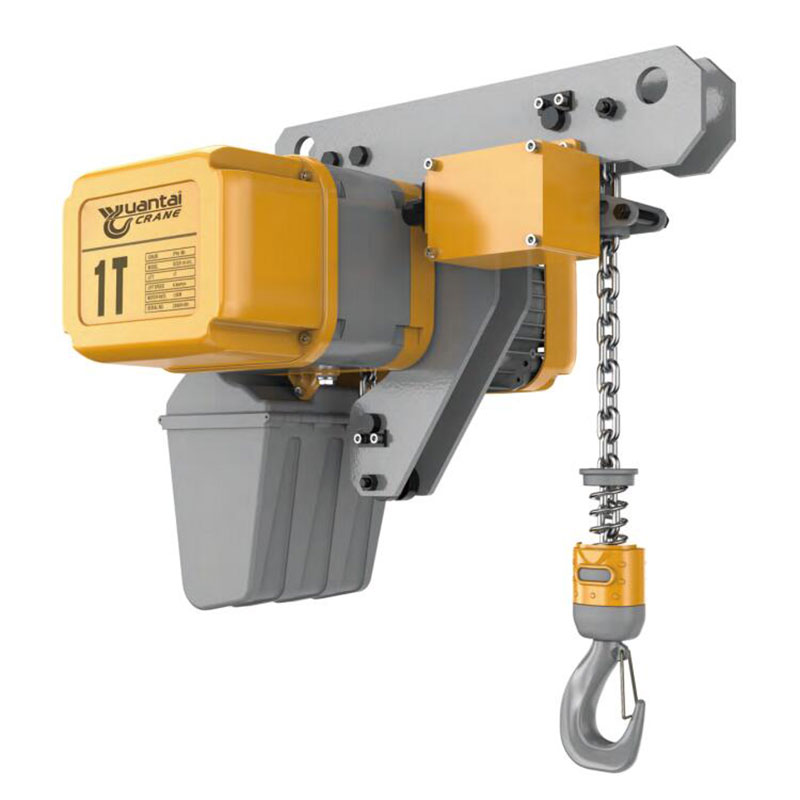
1-Ton Electric Chain Hoist: Flexible and Efficient Light-Load Solution
The 1-ton electric chain hoist is one of the most in-demand product categories in the market, accounting for approximately 25% of Dongqi’s total electric chain hoist sales. This type of equipment is mainly used in places such as small workshops, maintenance stations, warehouse logistics, and light assembly lines.
Regarding pricing, the reference price range for 1-ton electric chain hoists is between $500 and $3,000, depending on the following factors:
- Lifting Height: Configurations with standard height (3-10 meters) are the most economical; when height requirements increase to the 20-30 meter range, the price rises noticeably; specially customized heights (e.g., above 50 meters) lead to a significant price increase.
- Duty Class: Equipment rated for occasional use (M2 class) has a lower price, while equipment suitable for frequent operation (M4 or M5 class) commands a higher price.
- Additional Features: Special features such as explosion-proof models, dual-speed control, and remote radio control increase equipment cost.
A notable trend in the application of 1-ton electric chain hoists in 2025 was the development towards more compact designs, particularly driven by growing demand for use in low headroom environments.
2-Ton and 3-Ton Electric Chain Hoists: The Mainstay for Medium-Duty Applications
2-ton and 3-ton electric chain hoists together form the backbone of industrial applications, collectively accounting for about 35% of Dongqi’s total electric chain hoist sales. This type of equipment balances lifting capacity with economy and is widely used in fields such as general manufacturing, automotive repair, construction sites, and equipment installation.
In terms of price range, the reference price for 2-ton models is between $600 and $9,000, while for 3-ton models it is between $800 and $15,000. Price differences mainly stem from:
- Structural Design: Different prices for standard models versus low headroom models.
- Lifting Speed: Noticeable price differences between standard speed and dual-speed/frequency control models.
- Motor Type: Different costs between traditional asynchronous motors and high-efficiency permanent magnet motors.
- Control System: Price gap between basic control systems and integrated intelligent monitoring systems.
It is worth noting that in 2025, market attention to the energy efficiency performance of 2-3 ton electric chain hoists increased significantly. Many users began calculating the total lifecycle cost of the equipment, not just the initial purchase price.
5-Ton Electric Chain Hoist: The Threshold to Heavy-Duty Operations
The 5-ton electric chain hoist is a key entry-level product into the field of heavy-duty operations, accounting for approximately 20% of Dongqi’s total electric chain hoist sales. This type of equipment is commonly found in settings such as steel processing, heavy machinery maintenance, medium-sized component installation, and ship repair.
Regarding price range, the reference price for 5-ton electric chain hoists is between $1,000 and $10,000. Among the factors, lifting height is a key variable affecting price:
- Configurations with standard lifting height (10-15 meters) are the most common in terms of price.
- Medium lifting height (15-25 meters) increases the price by approximately 15-30%.
- Large lifting height (above 25 meters) may increase the price by 50% or more.
A characteristic of the 5-ton electric chain hoist market in 2025 was the increase in customization demands. Many users required equipment adapted to specific working environments, such as high-temperature workshops, dusty environments, or corrosive atmospheres. These special requirements significantly impact the final price.
10-Ton and Above Electric Chain Hoists: Professional Tools for Specialized Fields
10-ton, 15-ton, and 20-ton electric chain hoists belong to the category of heavy-duty professional equipment, collectively accounting for about 20% of Dongqi’s total electric chain hoist sales. This type of equipment primarily serves specialized fields such as large-scale construction projects, ports and terminals, power generation facilities, and heavy manufacturing plants.
The price range for these large-tonnage devices is relatively wide:
- 10-ton models: $1,500 to $15,000
- 15/16-ton models: $2,000 to $20,000
- 20-ton models: $3,000 to $25,000
Main factors affecting price include:
- Structural Strength: Large equipment requires stronger structural design and higher quality materials.
- Complexity of Control Systems: High-tonnage equipment typically requires more precise control systems and more safety devices.
- Lifting Mechanism: The lifting mechanism for large-tonnage equipment is more complex, with correspondingly increased costs.
- Compliance with Standards: Meeting specific industry standards (such as classification society certifications, nuclear power standards, etc.) adds extra cost.
In the application of large electric chain hoists in 2025, a clear trend was the increased level of intelligent integration. Many devices are now equipped with operational data logging, fault diagnosis, and remote monitoring functions. While this increases the initial investment, it improves the safety and maintainability of the equipment.
Key Considerations for Selection
Choosing a suitable electric chain hoist requires consideration of multiple aspects to ensure the equipment meets current needs while possessing appropriate scalability.
Determining Basic Parameters
The first thing to clarify is the maximum lifting requirement. This should not be just the occasional maximum load but should consider the most representative weight in routine operations. At the same time, an appropriate safety margin should be reserved; it is generally recommended to select equipment with a capacity 20-30% higher than the maximum regular load.
Determining the lifting height requires accurate measurement of the actual distance from the lowest to the highest point, considering the height of the lifting attachment itself. Special attention should be paid to the fact that when the lifting height exceeds the standard range, not only does the equipment price increase, but the complexity of installation and maintenance also rises.
Assessing the Working Environment
The environmental conditions where the equipment will be used directly influence model selection. Standard models can be used in clean indoor environments; dust-prone environments require equipment with better sealing; damp or outdoor environments need rust and waterproof protection; environments with explosion risks must use models with explosion-proof certification.
Power supply conditions are also a factor that must be confirmed in advance. It is necessary to understand the voltage, frequency, and phase available on-site and match them with equipment requirements. Dongqi electric chain hoists typically offer multiple power supply adaptation options, but confirming in advance can avoid additional costs for subsequent modifications.
Understanding the Duty Cycle
The frequency and intensity of equipment use determine the required duty class. For occasional use (less than 1 hour per day), M2 class can be selected; for regular use (1-2 hours per day), M3 class is suitable; for frequent use (3-4 hours per day), M4 class is needed; for high-intensity continuous operation, M5 or higher class is required.
Additionally, the installation method of the equipment needs consideration: whether it is fixed installation or requires travel capability; and whether travel is manual or motorized. These choices affect the design and cost of the overall solution.
Considering Long-Term Value
Beyond the initial procurement cost, it is necessary to evaluate the total lifecycle cost of the equipment, including energy consumption, maintenance frequency, availability of spare parts, and expected service life. More energy-efficient equipment may have a higher initial investment but lower long-term operating costs.
The scalability and compatibility of the equipment are also worth considering. For example, whether it is possible to add intelligent monitoring functions in the future; whether the control system supports upgrades; whether the equipment can work in coordination with existing or other material handling equipment.
Outlook on Technology Trends for 2026
As 2025 concluded, the electric chain hoist industry has already revealed several noteworthy development directions that may influence future equipment selection:
Intelligent integration will continue to deepen. It is expected that more electric chain hoists will be equipped with sensors and connectivity functions to enable real-time monitoring, predictive maintenance, and operational data collection. These features can not only improve safety but also extend equipment life by optimizing usage patterns.
Energy efficiency standards will further increase. With global emphasis on energy efficiency and carbon reduction, the energy performance of electric chain hoists will become an even more important selection criterion. Features such as high-efficiency motors, regenerative braking systems, and intelligent power consumption management may gradually transition from high-end options to standard configurations.
Modular design will become more widespread. Through standardized interfaces and modular components, users can configure equipment functions more flexibly and perform maintenance and upgrades more easily. This design concept can balance customization needs with the advantages of scale production.
Human-machine interaction experience will improve. Control devices that are more ergonomic, more intuitive operating interfaces, and more comprehensive safety feedback systems will make equipment operation safer and more convenient, reducing the learning curve and workload for operators.
Conclusion
As fundamental equipment in industrial production, the selection of electric chain hoists relates not only to current operational efficiency but also affects long-term operating costs and safety. The market in 2025 showed that equipment of different tonnages has its own clear application scenarios and value positioning.
From the flexibility and portability of 1-ton equipment to the powerful specialization of 20-ton equipment, electric chain hoists at each level are solutions for specific work requirements. In the selection process, balancing multiple factors such as lifting capacity, working environment, frequency of use, and long-term value is necessary to find the equipment most suitable for a specific application scenario.
With technological progress and evolving market demands, electric chain hoists are becoming more intelligent, efficient, and reliable. Understanding these development trends helps in making more forward-looking choices now, preparing for future production needs.
Whether for small workshops or large industrial facilities, a suitable electric chain hoist can become an important tool for improving efficiency and ensuring safety. By carefully evaluating needs, understanding product characteristics, and considering long-term development, the most appropriate solution can be found for material handling tasks.
