
8-Dec-2025
The QY Model 5t Insulating Bridge Crane: A Safeguard for Precision and Safety in Metal Smelting
In the demanding environment of a modern aluminum smelting plant, where powerful electrical currents are fundamental to production, a unique challenge arises in material handling. How do you safely transport raw materials and products within a facility where stray electrical currents pose a constant risk to both personnel and equipment? The answer lies in a specialized piece of engineering: the Insulating Overhead Crane.
Dongqi Crane’s QY Model 5t Insulating Bridge Crane is engineered specifically for this critical role. It is not merely a lifting device but an integrated safety system designed for industries like electrolytic aluminum and magnesium smelting, where preventing current passage is paramount. This crane integrates robust lifting capacity with essential insulation barriers, ensuring operational continuity and protecting both your workforce and valuable assets from electrical hazards.
1. Product Definition and Insulation Principle
An Insulating Bridge Crane, specifically the QY model, is a technologically advanced overhead lifting solution designed for electrically hazardous environments, particularly in the smelting of non-ferrous metals. Unlike standard cranes, its primary distinguishing feature is the incorporation of multiple, strategically placed insulation barriers.
The core function of these barriers is to create a high-resistance break in any potential conductive path. In processes such as aluminum electrolysis, the pots (or cells) operate at very high electrical potentials. If a standard crane hook were to touch both a charged pot and a grounded structure, it could create a catastrophic short circuit. The QY crane prevents this by installing certified insulating materials at critical interfaces—typically between the hook and the wire rope, and between the wire rope sheaves and the crane structure itself. This design ensures that even when handling conductive materials, the dangerous current is blocked from traveling up to the crane’s main structure and into the operator’s cab.
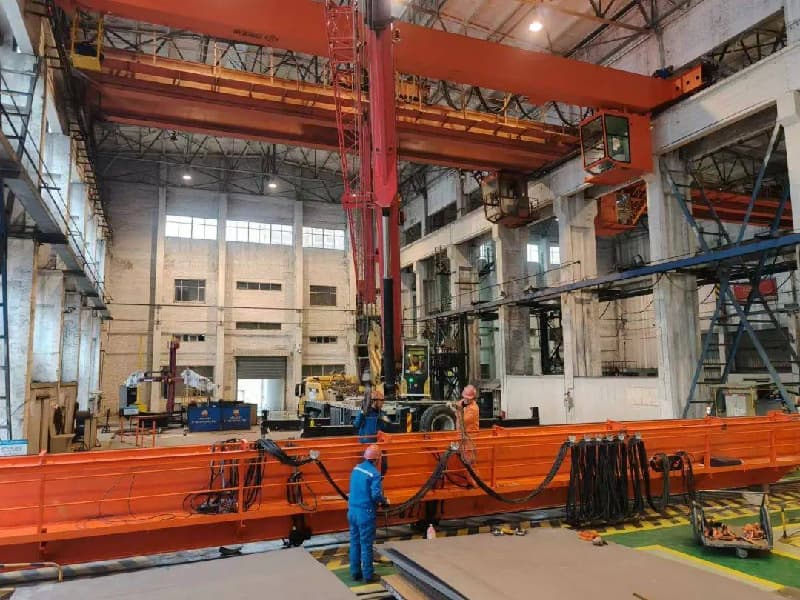
2. Key Features and Technical Superiority
The QY 5t Insulating Crane is built with features that address the twin demands of heavy-duty performance and absolute electrical safety.
- Multi-Point Insulation System: The crane’s safety is rooted in its redundant insulation design. Key insulating components are installed at the hook block, equalizing pulley, and connection points on the trolley frame. This multi-barrier approach ensures system integrity even if one point were compromised.
- Heavy-Duty Construction for Smelting: Designed for rigorous cycles common in metallurgical settings, this crane typically conforms to a high work duty class (A7). Its box-type bridge girders are fabricated for stability, and critical mechanisms are built to withstand the demanding, continuous operation of a smelting plant.
- Dual Braking System for Critical Safety: Recognizing the severe consequences of a load drop in a busy plant, the main hoist is often equipped with a dual braking system. This provides a critical fail-safe, ensuring controlled stopping and holding of the load.
- Enhanced Protection for Harsh Environments: Smelting facilities can be hot and corrosive. Options such as heat insulation plates under the girder protect the primary structure from radiant heat from molten metal baths. Furthermore, electrical components can be specified with higher protection (IP) ratings to resist dust and moisture.
3. Technical Specifications and Configurations
The QY model is highly configurable to meet specific plant layouts and process requirements. The following table outlines its core customizable parameters and typical ranges:
| Parameter Category | Specification / Typical Range | Description & Relevance |
|---|---|---|
| Rated Capacity | 5 tonnes (Customizable up to 50/10t or more) | The primary lifting capacity. The 5t model is common for handling anodes, cathode assemblies, and tooling. |
| Span (S) | 7.5m to 30m (Customizable) | Distance between crane rails. Determined by the width of the workshop bay. |
| Lifting Height (H) | 6m to 30m+ (Customizable) | The vertical distance the hook can travel. Crucial for multi-level plants and pit furnaces. |
| Work Duty Class | A7 (Heavy Duty) | Indicates a crane designed for frequent use with high loads, standard for metallurgy. |
| Power Supply | 3-Phase, 50Hz, 380V AC | Standard industrial power. Insulation systems are designed to be effective at this voltage. |
| Insulation Resistance | >1 MΩ (at specified DC voltage) | A key performance metric for the insulation system, ensuring effective blocking of stray currents. |
| Ambient Temperature | -10°C to +60°C | Operational temperature range, suitable for most smelting plant environments. |
4. Primary Applications in the Metallurgy Industry
This crane’s design directly targets the unique challenges of specific metallurgical processes:
- Electrolytic Aluminum/Magnesium Smelting: This is the quintessential application. In these facilities, direct current measured in hundreds of thousands of amperes passes through the electrolytic cells. The insulating crane is indispensable for safely handling anodes, cathode rods, and metal taps without creating a parallel current path that could damage equipment or cause electrical arcing.
- Handling of Other Conductive Materials in Charged Areas: Beyond primary smelting, it is used in any workshop area where large conductive materials (e.g., steel ingots, machinery) need to be moved near energized equipment or busbar systems, preventing accidental grounding.
- Foundries and Casting Shops: While its core use is in electrolysis, the robust A7 duty rating and optional heat protection make it a reliable choice for general foundry duties where electrical hazards may coexist with high temperatures.
5. The Critical Importance of CE Certification
For a device operating in the high-risk European market, CE marking is not just a label; it is a legal passport and a comprehensive safety declaration. For the QY 5t Insulating Crane, achieving CE certification involves rigorous conformity assessment against multiple European Union directives, primarily the Machinery Directive (2006/42/EC) and the Electromagnetic Compatibility Directive (2014/30/EU).
This process validates that the crane’s design has undergone a complete risk assessment, and all identified hazards—from mechanical failure and electrical shock to insulation breakdown—have been mitigated to an acceptable level. It certifies that the insulation system’s performance is reliably tested and documented. For the end-user, the CE mark provides assurance that the equipment meets the highest thresholds for health, safety, and environmental protection, simplifying procurement and ensuring compliance with local regulations.
6. Conclusion
Choosing the right lifting equipment for a metal smelting operation is a decision that impacts safety, productivity, and asset longevity. Dongqi Crane’s QY Model 5t Insulating Bridge Crane represents a specialized solution where standard equipment would introduce unacceptable risk.
By seamlessly integrating a certified insulation system with a heavy-duty crane platform designed for A7 duty, it transforms a potential hazard zone into a controlled, efficient workflow. Its configurability ensures it can be tailored to the precise needs of your facility, whether for handling delicate electrode assemblies in an electrolysis line or managing raw materials in a charged workshop.
In an industry where precision and safety are inseparable, this crane is more than a tool—it is a foundational component of a responsible and modern smelting operation.
If you are planning an upgrade or a new facility involving the handling of materials in electrically active zones, we strongly recommend consulting with our engineering team to explore how the QY Insulating Crane can be configured for your specific operational and safety requirements.
