
11-Jun-2025
Top Running vs Under Running Crane: Which Is Right for Your Needs?
Introduction
When selecting an overhead crane for industrial or manufacturing applications, one of the key decisions is choosing between a top running crane and an under running crane (also known as an underhung crane). Both types serve different purposes, and the best choice depends on factors such as space availability, load capacity, cost, and structural requirements.
This guide compares top running vs under running cranes across critical dimensions to help you determine which solution fits your operational needs.
What Are Top Running and Under Running Cranes?
When selecting an overhead crane system, one of the most fundamental distinctions is between top running cranes and under running (underhung) cranes. These two designs serve similar purposes in material handling but differ significantly in their structural configurations, load-bearing mechanisms, and ideal applications. Understanding these differences is crucial for selecting the right crane system for your facility.
Top Running Cranes: Heavy-Duty Overhead Lifting
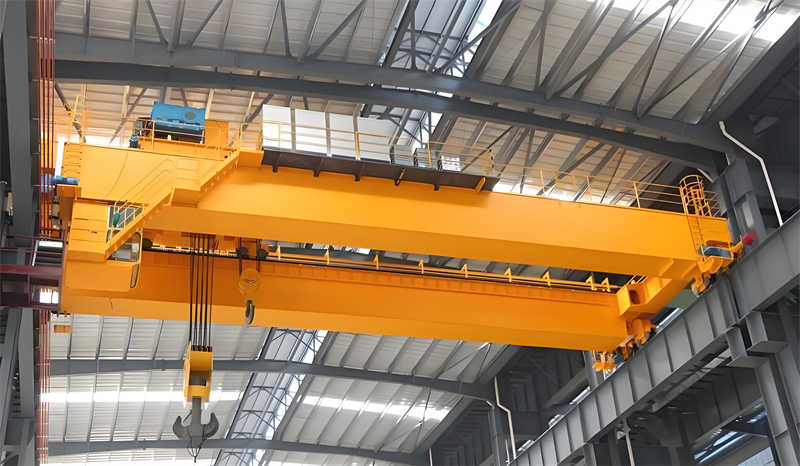
Structural Design and Operation
Top running cranes, also known as bridge cranes, feature a design where the crane’s bridge girder moves along rails installed on top of elevated runway beams. These runway beams are typically supported by the building’s columns or an independent support structure.
The key components include:
- Bridge Girder: The horizontal beam that spans the work area.
- End Trucks: Wheeled assemblies at each end of the girder that move along the runway rails.
- Runway Beams: Heavy-duty steel beams that support the entire crane system.
- Hoist and Trolley: The lifting mechanism that travels along the bridge girder.
Key Characteristics
- Higher Load Capacity: Designed for heavy-duty applications, top running cranes can handle loads ranging from 5 tons to over 500 tons, making them ideal for industries like steel manufacturing, mining, and heavy machinery.
- Requires Robust Support: Because the crane moves on top of the runway beams, the building’s structure must be capable of supporting both the crane’s weight and the load. This often means reinforced columns and foundations.
- Greater Hook Height: Since the crane operates above the runway beams, it provides more vertical lifting space, which is beneficial in facilities with high ceilings.
Best Applications
Top running cranes are commonly used in:
- Steel mills and foundries (handling molten metal, coils, and heavy plates).
- Power plants (lifting turbines, generators, and large equipment).
- Shipyards and large-scale construction (moving massive structural components).
Under Running (Underhung) Cranes: Space-Efficient Material Handling
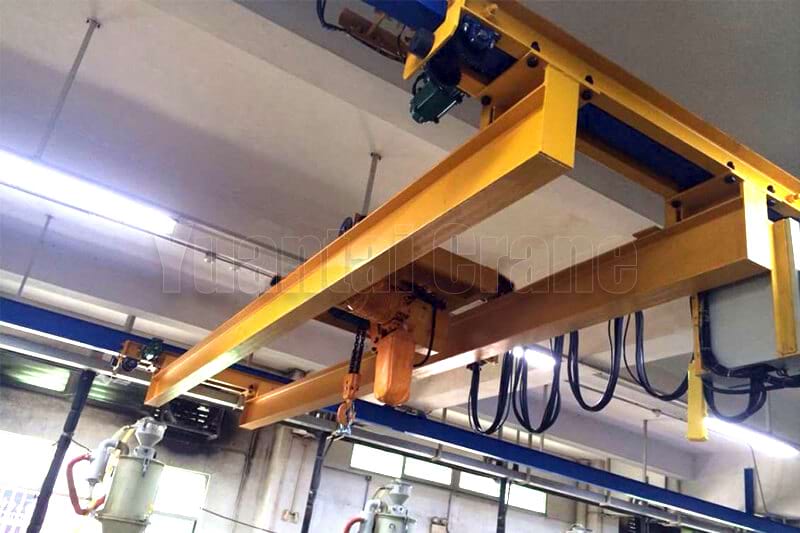
Structural Design and Operation
Under running cranes, also called underhung cranes, have a fundamentally different design. Instead of riding on top of runway beams, the crane’s bridge is suspended from the bottom flange of the runway beams, which are typically attached to the ceiling or roof structure.
Key components include:
- Bridge Girder: Similar to top running cranes but designed to hang from the runway.
- End Trucks: Equipped with wheels that run along the bottom flange of the runway beams.
- Runway Beams: Usually lighter than those used in top running cranes, as they don’t bear the same structural load.
- Hoist and Trolley: Moves along the underside of the bridge girder.
Key Characteristics
- Space-Saving Design: Since the crane hangs from the runway beams, it requires less headroom, making it ideal for facilities with low ceilings.
- Lower Load Capacity: Typically rated for 0.5 to 20 tons, under running cranes are best suited for light to medium-duty lifting.
- Easier Installation: Because they rely on the existing roof structure (rather than requiring reinforced columns), they are often quicker and cheaper to install.
Best Applications
Under running cranes are commonly found in:
- Warehouses and distribution centers (handling pallets, boxes, and light machinery).
- Automotive assembly lines (moving car parts and components).
- Food & beverage processing plants (overhead transport of packaged goods).
Key Comparison Factors
A. Space Utilization
| Factor | Top Running Crane | Under Running Crane |
|---|---|---|
| Headroom | Requires more vertical space. | Saves headroom. |
| Floor Space | No floor obstructions. | May require additional support columns if runway beams are floor-mounted. |
| Best For | High-ceiling facilities (e.g., steel plants, shipyards). | Low-clearance buildings (e.g., warehouses, assembly lines). |
Bottom Line:
- Choose Top Running if you have high ceilings and need unobstructed floor space.
- Choose Under Running if vertical space is limited.
B. Load Capacity
| Factor | Top Running Crane | Under Running Crane |
|---|---|---|
| Typical Capacity | 5 tons to 500+ tons. | 0.5 tons to 20 tons. |
| Structural Support | Requires heavy-duty runway beams and columns. | Supported by roof/ceiling structure. |
| Best For | Heavy lifting (steel, mining, construction). | Light to medium loads (manufacturing, warehouses). |
Bottom Line:
- Top Running is better for heavy industrial loads.
- Under Running is suitable for light to medium-duty applications.
C. Cost Considerations
| Factor | Top Running Crane | Under Running Crane |
|---|---|---|
| Initial Cost | Higher (requires reinforced support structure). | Lower (uses existing roof structure). |
| Installation | More complex (needs structural modifications). | Simpler and faster to install. |
| Maintenance | Lower maintenance (less wear on rails). | Higher long-term wear on wheels and tracks. |
Bottom Line:
- Top Running has a higher upfront cost but lower maintenance.
- Under Running is more budget-friendly initially but may require more upkeep.
D. Installation & Flexibility
| Factor | Top Running Crane | Under Running Crane |
|---|---|---|
| Structural Modifications | Often requires reinforced columns/foundations. | Minimal structural changes needed. |
| Mobility & Adjustments | Fixed installation, harder to modify. | Easier to relocate or expand. |
| Best For | Permanent, high-capacity installations. | Flexible layouts (e.g., production lines). |
Bottom Line:
- Top Running is best for permanent, high-capacity setups.
- Under Running is better for adaptable or temporary needs.
Which Should You Choose?
When to Use a Top Running Crane
✔ Heavy loads (e.g., steel coils, machinery, construction materials).
✔ High-ceiling facilities (e.g., foundries, power plants).
✔ Long-term, high-duty cycle operations.
When to Use an Under Running Crane
✔ Limited vertical space (e.g., warehouses, small workshops).
✔ Light to medium loads (e.g., assembly lines, packaging).
✔ Budget constraints or need for quick installation.
Industry Applications: Where Top Running and Under Running Cranes Excel
Top Running Cranes in Heavy Industries
Top running cranes dominate industries where extreme weight and durability are non-negotiable. Their robust construction allows them to excel in:
1. Steel Production & Metal Fabrication
- Handling 50-ton+ steel coils with precision in rolling mills
- Pouring molten metal in foundries (up to 300°C continuous operation)
- Moving massive press brake machines in fabrication shops
- Specialized features: Heat-resistant coatings, dual-hoist systems
2. Power Generation Facilities
- Installing 400-ton turbine rotors in hydroelectric plants
- Maintaining nuclear reactor components (with radiation-resistant variants)
- Handling coal scrubbers in thermal power stations
- Critical requirement: ISO 12488-1 compliance for precision positioning
3. Heavy Machinery Manufacturing
- Assembling 200-ton mining truck frames
- Positioning CNC gantry mills in aerospace plants
- Special configurations: 10-meter+ spans with tandem crane operation
4. Shipbuilding & Offshore
- Turning 500-ton ship sections in dry docks
- Installing offshore platform modules
- Unique needs: Corrosion-resistant models for marine environments
Under Running Cranes in Light & Medium Industries
Under running cranes provide optimal solutions where space efficiency and flexibility matter most:
1. Automotive Manufacturing
- Just-in-time part delivery on assembly lines
- Engine block positioning (2-5 ton range)
- Special features: Cleanroom variants for EV battery production
2. Food & Beverage Processing
- Hygienic stainless steel models for meat processing
- CIP (Clean-in-Place) compatible designs
- Overhead packaging line systems with <1mm positioning accuracy
3. E-Commerce Warehousing
- High-speed parcel sorting systems (150+ lifts/hour)
- Narrow-aisle configurations for dense storage
- Integration with AMRs and conveyor systems
4. Pharmaceutical Production
- Cleanroom-certified models for sterile environments
- Vibration-damped versions for sensitive instrumentation
- GMP-compliant designs with smooth surfaces
Hybrid Applications: When Both Types Work Together
Some advanced facilities combine both systems strategically:
Automotive Mega-Factories
- Top running: For press shop operations (handling 50-ton dies)
- Under running: In assembly areas (moving car bodies)
Aerospace Manufacturing
- Top running: For wing assembly jigs
- Under running: For component sub-assemblies
Food Processing Plants
- Top running: For bulk ingredient handling
- Under running: For finished product packaging lines
Emerging Industry Trends
- Smart Crane Integration
- IoT-enabled load monitoring (common in top running)
- Predictive maintenance systems (adopted faster in under running)
- Energy Efficiency Focus
- Regenerative braking in frequent-use under running cranes
- LED lighting systems for both types
- Modular Designs
- Reconfigurable under running systems for flexible manufacturing
- Bolt-together top running cranes for quick installation
- Specialized Variants
- Explosion-proof models for chemical plants
- MRI-compatible non-magnetic cranes for medical facilities
Selection Considerations by Industry
| Industry | Recommended Type | Key Features Needed |
|---|---|---|
| Steel Mills | Top Running | 100+ ton capacity, heat resistant |
| Automotive | Under Running (90%) | 2-10 ton, high positioning accuracy |
| Pharmaceuticals | Under Running | Stainless steel, cleanroom rated |
| Shipbuilding | Top Running | 50m+ span, outdoor rated |
| Data Centers | Under Running | Vibration control, quiet operation |
For operations requiring both heavy and light lifting, many facilities are now implementing dual-crane systems where top running cranes handle primary heavy loads while under running systems manage secondary operations – creating optimized material flow throughout the production process.
FAQs
Q: Can I combine both types in one facility?
A: Yes! Some facilities use top running cranes for heavy lifting and under running cranes for lighter tasks in auxiliary areas.
Q: How do I know if my building supports a top running crane?
A: A structural engineer must assess roof load capacity, column strength, and foundation stability.
Q: Which is more energy-efficient?
A: Under running cranes may use smaller motors for light loads, but efficiency depends on usage.
Conclusion
Choosing between a top running and under running crane depends on:
- Load requirements (heavy vs. light).
- Available space (high ceilings vs. compact areas).
- Budget (initial cost vs. long-term maintenance).
Final Recommendation:
- For heavy industry: Top Running is the best choice.
- For light-duty, space-constrained operations: Under Running is more practical.
Consult with a crane specialist to evaluate your facility’s specific needs before making a decision.
Would you like additional details on customization options or specific brands? Let us know in the comments!
