
17-Jun-2025
Underhung Cranes for Light-Duty Lifting: Cost-Effective & Space-Saving Solutions
Introduction
Underhung cranes (also called under-running cranes) are a smart, efficient solution for light-duty material handling. Unlike traditional top-running cranes, they operate on the bottom flange of runway beams, making them ideal for facilities with limited headroom or lighter load requirements (typically 1-10 tons).
Businesses in manufacturing, warehousing, and assembly often choose underhung cranes for their cost savings, flexibility, and space efficiency. In this guide, we’ll explore how they work, their key benefits, and why they might be the perfect fit for your light-duty lifting needs.
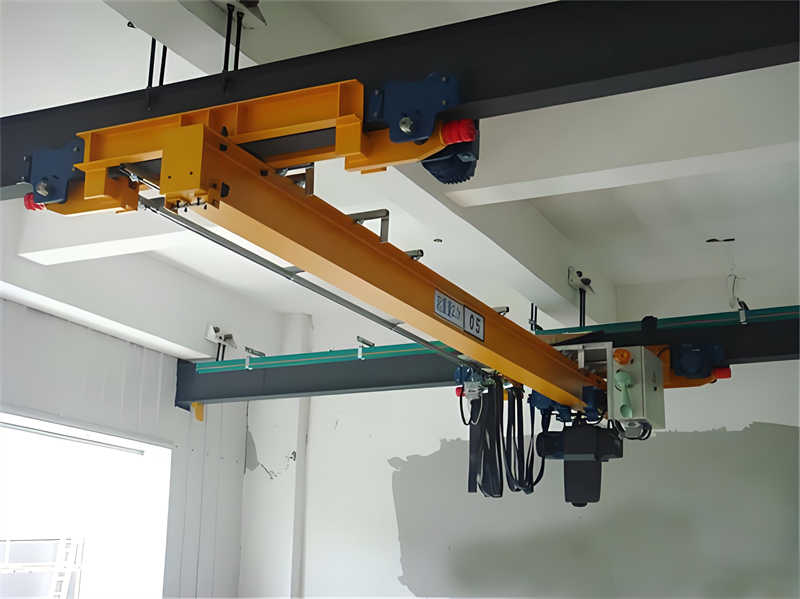
How Underhung Cranes Work
Underhung cranes (also called under-running cranes) operate differently from traditional top-running cranes by utilizing the bottom flange of overhead support beams for movement. This unique design makes them ideal for light-duty applications (1-10 tons) where space efficiency and cost savings are priorities.
Here’s a detailed look at their components, operation, and key features:
1. Structural Components of an Underhung Crane
A. Runway Beam System
- Unlike top-running cranes that ride on top of rails, underhung cranes hang from the lower flange of an I-beam.
- The runway beams are supported by the building’s roof structure or ceiling, eliminating the need for additional columns.
- Common materials: High-strength steel or galvanized steel for durability.
B. Bridge Girder (Single or Double Girder)
- Single-girder design (for lighter loads, up to ~5 tons):
- Uses one main beam with a trolley and hoist.
- More cost-effective and requires less headroom.
- Double-girder design (for higher capacities, up to ~10 tons):
- Two parallel beams for increased stability.
- Better for wider spans and heavier loads.
C. Trolley & Hoist Mechanism
- The trolley moves along the bridge girder, carrying the hoist.
- Hoist options:
- Electric chain hoist – Best for frequent, automated lifting.
- Wire rope hoist – Smoother for heavier light-duty loads.
- Manual hoist – Economical for low-frequency use.
D. End Trucks (Wheel Assemblies)
- Equipped with steel or polyurethane wheels that run along the bottom flange of the runway beam.
- Some models include flange guards to prevent derailment.
2. How an Underhung Crane Moves & Operates
A. Horizontal Movement (Bridge Travel)
- The entire bridge (girder + trolley + hoist) moves along the runway beams.
- Powered by electric motors (common) or manual push (for very light loads).
B. Trolley Travel (Cross Movement)
- The trolley moves side-to-side along the girder, allowing precise load positioning.
C. Vertical Lifting (Hoist Operation)
- The hoist raises/lowers the load via chain or wire rope.
- Controls: Pendant station, radio remote, or automated systems.
D. Optional Features for Enhanced Functionality
- Variable speed control – For smoother load handling.
- Limit switches – Prevents over-travel.
- Anti-sway technology – Improves precision in assembly tasks.
3. Why the Underhung Design is Efficient for Light-Duty Use
✔ Space-Saving – No need for extra support columns; uses existing ceiling structure.
✔ Lower Power Consumption – Light-duty motors require less energy.
✔ Smooth & Precise Handling – Ideal for assembly lines, packaging, and workshops.
✔ Easy Installation & Reconfiguration – Modular design allows adjustments as needs change.
4. Real-World Example: Underhung Crane in a Small Workshop
Scenario: A bicycle manufacturing plant uses a 5-ton underhung crane to move frames between workstations.
- How it works:
- The trolley positions the hoist above a bike frame.
- The electric chain hoist lifts the frame smoothly.
- The bridge moves along the runway, transporting the frame to the next station.
- Precise placement ensures no damage to delicate parts.
Result: Faster production, no floor obstructions, and lower costs vs. a top-running crane.
5. Maintenance & Safety Considerations
- Regular inspections of wheels, hoist ropes/chains, and runway alignment.
- Lubrication of moving parts to prevent wear.
- Load testing to ensure safe operation.
Key Advantages of Underhung Cranes for Light-Duty Use
Underhung cranes offer distinct benefits that make them ideal for light-duty material handling applications (typically 1-10 tons). Here’s an in-depth look at their key advantages:
1. Space Optimization & Structural Efficiency
- Ceiling-Mounted Design: Utilizes existing building support structures rather than requiring additional floor space or support columns
- Low Headroom Operation: Requires significantly less vertical clearance than top-running cranes (up to 18-24″ of headroom savings)
- Modular Configuration: Can be designed to follow curved or angled building layouts when standard straight-line movement isn’t practical
2. Cost-Effectiveness Across the Lifespan
- Lower Initial Costs:
- 30-40% less expensive than comparable top-running cranes
- Reduced structural requirements (no need for additional runway support columns)
- Reduced Installation Expenses:
- Faster installation (typically 25-50% quicker than top-running systems)
- Minimal disruption to ongoing operations during setup
- Long-Term Savings:
- Energy-efficient operation (smaller motors required for light loads)
- Lower maintenance costs (simpler design with fewer wear components)
3. Enhanced Operational Flexibility
- Adaptable Workflows:
- Can be configured with multiple bridge segments for complex material flow patterns
- Compatible with monorail systems for multi-directional movement
- Scalable Capacity:
- Easy to upgrade components (hoists, controls) as needs evolve
- Modular design allows for future expansion of runway length
- Precision Handling:
- Smoother load control compared to jib cranes or gantry systems
- Available with variable frequency drives for precise positioning
4. Improved Workplace Safety & Ergonomics
- Reduced Floor Obstructions: Eliminates trip hazards from floor-mounted supports
- Better Load Visibility: Operators have clearer sight lines to lifted loads
- Integrated Safety Features:
- Overload protection systems
- Emergency stop functions
- Anti-collision systems for multiple crane installations
5. Energy Efficiency & Sustainability Benefits
- Lower Power Consumption:
- Smaller motors require less energy (typically 15-30% less than top-running equivalents)
- Regenerative braking options available on some models
- Sustainable Design:
- Longer component lifespan reduces replacement frequency
- Can be constructed with eco-friendly materials (low-VOC paints, recyclable steel)
6. Industry-Specific Advantages
- Manufacturing:
- Enables just-in-time part delivery to workstations
- Reduces manual handling injuries in assembly processes
- Warehousing:
- Maximizes storage space by eliminating floor-based equipment
- Improves inventory rotation efficiency
- Maintenance Facilities:
- Provides overhead access without permanent floor obstructions
- Simplifies equipment servicing in tight spaces
7. Comparative Advantage Over Alternative Solutions
- Versus Jib Cranes:
- Greater coverage area (entire work bay vs. circular radius)
- Higher load capacities available
- Versus Gantry Cranes:
- Doesn’t consume valuable floor space
- More stable for precision lifting
- Versus Top-Running Cranes:
- Lower cost for equivalent light-duty applications
- Better suited for facilities with height restrictions
Real-World Impact Example:
A mid-sized auto parts manufacturer reduced part-damage incidents by 60% after replacing their forklift-based system with an underhung crane network, while simultaneously increasing workstation throughput by 35%.
Common Light-Duty Applications
Underhung cranes are widely used in industries where small to medium loads need frequent, efficient movement:
✔ Manufacturing – Assembly lines, part handling, machine servicing.
✔ Warehousing & Logistics – Moving lightweight materials, boxes, or tools.
✔ Automotive & Aerospace – Handling small components, engines, or machinery parts.
✔ Maintenance Workshops – Lifting tools, motors, or equipment for repair.
Underhung Cranes vs. Top-Running Cranes
| Feature | Underhung Crane | Top-Running Crane |
|---|---|---|
| Installation | Uses existing structure | Needs extra support beams |
| Cost | Lower initial investment | Higher upfront cost |
| Load Capacity | 1-10 tons (light-duty) | 10+ tons (heavy-duty) |
| Space Efficiency | Compact, ideal for low ceilings | Requires more headroom |
| Best For | Small workshops, assembly lines | Heavy manufacturing, foundries |
→ Which Should You Choose?
- Underhung cranes are best for light loads, tight spaces, and cost-sensitive projects.
- Top-running cranes suit heavy-duty industrial environments with higher load demands.
Why Choose Dongqi Underhung Cranes?
Dongqi Crane specializes in high-quality, reliable underhung cranes for light-duty applications. Our advantages include:
✅ Custom Solutions – Tailored span, capacity, and control options.
✅ Durable Construction – High-grade steel, corrosion-resistant finishes.
✅ Smooth Operation – Electric or manual hoists for precise handling.
✅ Safety & Compliance – Meets ISO, CE, and OSHA standards.
✅ Full Support – Installation, maintenance, and spare parts available.
Conclusion: Are Underhung Cranes Right for You?
If your operations involve light to medium loads (1-10 tons) and you need a cost-effective, space-saving lifting solution, an underhung crane could be the perfect fit.
Interested in a custom solution?
📞 Contact Dongqi Crane today for a free consultation or quote!
