
25-Jul-2025
Why Choose Overhead Bridge Cranes Over Gantry Cranes for Indoor Port Handling?
Ports and logistics hubs are constantly seeking ways to maximize efficiency, reduce costs, and optimize space—especially in indoor transfer operations where every square meter matters. When it comes to material handling in confined warehouse environments, overhead bridge cranes (double-girder bridge cranes) often outperform traditional gantry cranes in key operational aspects.
This article explores the practical advantages of overhead bridge cranes in port indoor handling, focusing on:
✔ Space efficiency – How bridge cranes unlock more usable floor and vertical space
✔ Operational performance – Faster speeds, better precision, and smoother handling
✔ Cost savings – Lower initial investment and reduced maintenance expenses
✔ Safety & reliability – Fewer collision risks and better environmental resilience
Let’s examine why many modern ports are switching from gantry cranes to high-efficiency overhead bridge cranes.
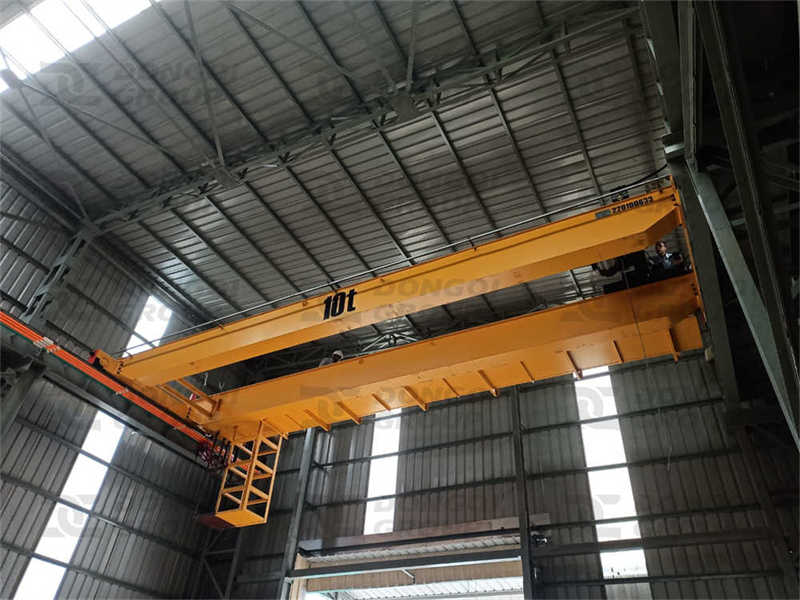
1. Space Efficiency: Free Up Your Floor & Maximize Stacking Height
1.1 No Ground Obstructions – 100% Clear Floor Space
Gantry crane challenge:
- Large support legs occupy valuable floor space, blocking AGVs, forklifts, and trucks.
- Creates “dead zones” where other equipment cannot operate efficiently.
Bridge crane advantage:
- No ground legs—runs on elevated rails mounted to the building structure.
- Full floor accessibility for vehicles and personnel, improving workflow.
- Ideal for automated ports where AGVs need unobstructed movement.
1.2 Higher Lifting Capacity – Stack More in the Same Building
Gantry crane limitation:
- Leg height reduces usable lifting height (distance from hook to floor).
Bridge crane benefit:
- Maximizes vertical space—hooks can reach closer to the ceiling.
- Enables higher stacking (e.g., 6 container layers instead of 5).
- Increases storage density without expanding the warehouse.
1.3 Adapts to Column Layouts – No Wasted Space
Gantry crane issue:
- Fixed spans may not align with irregular column spacing, leaving unused areas.
Bridge crane flexibility:
- Rails installed on existing building columns, fitting naturally into the layout.
- Can cover multiple bays with a single crane, reducing blind spots.
2. Operational Performance: Faster, Smoother, More Precise Handling
2.1 Higher Speeds & Quicker Acceleration
- Bridge cranes typically move 20-30% faster than gantry cranes (due to lighter structure & reduced friction).
- Faster acceleration/deceleration means shorter cycle times and more lifts per hour.
2.2 Superior Positioning Accuracy (±5mm or Better)
- Gantry cranes suffer from ground track imperfections, causing sway and misalignment.
- Bridge cranes run on stable overhead rails, reducing vibrations for precise load placement.
- Ideal for delicate cargo, automated systems, and tight stacking.
2.3 Better Stability & Less Vibration
- Gantry cranes can wobble due to long spans and ground movement.
- Bridge cranes are rigidly connected to the building, minimizing sway for safer high-stacking operations.
3. Cost Savings: Lower Investment & Reduced Operating Expenses
3.1 Lower Initial Costs
- Gantry cranes require heavy support legs, reinforced foundations, and ground tracks.
- Bridge cranes eliminate these costs, often saving 15-25% on initial investment.
3.2 Energy Efficiency
- Lighter structure = smaller motors & lower power consumption.
- Estimated 10-20% energy savings compared to gantry cranes.
3.3 Easier & Cheaper Maintenance
- Gantry crane issues:
- Ground tracks collect debris, rust, and need frequent leveling.
- Leg mechanisms require more inspections.
- Bridge crane benefits:
- Elevated rails stay cleaner and last longer.
- Components are easier to access (no need for pit or track maintenance).
4. Safety & Environmental Advantages
4.1 Eliminates Leg Collision Risks
- Gantry cranes pose collision hazards with vehicles, equipment, and workers.
- Bridge cranes remove this risk entirely, improving workplace safety.
4.2 Better Resistance to Harsh Conditions
- Gantry cranes have motors and controls near the ground, exposed to dust, moisture, and corrosion.
- Bridge cranes keep critical components elevated and protected, extending lifespan.
5. Dongqi’s Overhead Bridge Cranes: Optimized for Port Efficiency
Dongqi’s double-girder bridge cranes are engineered for high-speed, high-precision port operations, offering:
✔ Custom spans & lifting heights – Tailored to your warehouse layout.
✔ Smooth, variable-speed control – For precise load handling.
✔ Robust construction – Built for heavy-duty, 24/7 port operations.
✔ Automation-ready – Compatible with remote control & smart logistics systems.
Conclusion: Why Ports Are Switching to Overhead Bridge Cranes
For indoor port handling, overhead bridge cranes deliver clear advantages over gantry cranes:
✅ More usable space (no ground obstructions, higher stacking).
✅ Faster, more precise operations (higher speeds, better stability).
✅ Lower costs (reduced investment, energy, and maintenance).
✅ Safer & more reliable (no leg collisions, better environmental protection).
Upgrading to a Dongqi overhead bridge crane?
📞 Contact our port handling experts for a customized solution!
