
9-Jul-2025
Why Replace Jib Cranes with Single Girder Overhead Cranes?
Introduction: Understanding Your Lifting Options
In industrial material handling, choosing the right crane system significantly impacts operational efficiency and workplace safety. At Dongqi Crane, we manufacture both jib cranes and single girder overhead cranes – each serving distinct purposes in modern facilities. While jib cranes remain a practical solution for certain applications, many operations are transitioning to single girder overhead cranes to overcome limitations and enhance productivity.
This comprehensive guide examines both systems objectively, helping you determine which solution best fits your operational requirements. We’ll explore key differences, optimal use cases, cost considerations, and why an increasing number of businesses are making the switch to overhead crane systems.
Key Differences Between Jib Cranes and Single Girder Overhead Cranes
Coverage and Mobility
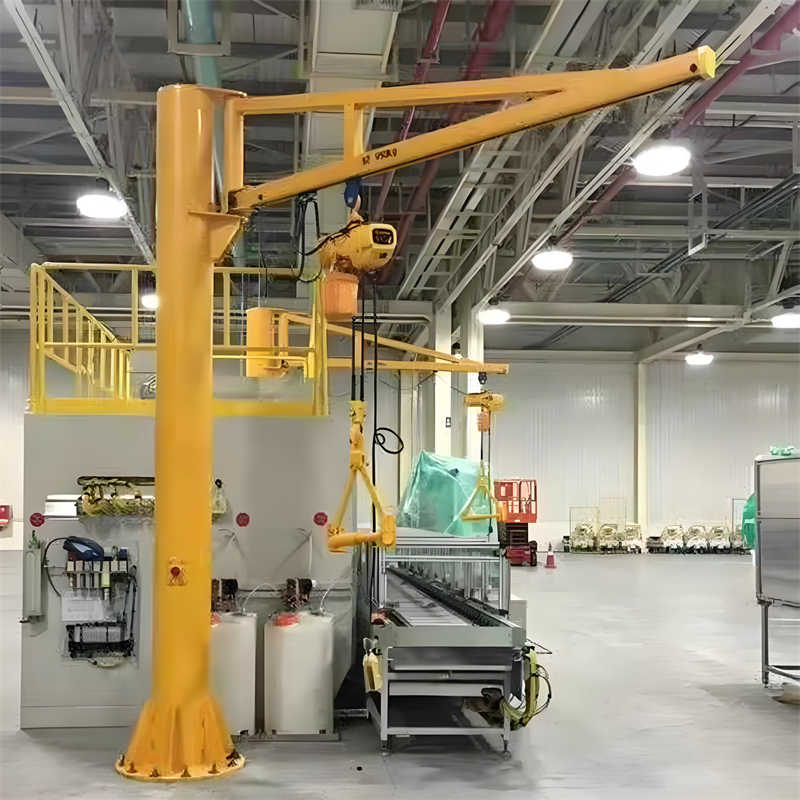
Jib cranes operate within a fixed radius, typically offering 180° to 360° rotation. This design creates natural limitations in coverage, often requiring manual repositioning of loads beyond the boom’s reach. The constrained work envelope frequently results in inefficient material flow, especially in larger facilities.
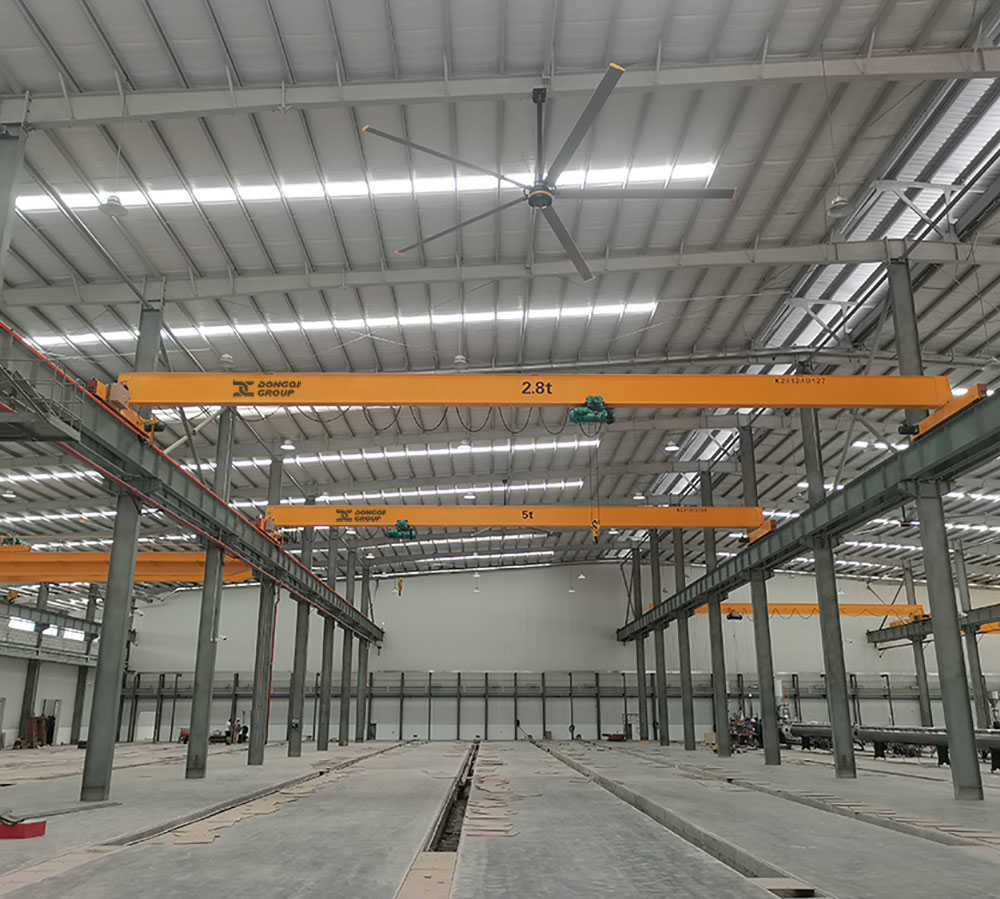
Single girder overhead cranes provide complete longitudinal coverage along their runway system, with no blind spots in the work area. This unrestricted movement allows direct point-to-point transportation of materials, significantly reducing handling time. The system’s trolley and hoist combination enables precise positioning anywhere within the crane’s span, making it ideal for servicing multiple workstations.
Load Capacity and Performance
Standard jib cranes typically handle loads up to 10 tons, with some heavy-duty models reaching higher capacities. However, their cantilevered design creates inherent stress limitations, particularly in wall-mounted configurations where load capacity depends on building structural support.
Our single girder overhead cranes offer standard capacities from 1 to 20 tons, with custom solutions available up to 50+ tons. The balanced bridge design distributes load stress evenly across supporting runways, allowing for safer heavy lifting operations. This structural advantage makes overhead cranes the preferred choice for demanding industrial applications requiring frequent heavy load movements.
Space Utilization and Facility Impact
Jib cranes’ floor-mounted or wall-mounted designs consume valuable workspace. Freestanding models require significant floor area for the column base and boom clearance, while wall-mounted versions may interfere with building layouts and workflow patterns.
Single girder overhead cranes maximize facility space efficiency by operating entirely above the work area. The ceiling-mounted system eliminates floor obstructions, allowing unobstructed movement of personnel, equipment, and materials beneath the crane. This design proves particularly valuable in crowded production environments or facilities with limited square footage.
Control Systems and Automation
Traditional jib cranes typically feature manual or basic motorized rotation, requiring operator intervention for precise positioning. While functional for simple lifting tasks, this limits productivity in high-volume operations.
Our single girder overhead cranes incorporate advanced control options including variable frequency drives for smooth acceleration/deceleration, wireless remote operation, and programmable automation. These features enable precise load placement, reduce operator fatigue, and allow integration with automated production systems – capabilities simply unavailable with standard jib cranes.
When to Choose a Jib Crane
Despite their limitations, jib cranes remain the optimal choice for specific applications:
- Small workshops with infrequent lifting needs
- Dedicated workstations requiring repetitive lifts in a fixed area
- Budget-conscious operations with light-duty requirements
- Temporary installations or locations where runway systems are impractical
- Environments requiring minimal installation footprint
Jib cranes offer particular advantages in maintenance bays, loading docks, and assembly stations where their simplicity and lower initial cost justify their use. Their straightforward design also means easier installation and lower technical requirements for operators.
When to Upgrade to a Single Girder Overhead Crane
Several operational factors indicate when transitioning to an overhead crane system becomes advantageous:
- Increased Production Demands:
When material handling requirements outpace your jib crane’s capacity, overhead cranes provide the throughput needed to maintain production schedules. Their faster cycle times and continuous operation capability significantly boost productivity. - Heavy Load Requirements:
For loads exceeding 10 tons or requiring precise placement, overhead cranes offer superior stability and control. The balanced bridge design handles heavy weights more safely than cantilevered jib systems. - Expanded Facility Coverage:
Operations that have grown beyond a few workstations benefit from overhead cranes’ full facility access. Eliminating the need for manual load transfer between jib cranes reduces labor costs and improves workflow. - Automation Integration:
Facilities implementing Industry 4.0 initiatives find overhead cranes more compatible with automated systems. Programmable movements, data collection capabilities, and IoT connectivity options support smart factory implementations. - Long-Term Cost Efficiency:
While requiring greater initial investment, overhead cranes typically demonstrate lower total cost of ownership through reduced labor requirements, minimal maintenance, and extended service life.
Cost and ROI Comparison
A thorough financial analysis reveals why many operations transition to overhead crane systems:
| Cost Factor | Jib Crane | Single Girder Overhead Crane |
|---|---|---|
| Initial Investment | $15,000-$50,000 | $30,000-$150,000 |
| Installation Cost | Low (minimal infrastructure) | Moderate (requires runway system) |
| Labor Requirements | 1-2 operators per shift | 1 operator can manage multiple cranes |
| Energy Consumption | Moderate | Efficient (regenerative options available) |
| Maintenance Costs | $3,000-$8,000/year | $1,500-$5,000/year |
| Service Life | 10-15 years | 25+ years with proper maintenance |
| Productivity Gain | Baseline | 30-50% improvement typical |
| Payback Period | N/A | 12-36 months for upgrade scenarios |
The higher initial cost of overhead cranes becomes justified when considering total lifecycle value. Reduced labor costs, increased throughput, and lower maintenance expenses typically generate a complete return on investment within two to three years for most operations.
Dongqi Crane Solutions for Every Need
As a leading crane manufacturer, we provide both jib and overhead crane systems tailored to your specific requirements:
Jib Crane Options:
- Wall-mounted and freestanding designs
- Capacities from 0.5 to 20 tons
- Manual rotation or motorized options
- Standard and explosion-proof configurations
Single Girder Overhead Cranes:
- Span capabilities up to 35 meters
- Load capacities to 50+ tons
- Advanced control and automation packages
- Custom configurations for special environments
Our engineering team works closely with clients to evaluate current and future needs, recommending the most cost-effective solution that aligns with operational goals and budget parameters.
Making the Right Choice for Your Operation
Selecting between jib cranes and overhead cranes involves careful consideration of multiple factors:
- Assess Current and Future Workflow:
- Map your material flow patterns
- Project growth in production volume
- Identify bottlenecks in current handling systems
- Evaluate Facility Constraints:
- Available headroom and floor space
- Building structural capacity
- Future expansion plans
- Consider Total Cost of Ownership:
- Initial investment vs long-term savings
- Labor efficiency gains
- Maintenance and energy costs
- Review Safety Requirements:
- Load stability needs
- Operator protection
- Compliance with industry standards
For many operations, the transition from jib cranes to overhead systems represents a strategic investment in operational efficiency and future growth potential. The enhanced capabilities, improved safety, and long-term cost savings typically justify the upgrade for medium to large-scale industrial applications.
Conclusion: Matching the Solution to Your Needs
While jib cranes continue to serve well in specific limited applications, single girder overhead cranes offer compelling advantages for growing operations. The decision ultimately depends on your unique material handling requirements, facility characteristics, and production goals.
At Dongqi Crane, we don’t believe in one-size-fits-all solutions. Our experts can help you conduct a thorough evaluation of your current and future needs to determine whether maintaining jib cranes, transitioning to overhead cranes, or implementing a hybrid solution makes the most sense for your operation.
Contact our team today for a complimentary consultation and facility assessment. We’ll provide unbiased recommendations and detailed cost-benefit analysis to help you make the most informed decision for your material handling needs.
