
16-Sep-2025
Why Standard Overhead Cranes Fail in Metallurgical Plants: The Critical Need for High-Temperature Specialized Cranes
In the heart of metallurgical operations—be it a steel mill, foundry, or forging shop—the environment is anything but ordinary. These facilities are characterized by intense heat, airborne abrasives, and demanding cycles that push equipment to its absolute limits. While standard overhead cranes are workhorses in many industries, they are fundamentally unsuited for these extreme conditions. Understanding why standard cranes fail and why a specialized solution is not just beneficial but essential is the first step toward ensuring safety, productivity, and operational continuity.
The Unforgiving Challenges of a High-Temperature Job-Shop
A metallurgical workshop presents a unique set of challenges that act as constant threats to equipment:
- Intense Radiant Heat: The primary adversary. Molten metal, hot ingots, and casting processes generate relentless radiant heat. This heat doesn’t just warm the air; it radiates upwards and outwards, bathing the crane’s structure, electrical components, and hoisting assembly in high temperatures that can easily exceed 180°F (82°C) and often soar much higher.
- Abrosive Dust and Corrosive Fumes: The air is laden with metallic dust, sand, and chemical fumes from fluxes and processes. These contaminants are highly abrasive to moving parts and corrosive to electrical components and structural surfaces, leading to accelerated wear and tear.
- High Duty Cycles and Heavy Loads: Operations are continuous and intensive. Cranes are required to lift, transport, and position extremely heavy loads (often tens or hundreds of tons) with precision, repeatedly throughout the day. This places immense stress on the crane’s mechanical and structural systems.
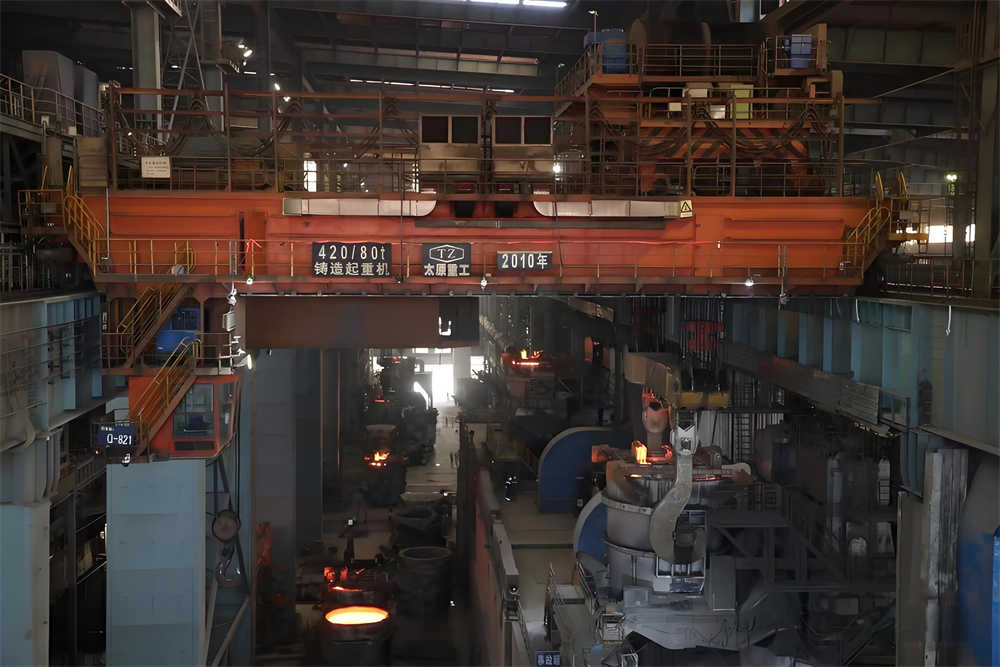
Why Standard Cranes Are a High-Risk Proposition
Deploying a standard industrial crane in this environment is a recipe for frequent downtime, safety hazards, and costly failures. Here’s what happens:
- Motor Burnout: Standard electric motors are typically rated for Class B or F insulation, designed for ambient temperatures up to 40°C. When exposed to radiant heat, their internal temperature skyrockets, causing insulation to break down rapidly. This leads to frequent motor burnout, resulting in unexpected downtime and expensive replacements.
- Electrical System Failure: Control panels, contactors, and wiring not designed for heat will overheat. Components become prone to melting, short-circuiting, and erratic behavior. Dust and fumes ingress into standard enclosures, causing corrosion and blockages that further compromise reliability.
- Structural Weakening: While steel strength decreases as temperature rises. Continuous exposure to high heat can affect the structural integrity of the crane’s girders and end trucks over time, potentially leading to deformation or, in worst-case scenarios, catastrophic failure under load.
- Premature Hoist Failure: The hoist assembly is most vulnerable. Standard wire ropes can lose their lubricity and tensile strength when baked by heat, becoming brittle and prone to snapping. Grease in gears and bearings can melt away, leading to rapid, unprotected wear and seizure.
- Safety Hazards: The combination of potential mechanical failure (e.g., broken wire rope) and electrical malfunction in a area where personnel and valuable assets are present creates an unacceptable safety risk.
The Solution: Purpose-Built Engineering for Extreme Environments
The stark limitations of standard cranes underscore a critical truth: metallurgical applications require a purpose-engineered solution. At Dongqi Crane, we don’t simply sell cranes; we design and build Integrated Lifting Systems that are born from a deep understanding of metallurgical processes.
Our Metallurgical Double Girder Electric Overhead Cranes are not modified standard models. They are specifically conceived from the ground up to not only survive but thrive in high-temperature job-shops. Every critical component—from the H-class insulated motors and sealed electrical systems to the heat-deflecting structures and high-temperature wire rope configurations—is selected and designed to counter the specific challenges you face.
Investing in a crane built for the environment is an investment in safety, reduced total cost of ownership, and uninterrupted production. It is the logical and necessary choice for any serious metallurgical operation committed to excellence and safety.
Ready to discuss a crane solution built for your specific high-temperature challenges? Contact Dongqi Crane today for a consultation and learn how our engineered systems can enhance your operational safety and efficiency.
Kewwords
- Metallurgical Overhead Crane
- High-Temperature Crane
- Standard Crane Failure
- Foundry Crane
- Steel Mill Crane
- Radiant Heat
- Motor Burnout
- Dongqi Crane Solution
- Purpose-Built Crane
- Safety Hazard
